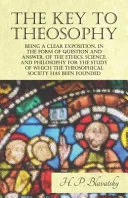
The Key to Theosophy - Being a Clear Exposition, in the Form of Question and Answer, of the Ethics, Science, and Philosophy for the Study of Which the Theosophical Society Has Been Founded
 81
81

The Key to Theosophy - Being a Clear Exposition, in the Form of Question and Answer, of the Ethics, Science, and Philosophy for the Study of Which the Theosophical Society Has Been Founded
Helena Petrovna Blavatsky's "The Key to Theosophy" remains a singular document for anyone attempting to grasp the foundational principles of the movement she helped birth. Its Q&A format, while occasionally dense, offers a direct conduit into Blavatsky's thought, sidestepping the more elaborate allegories found in her other works. The clarity with which she elucidates concepts like the Seven Principles of Man, particularly the distinction between the lower personal and higher spiritual egos, is a notable strength. However, the text's inherent bias and the sometimes dogmatic tone can present a challenge; Blavatsky rarely entertains alternative interpretations of her own system. A passage discussing the nature of Devachan, explaining it as a state of spiritual rest between incarnations rather than a celestial paradise, exemplifies the book's attempt to demystify spiritual concepts. Ultimately, "The Key to Theosophy" is an indispensable, if at times uncompromising, primer for Theosophical study.
📝 Description
81
Helena Blavatsky published "The Key to Theosophy" in 1889 to answer common questions about her movement.
This book takes the form of questions and answers, designed by Helena Petrovna Blavatsky to explain the core ethics, science, and philosophy behind the Theosophical Society. Blavatsky, a central figure in the society's formation, wrote this work to address fundamental inquiries regarding human nature, the universe, and spiritual development. It aims to provide a clear explanation of Theosophical beliefs for those interested in the subject. The text is particularly useful for individuals investigating the origins and principles of Theosophy and the specific teachings of Blavatsky. It will also interest students of comparative religion, esoteric philosophy, and Western occultism seeking a direct presentation of Blavatsky's perspective. Readers familiar with concepts like karma, reincarnation, and the astral plane will find these ideas situated within the Theosophical framework.
"The Key to Theosophy" appeared in the late 19th century, a time of significant spiritual and intellectual questioning in the West. Theosophy itself arose as a counterpoint to prevailing materialism and a desire to recover ancient traditions. Blavatsky, with co-founders like Henry Steel Olcott, established the Theosophical Society in 1875 with the aim of fostering universal brotherhood and studying ancient religions, philosophies, and sciences. This book served as an important guide to the society's goals and teachings during a period of growing interest in spiritualism and Eastern philosophies.
Published in 1889, "The Key to Theosophy" is a product of the late 19th-century Western esoteric revival. Blavatsky's work sought to synthesize Eastern philosophies, particularly Hinduism and Buddhism, with Western occult traditions and a critique of scientific materialism. It positioned Theosophy as a modern interpretation of ancient wisdom, accessible to Western minds through a structured, philosophical approach. The book engages with concepts of cosmic cycles, human spiritual evolution, and the existence of enlightened beings, aiming to establish a universalist spiritual framework distinct from conventional religious dogma.
💡 Why Read This Book?
• Understand the fundamental ethical and philosophical framework of the Theosophical Society, as articulated by its co-founder Helena Blavatsky in the late 19th century. • Gain clarity on core Theosophical concepts like Karma and Reincarnation, presented in a direct Q&A format designed for accessibility. • Explore Blavatsky's exposition of the "Seven Principles of Man," a unique model for understanding human consciousness and its spiritual evolution.
⭐ Reader Reviews
Honest opinions from readers who have explored this book.
❓ Frequently Asked Questions
What is the primary purpose of "The Key to Theosophy"?
Its primary purpose is to provide a clear, accessible explanation of the core ethics, science, and philosophy behind the Theosophical Society, directly from one of its founders, H. P. Blavatsky.
Who founded the Theosophical Society?
The Theosophical Society was co-founded by Helena Petrovna Blavatsky, Henry Steel Olcott, and William Quan Judge in 1875.
What does "The Key to Theosophy" say about karma?
The book explains karma as the immutable law of cause and effect, governing the cycles of birth, death, and rebirth, ensuring that every action has a corresponding consequence across lifetimes.
Is "The Key to Theosophy" suitable for beginners?
Yes, its Q&A format is specifically designed to make complex Theosophical ideas understandable to those new to the subject, acting as an introductory guide.
What are the 'Seven Principles of Man' mentioned in the book?
Blavatsky outlines seven principles that constitute a human being, ranging from the physical body (Sthula Sharira) to the spiritual monad (Atman), providing a framework for understanding consciousness.
When was "The Key to Theosophy" first published?
The book was first published in 1889, offering a synthesized overview of Theosophical teachings.
🔮 Key Themes & Symbolism
The Seven Principles of Man
This work meticulously details Blavatsky's model of the human constitution, comprising seven principles from the physical body (Sthula Sharira) to the divine spark (Atman). It moves beyond simplistic dualities, presenting a layered understanding of consciousness, the personal ego (Kama-Manas), and the higher spiritual principles. The interplay between these principles, particularly the transient lower and the eternal higher aspects, is crucial for understanding spiritual evolution and the process of reincarnation. Blavatsky uses this framework to explain the nature of spiritual growth and the path towards enlightenment, emphasizing the development of the higher faculties over the limitations of the material form.
Karma and Reincarnation
Central to the exposition is the doctrine of Karma, presented not as fatalistic punishment but as the impersonal, scientific law of cause and effect. Blavatsky clarifies how actions and intentions generate consequences that manifest across multiple lifetimes, shaping an individual's destiny and experiences. Reincarnation is depicted as the necessary vehicle for this cosmic justice and for the soul's gradual purification and evolution. The book explains how understanding these laws provides a rational basis for the inequalities observed in the world and offers a path for self-directed spiritual progress by acting consciously and ethically.
The Mission of Theosophy
Blavatsky outlines the threefold mission of the Theosophical Society: to form a nucleus of universal brotherhood, to encourage the study of comparative religion, philosophy, and science, and to investigate unexplained laws of nature and the powers latent in humanity. "The Key to Theosophy" serves as an instrument for the second objective, providing an authoritative voice for the Society's philosophical underpinnings. It argues for the existence of ancient spiritual wisdom, present in all major traditions, which Theosophy seeks to revive and make accessible in an age dominated by materialism and scientific reductionism.
The Nature of the Absolute
While avoiding anthropomorphic depictions, Blavatsky addresses the ultimate reality as an unknowable, Absolute Principle, often referred to as Parabrahman. From this Absolute emanates the manifested universe, governed by divine laws. The book emphasizes that true spiritual understanding involves recognizing the unity underlying all diversity and perceiving the divine spark within oneself and all beings. This perspective counters the materialistic worldview by positing a fundamentally spiritual cosmos, where consciousness and spirit are primary, and the physical world is a manifestation of deeper, unseen realities.
💬 Memorable Quotes
Direct passages from the work, attributed to the author.
“The Theosophical Society has been founded with three noble objects.”
— This statement directly introduces the Society's core purpose, framing its existence as a deliberate effort towards universal brotherhood, comparative spiritual study, and the investigation of nature's hidden laws.
“Karma is not a thing that is inflicted upon us, but is the result of our own actions.”
— This clarifies the active, rather than passive, nature of karmic law, emphasizing personal responsibility for one's circumstances and the potential for conscious self-improvement through ethical conduct.
“Man is a complex being, and is not made up of merely two principles, body and soul.”
— This challenges simplistic views of human nature, asserting the Theosophical doctrine of a multi-faceted constitution, typically seven principles, essential for understanding spiritual evolution.
“Reincarnation is the vehicle of Karma, and Karma is the engine.”
— This concise analogy illustrates the inseparable relationship between the law of cause and effect (Karma) and the process through which it unfolds across multiple lifetimes (Reincarnation).
💡 Key Ideas
Editorial paraphrase of the work's core concepts — not direct quotes.
The Masters are men who have reached the end of our evolutionary path.
This paraphrased concept explains the nature of the spiritual teachers recognized in Theosophy, presenting them not as divine beings but as advanced human beings who have achieved spiritual mastery.
🌙 Esoteric Significance
Tradition
This work is foundational to the Theosophical tradition, a modern esoteric movement heavily influenced by Neoplatonism, Hermeticism, Kabbalah, and Eastern philosophies (Hinduism and Buddhism). Blavatsky sought to synthesize these disparate streams into a coherent "occult science." While drawing heavily on existing traditions, Theosophy, as presented here, offers a distinct cosmology and anthropology, emphasizing a scientific approach to the spiritual and proposing a unique evolutionary path for humanity guided by Masters.
Symbolism
The text frequently references the "Seven Principles of Man," a symbolic representation of consciousness's layered nature, moving from the physical to the divine. Another key symbol is the "Cycle," representing the vast periods of cosmic manifestation and dissolution (Manvantara and Pralaya) and the individual cycles of birth, death, and rebirth (reincarnation), all governed by the law of Karma. The concept of the "Absolute" itself functions as a symbol of ultimate, unknowable reality from which all manifests.
Modern Relevance
Contemporary spiritual seekers, students of comparative religion, and practitioners of various New Age and esoteric paths continue to draw from Blavatsky's concepts. Modern Theosophical societies globally still use this text as a primary introduction. Its ideas on consciousness, karma, and universal brotherhood have influenced subsequent movements and thinkers, including Alice Bailey and Rudolf Steiner (though Steiner later diverged to form Anthroposophy).
👥 Who Should Read This Book
• Students of comparative religion and philosophy seeking to understand the origins and core doctrines of the Theosophical movement. • Individuals interested in esoteric traditions of the late 19th century and the intellectual climate that fostered spiritualism and occultism. • Seekers exploring concepts like karma, reincarnation, and the nature of consciousness from a foundational Theosophical perspective.
📜 Historical Context
Emerging in 1889, "The Key to Theosophy" was published during a period of intense spiritual and philosophical ferment in the West, marked by a reaction against prevailing scientific materialism and a renewed interest in Eastern religions and esoteric traditions. Helena Petrovna Blavatsky, alongside co-founders like Henry Steel Olcott, established the Theosophical Society in 1875 with the aim of reviving ancient wisdom. This era saw figures like Helena Blavatsky and Annie Besant become prominent, challenging orthodoxies and popularizing concepts such as karma and reincarnation. Theosophy positioned itself as a synthesis of religion, philosophy, and science, distinct from both traditional religious dogma and purely materialistic scientific views. Its influence was significant, sparking debates and inspiring numerous other movements and thinkers, though it also faced criticism and accusations of fraud, notably through the Hodgson Report concerning purported spiritual communications.
📔 Journal Prompts
The Seven Principles of Man as presented by Blavatsky; which principle requires the most conscious cultivation for you?
Reflecting on the law of Karma: how does the concept of ongoing consequences across lifetimes alter your perception of present actions?
Theosophy's aim for universal brotherhood; what specific challenges did Blavatsky identify in achieving this in the late 19th century?
The role of Masters in Theosophical teachings; how does their existence as advanced humans shape the path of spiritual evolution?
Understanding the Absolute Principle; what does it mean to perceive unity underlying diversity in daily life?
🗂️ Glossary
Theosophy
A system of thought and belief aiming to reconcile ancient religious philosophies and sciences with modern scientific discoveries, positing a spiritual and ethical path for humanity.
Karma
The universal law of cause and effect, where actions and intentions determine future experiences across multiple lifetimes, guiding spiritual evolution.
Reincarnation
The process by which a soul or spiritual principle passes through a series of earthly lives, experiencing the consequences of past actions (Karma).
Seven Principles of Man
Theosophical doctrine describing human beings as constituted of seven distinct principles or layers of consciousness, from the physical body to the divine spark.
Absolute Principle
The ultimate, unknowable, and undifferentiated reality or source from which all manifested existence originates, often referred to as Parabrahman.
Devachan
A state of spiritual bliss and rest experienced by the higher principles of a person between physical incarnations, characterized by the fruition of good karma.
Sthula Sharira
The physical body, considered the lowest and most transient of the Seven Principles of Man in Theosophical philosophy.