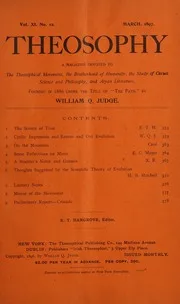
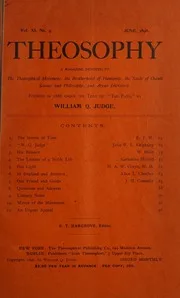
Theosophy 1897-03: Vol 11 Iss 12
 73
73

Theosophy 1897-03: Vol 11 Iss 12

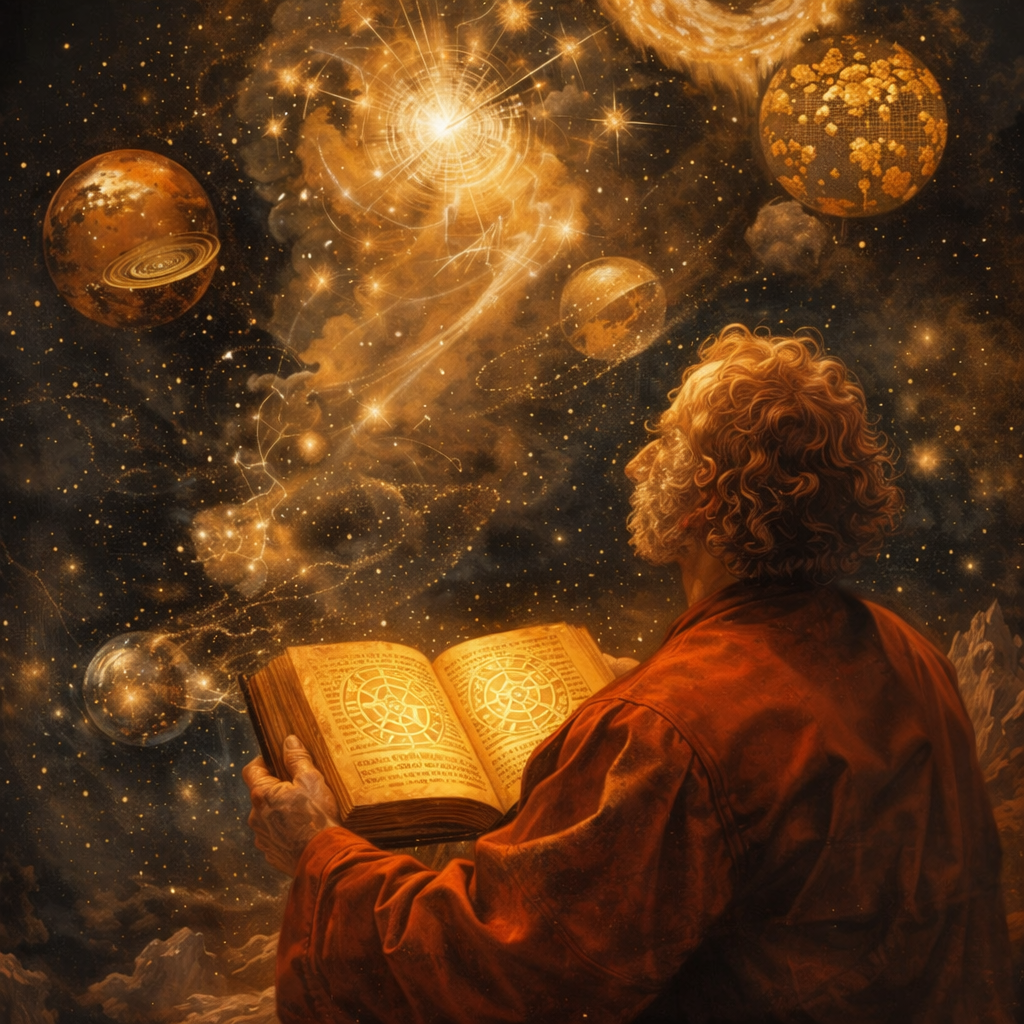

Silas Hawthorne, Hermetic Studies Editor: This issue of 'Theosophy' from March 1897 is a treasure trove for serious students of the occult. The anonymous author skillfully navigates complex metaphysical doctrines, offering clarity on perennial philosophical questions that have captivated minds for centuries. Its strength lies in its unadorned presentation of profound truths, eschewing sensationalism for genuine insight. The articles delve into the subtle architecture of the unseen realms and the nature of consciousness, providing essential groundwork for anyone dedicated to the path of spiritual science. Highly recommended for the discerning reader seeking foundational theosophical knowledge.
📝 Description
73
The March 1897 issue of Theosophy (Vol. 11, No. 12) discusses humanity's cosmic role.
This issue of Theosophy, published in March 1897, contains articles by an anonymous author. It examines humanity's position in the universe and the hidden aspects of existence. The text draws upon ancient traditions and ideas about spiritual development. It aims to speak to readers seeking knowledge beyond ordinary perception, combining logical thought with intuitive understanding.
Each section encourages reflection on the connections between all elements, the different levels of awareness, and the soul's progression. The content invites engagement with ideas that relate to the fundamental nature of existence. It seeks to stimulate internal reflection and guide readers toward spiritual enlightenment.
Published during a period of intense interest in spiritual and occult subjects, this issue of Theosophy belongs to the broader esoteric revival of the late 19th century. The Theosophical Society, founded in 1875, sought to synthesize Eastern and Western mystical traditions, promoting the study of comparative religion, philosophy, and science. This particular publication reflects the society's aim to uncover and disseminate 'esoteric wisdom,' often through interpretations of ancient scriptures and philosophies, emphasizing universal brotherhood and the hidden laws governing the cosmos.
💡 Why Read This Book?
This issue offers a direct conduit to the foundational thought of the late 19th-century esoteric revival. It is essential for seekers wishing to understand the roots of modern spiritual movements, scholars exploring the history of occult philosophy, and practitioners seeking to deepen their comprehension of universal laws and principles. It provides timeless wisdom for navigating personal evolution and understanding the grander cosmic design.
⭐ Reader Reviews
Honest opinions from readers who have explored this book.
❓ Frequently Asked Questions
What is the primary focus of this particular issue?
This issue primarily focuses on exploring core theosophical tenets, including the nature of evolution, theosophical cosmology, and the principles of spiritual development, as understood in the late 19th century.
Is prior knowledge of Theosophy required to understand this issue?
While some familiarity with metaphysical concepts can be beneficial, the issue is written with a clarity that allows dedicated newcomers to grasp its fundamental ideas. It serves as an excellent introduction to key theosophical thought.
Who was the intended audience for 'Theosophy' in 1897?
The intended audience comprised individuals actively engaged in or curious about the burgeoning spiritual and philosophical movements of the era, seeking deeper understanding beyond mainstream religious or scientific paradigms.
Does this issue offer practical guidance for spiritual practice?
While primarily theoretical and philosophical, the insights presented offer profound implications for personal transformation and spiritual practice, guiding the reader toward a more conscious and evolved existence.
What is the significance of the 'Unknown' author?
The authorship being unknown emphasizes the universal nature of the teachings, suggesting that the wisdom transcends individual personality and points to a collective or channeled source of esoteric knowledge.
🔮 Key Themes & Symbolism
The Grand Evolutionary Cycle
This theme explores the vast, cyclical nature of existence as understood within theosophical cosmology. It posits that the universe and all its inhabitants are engaged in a continuous process of evolution, not merely in a linear, material sense, but across multiple planes of consciousness and through successive rebirths. This perspective offers a profound framework for understanding history, individual lives, and the ultimate destiny of humanity and the cosmos, emphasizing a purposeful and divinely ordered progression towards perfection.
The Nature of the Higher Self
Central to theosophical thought is the concept of the Higher Self, the divine spark within each individual that is eternally connected to the Universal Consciousness. This theme examines the intricate relationship between the physical, astral, and mental bodies and the immortal ego, or Higher Self. It illuminates how understanding and aligning with this inner divinity is the key to spiritual realization, offering guidance on transcending limitations and awakening latent potentials for wisdom and compassion.
The Unseen Worlds and Subtle Bodies
This theme meticulously examines the concept of planes of existence beyond the physical, such as the astral and mental realms, and the subtle bodies that populate them. It explains the complex architecture of consciousness, explaining how these unseen dimensions interact with our everyday reality and influence our thoughts, emotions, and experiences. Understanding these subtle energies is presented as crucial for comprehending karma, reincarnation, and the journey of the soul after physical death.
💬 Memorable Quotes
Direct passages from the work, attributed to the author.
“The universe is a thought in the mind of the Absolute.”
— This profound statement expresses the idealistic and monistic underpinnings of theosophy, suggesting that reality is fundamentally consciousness and that all manifested phenomena arise from a singular, ultimate source of divine thought.
“The law of karma is the cosmic principle of cause and effect, guiding souls through cycles of experience.”
— This defines karma not as fatalistic punishment, but as an impersonal, just system of action and reaction that shapes an individual's journey across lifetimes, facilitating learning and spiritual growth.
“Within each atom sleeps a star, waiting for its appointed time to shine.”
— This poetic metaphor speaks to the latent potential and inherent divinity present in all things, from the smallest particle to the grandest celestial body, underscoring the universal principle of spiritual unfolding.
“True knowledge is not acquired, but remembered from the soul's vast archives.”
— This suggests that wisdom is not external information to be learned, but an innate remembrance of truths held within the soul's eternal memory, accessible through introspection and spiritual practice.
💡 Key Ideas
Editorial paraphrase of the work's core concepts — not direct quotes.
Evolution is not merely growth, but the unfolding of inherent divinity.
This quote highlights the theosophical view of evolution as an internal process of spiritual awakening, rather than solely external adaptation. It emphasizes that the potential for perfection is already present within each being, waiting to be realized.
🌙 Esoteric Significance
Tradition
This work is deeply rooted in the Theosophical tradition, which draws heavily from ancient Eastern wisdom, particularly the philosophies of Hinduism and Buddhism, blended with Western Hermeticism, Gnosticism, and Neoplatonism. It aims to present a universal brotherhood of humanity based on the recognition of a common spiritual source and the interconnectedness of all life, emphasizing the study of comparative religion, philosophy, and science to reveal the underlying unity of truth.
Symbolism
Key symbols likely explored include the 'Eye of Horus' or 'All-Seeing Eye' representing divine omniscience and spiritual perception; the 'Serpent' or 'Ouroboros' symbolizing cyclical time, eternity, and the unity of creation and destruction; and the 'Lotus,' signifying purity, spiritual awakening, and the unfolding of consciousness from the mud of material existence. These symbols serve as keys to unlock deeper meanings within the text, pointing towards universal spiritual principles.
Modern Relevance
The concepts of interconnectedness, karma, reincarnation, and the exploration of consciousness remain profoundly relevant today. In an era grappling with global challenges and a persistent search for meaning, theosophical insights offer a framework for understanding our place in the cosmos, fostering compassion, and encouraging personal responsibility for our spiritual evolution. The emphasis on a universal spiritual science transcends dogma, providing timeless wisdom for reading through the complexities of modern life.
👥 Who Should Read This Book
This particular issue of 'Theosophy' is an indispensable resource for several distinct audiences. For the **beginner seeker**, it offers a clear, albeit profound, introduction to the foundational principles of Theosophy, providing a solid grounding for further exploration. **Scholars** of comparative religion, philosophy, and occult history will find it a valuable primary source for understanding the intellectual currents of the late 19th century and the development of esoteric thought. **Practitioners** on the spiritual path will benefit from its insights into karma, reincarnation, and the nature of consciousness, which can inform and deepen their meditative and contemplative practices. Ultimately, anyone with a sincere yearning to understand the deeper workings of the universe and their role within it will find this issue useful.
📜 Historical Context
Published in March 1897, this issue of 'Theosophy' emerges from a period of intense spiritual and intellectual ferment in the Western world. The late 19th century witnessed a widespread disillusionment with purely materialistic scientific and religious paradigms, leading many to seek alternative explanations for the mysteries of life, consciousness, and the universe. Theosophy, spearheaded by figures like Helena Blavatsky and Annie Besant, offered a compelling synthesis of Eastern esoteric traditions (Buddhism, Hinduism) and Western Hermeticism, Gnosticism, and Neoplatonism. This era saw a flourishing of occult societies, spiritualist movements, and philosophical inquiries into the unseen. 'Theosophy' served as a vital organ for disseminating these revolutionary ideas, challenging conventional thought and inspiring a generation of seekers to explore the depths of human potential and cosmic interconnectedness.
📔 Journal Prompts
Reflect on the concept of 'evolution' as presented here. How does it differ from your current understanding, and what implications does this have for your life?
Consider the idea of 'unseen worlds.' How might your perception of reality shift if you acknowledged the existence and influence of subtle planes of consciousness?
Meditate on the 'Higher Self.' What practices could you incorporate to foster a stronger connection with this inner divine aspect?
How do the principles of karma and reincarnation, as discussed, influence your understanding of your past, present, and future actions?
What symbols from this text resonate most deeply with you, and what personal meaning do they hold?
🗂️ Glossary
Theosophy
A philosophical and religious movement founded in the late 19th century, seeking to uncover the universal wisdom underlying all religions, philosophies, and sciences, and to promote spiritual enlightenment and universal brotherhood.
Karma
The spiritual principle of cause and effect where intent and actions of an individual influence their future, shaping their destiny across lifetimes through a system of cosmic justice and learning.
Reincarnation
The belief that the soul, or conscious essence, begins a new life in a new body after biological death, progressing through successive lives to learn and evolve spiritually.
Subtle Bodies
Esoteric concept referring to non-physical vehicles or layers of consciousness (e.g., astral, mental bodies) that accompany the soul and interact with different planes of existence.
Cosmic Evolution
The theosophical understanding of the universe's development not just physically, but also across spiritual and consciousness planes, occurring in grand cycles of manifestation and dissolution.
This book appears in 2 collections
🔮 Readers Also Liked
Browse all →




From the “Theosophy” Collection
View all →






More Free Theosophy & Anthroposophy Books
View all →