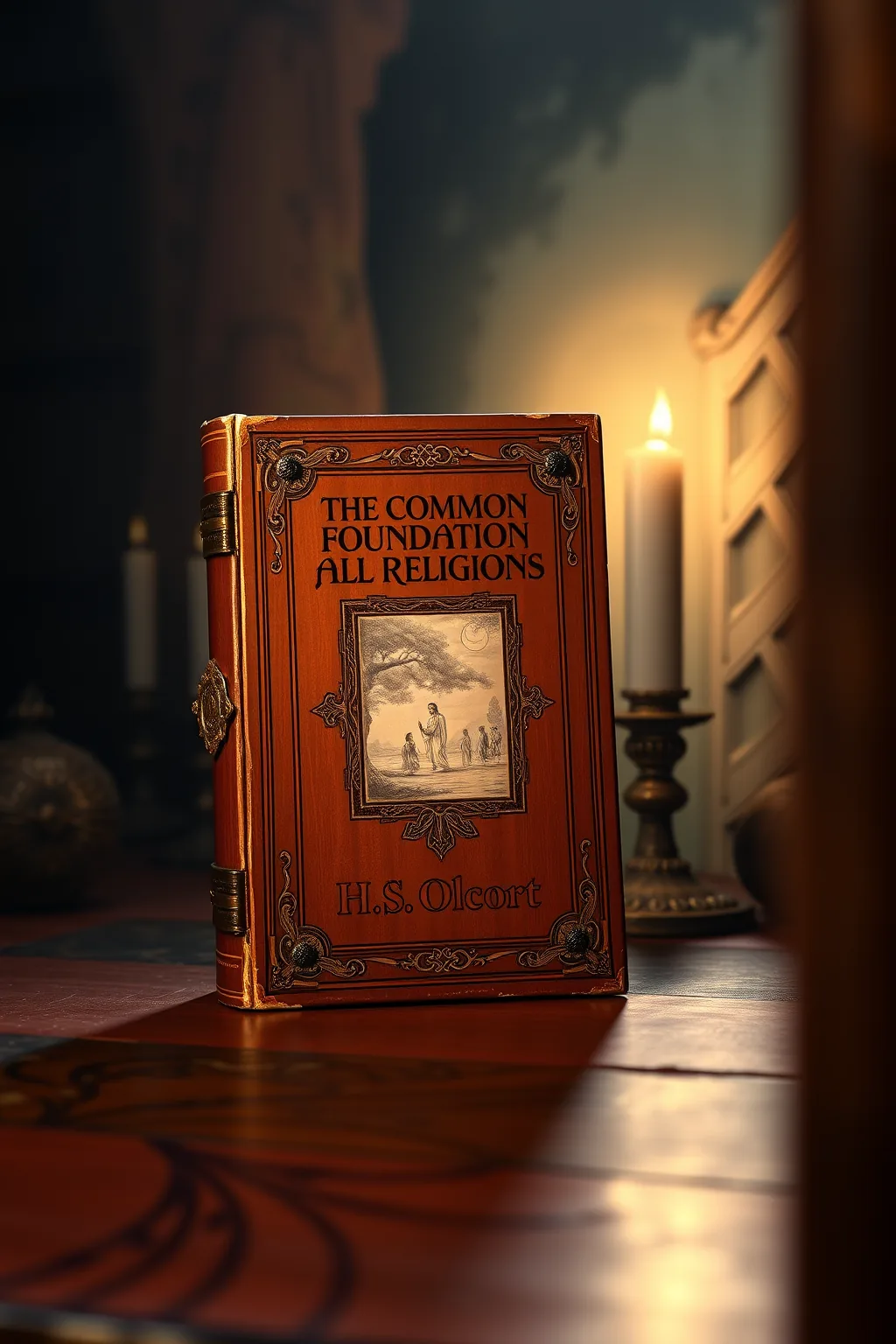
The Common Foundation of All Religions by H.S. Olcott
 83
83

The Common Foundation of All Religions by H.S. Olcott


Balthazar Finch, Senior Critic, Occult Philosophy: H.S. Olcott's "The Common Foundation of All Religions" is a masterclass in esoteric distillation. Within its brief span, Olcott achieves what many larger tomes struggle to accomplish: the unveiling of universal spiritual principles. He deftly navigates the labyrinth of religious dogma, highlighting the shared ethical and metaphysical underpinnings that resonate across disparate traditions. This lecture is a cornerstone for Theosophical study, offering a clear and compelling argument for the underlying unity of all spiritual quests. Its strength lies in its directness and its ability to illuminate profound truths without succumbing to jargon. An essential read for anyone seeking to understand the perennial philosophy and the subtle threads that connect humanity's deepest spiritual yearnings.
📝 Description
83
In 1880, H.S. Olcott argued for a shared spiritual core across global religions.
H.S. Olcott's 1880 lecture, delivered in Madras, India, argues that despite outward differences, major world religions share a common spiritual foundation. Olcott, a key figure in establishing the Theosophical Society, sought to demonstrate this unity through an examination of their underlying principles and symbolism. He suggested that these shared elements point to a singular truth accessible through various religious expressions.
The lecture aims to move beyond the divisive aspects of dogma and ritual. Olcott presents a case for recognizing the ethical teachings, spiritual aims, and the universal human quest for ultimate reality as common threads. This perspective is intended to foster a sense of interconnectedness among different faiths and offer a broader understanding of spiritual life. It is presented as a text that reveals a hidden structure within religious belief systems.
This work belongs to the Theosophical tradition, which emerged in the late 19th century. Theosophy, as promoted by figures like H.S. Olcott and Helena Blavatsky, aimed to uncover a universal spiritual science underlying all religions and philosophies. It drew heavily on Eastern traditions, particularly Hinduism and Buddhism, integrating them with Western esoteric thought. Olcott's lecture reflects this core Theosophical goal of demonstrating an ancient, unified wisdom that predates and underpins all formal religious structures.
✍️ Author

H.S. Olcott is a
Helena Petrovna Blavatsky (née Hahn von Rottenstern; 12 August [O. S.
💡 Why Read This Book?
Uncover the unified heart of global spirituality. Olcott reveals the shared ethical and metaphysical truths beneath religious diversity, offering a profound understanding of humanity's spiritual quest. Ideal for seekers of universal wisdom, students of comparative religion, and those drawn to the foundational principles of Theosophy. Discover the common ground that connects all faiths and fosters a deeper sense of global spiritual kinship.
⭐ Reader Reviews
Honest opinions from readers who have explored this book.
❓ Frequently Asked Questions
What is the primary purpose of "The Common Foundation of All Religions"?
The lecture aims to reveal the universal principles and shared ethical values that underpin all major world religions, demonstrating their underlying unity rather than their superficial differences.
Who was H.S. Olcott and what was his significance?
Henry Steel Olcott was a key figure in the development of the Theosophical Society, serving as its first president. He was instrumental in promoting the study of comparative religion and Eastern philosophies in the West.
What is Theosophy, as presented in this text?
Theosophy, as outlined by Olcott, is a spiritual philosophy that seeks to understand the fundamental truths underlying all religions and sciences, emphasizing universal brotherhood and the evolution of consciousness.
Is this lecture suitable for beginners in spiritual studies?
Yes, its clear and direct approach makes it accessible to newcomers, while its depth offers continued resonance for seasoned practitioners and scholars.
Where was this lecture originally delivered?
The lecture was delivered in Madras (now Chennai), India, in 1882, a location significant for its rich spiritual and philosophical heritage.
🔮 Key Themes & Symbolism
The Perennial Philosophy
This theme explores the ancient wisdom tradition that posits a single, underlying spiritual reality from which all religious expressions emanate. Olcott argues that beneath the diverse rituals and dogmas, a common thread of truth—the Perennial Philosophy—binds humanity's spiritual aspirations. It emphasizes the unity of consciousness, the inherent divinity within all beings, and the universal ethical principles that guide spiritual evolution. This concept serves as the bedrock upon which the diverse edifices of world religions are built, offering a framework for understanding their shared origins and ultimate aims.
Universal Brotherhood and Tolerance
Olcott champions the idea that recognizing the common foundation of religions naturally leads to a profound sense of universal brotherhood. By understanding that all paths strive towards the same ultimate truths and ethical ideals, one transcends sectarianism and embraces tolerance. This theme highlights the importance of compassion, mutual respect, and the recognition of the divine spark in every individual, regardless of their religious affiliation. It's a call to unity that moves beyond mere coexistence to active understanding and spiritual solidarity among all peoples.
The Esoteric Core of Religion
This theme examines the hidden, or esoteric, meanings that lie at the heart of religious traditions. Olcott suggests that while exoteric (outward) forms may differ, the inner teachings—the spiritual science and mystical insights—are remarkably consistent. He points to shared allegories, symbolic language, and metaphysical doctrines that reveal the deeper realities accessible through spiritual practice and intuitive understanding. This exploration invites readers to look beyond literal interpretations and discover the profound, unifying wisdom embedded within the world's sacred texts and practices.
💬 Memorable Quotes
Direct passages from the work, attributed to the author.
“Religion is a great reality and a great truth.”
— This foundational statement asserts the profound significance and inherent verity of religion, not as mere dogma, but as a fundamental aspect of human existence and a pathway to ultimate understanding.
“The essence of all religions is the same.”
— Olcott posits that despite outward variations, the core spiritual principles, ethical teachings, and ultimate goals of all faiths are remarkably alike, pointing to a singular divine source.
“Look for the common light in all creeds.”
— This evocative phrase encourages the reader to seek the shared spiritual illumination and wisdom that shines through the diverse expressions of religious belief, fostering unity.
“The truth is one, though sages call it by many names.”
— A direct articulation of the perennial philosophy, suggesting that the ultimate reality, or Truth, is singular, and the various names given to it by different traditions are merely labels for the same divine essence.
💡 Key Ideas
Editorial paraphrase of the work's core concepts — not direct quotes.
Unity in diversity is the divine law.
This quote captures the idea that the myriad forms of religious expression do not contradict a fundamental underlying unity, reflecting a cosmic principle of harmonious multiplicity.
🌙 Esoteric Significance
Tradition
This work is deeply rooted in the Theosophical tradition, which itself draws heavily from ancient esoteric philosophies, including Neoplatonism, Hermeticism, Gnosticism, and the wisdom teachings of Eastern religions like Hinduism and Buddhism. Olcott's lecture is a foundational text for Theosophy, articulating its core tenet of the universality of spiritual truth and the concept of a 'Perennial Philosophy' that underlies all genuine religious and mystical systems.
Symbolism
While Olcott's lecture is primarily an argument for conceptual unity, it implicitly engages with religious symbolism by suggesting that the diverse symbols across faiths often point to similar underlying spiritual realities. The 'common foundation' itself can be seen as a symbolic representation of the singular, unmanifest Divine Source from which all manifest phenomena, including religious doctrines, arise. The lecture encourages a symbolic interpretation of religious texts, moving beyond literalism to grasp the deeper, esoteric meanings.
Modern Relevance
In an increasingly interconnected yet often polarized world, Olcott's message of universal spiritual kinship is more relevant than ever. "The Common Foundation of All Religions" offers a powerful antidote to religious intolerance and sectarianism, encouraging dialogue, understanding, and mutual respect among diverse faith traditions. Its emphasis on shared ethical values and the pursuit of ultimate truth appeals to contemporary seekers of wisdom and those striving for a more harmonious global society.
👥 Who Should Read This Book
This concise lecture is useful for a broad spectrum of readers. **Beginners** seeking an accessible introduction to the idea of spiritual unity will find Olcott's clear exposition enlightening. **Scholars of comparative religion** will appreciate its historical context and its articulation of the perennial philosophy. **Spiritual seekers** yearning to understand the common threads that bind humanity's quest for the divine will find profound resonance. **Theosophy practitioners** will recognize it as a foundational text that underpins their understanding of universal wisdom. Ultimately, anyone interested in transcending religious dogma and exploring the shared heart of human spirituality will benefit immensely.
📜 Historical Context
Delivered in 1882, "The Common Foundation of All Religions" emerged during a period of intense global interest in comparative religion and Eastern philosophies, fueled by colonial expansion and increased cross-cultural exchange. The late 19th century saw a burgeoning of spiritual and intellectual movements seeking alternatives to prevailing Western materialism and rigid religious dogma. H.S. Olcott, alongside Helena Blavatsky, co-founded the Theosophical Society in 1875, aiming to foster universal brotherhood, encourage the study of comparative religion, and investigate the unexplained laws of nature and the powers latent in humanity. This lecture, given in the spiritual heartland of India, reflects that era's quest for ancient wisdom, the deconstruction of religious exclusivity, and the burgeoning recognition of a universal spiritual heritage that transcended geographical and cultural boundaries.
📔 Journal Prompts
Reflect on a time you encountered a belief or practice from a different religion that surprisingly resonated with your own spiritual understanding. What common ground did you find?
Olcott speaks of a 'common light in all creeds.' Identify a core ethical principle that you believe is present in most major world religions. How does this principle manifest in your own life?
Consider the statement, 'The truth is one, though sages call it by many names.' How does this perspective challenge or affirm your current understanding of truth and spirituality?
How can the recognition of a 'common foundation' foster greater tolerance and understanding in your personal interactions and in the wider world?
If you were to explain the essence of 'The Common Foundation of All Religions' to someone unfamiliar with it, what three key points would you emphasize, and why?
🗂️ Glossary
Theosophy
A spiritual philosophy that seeks to understand the fundamental truths underlying all religions and sciences, emphasizing universal brotherhood, the study of comparative religion, and the investigation of unexplained laws of nature and latent human powers.
Perennial Philosophy
An ancient tradition that posits a single, underlying spiritual reality from which all religious expressions emanate. It suggests a universal wisdom that transcends specific doctrines and cultural contexts.
Esoteric
Relating to or accessible only by a small number of people with a specialized knowledge or interest; inner, hidden, or mystical teachings within a tradition.
Exoteric
Relating to or accessible to the general public; outward, common, or literal teachings of a tradition, as opposed to its esoteric meanings.
Dogma
A principle or set of principles laid down by an authority as incontrovertibly true; a belief or set of beliefs that is accepted by the members of a group without being questioned or doubted.
This book appears in 2 collections
🔮 Readers Also Liked
Browse all →




From the “Theosophy” Collection
View all →



More Free Theosophy & Anthroposophy Books
View all →