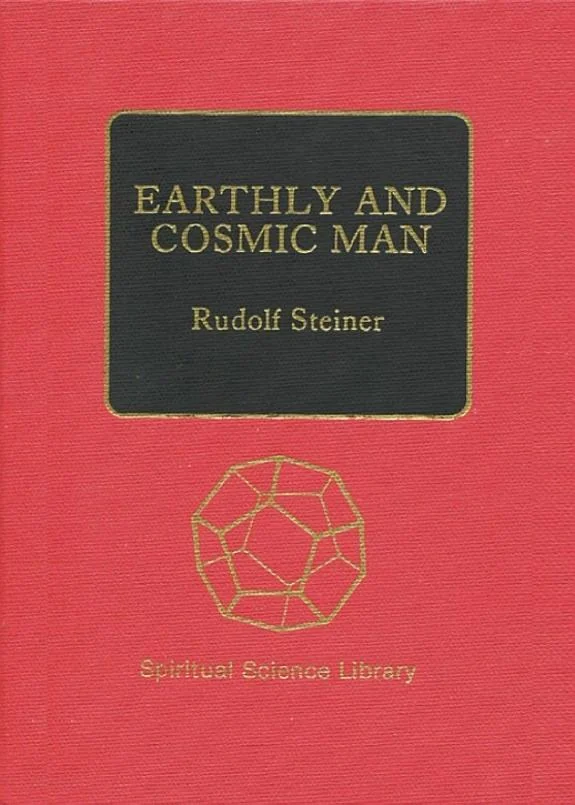
Earthly and Cosmic Man
 84
84

Earthly and Cosmic Man
Rudolf Steiner’s "Earthly and Cosmic Man" presents a densely argued case for a cosmos deeply interwoven with human destiny. The strength of this collection of lectures lies in its systematic exploration of reincarnation not merely as a concept, but as a dynamic engine for personal and collective evolution. Steiner’s insistence on the development of a free, self-conscious personality as the aim of this process offers a compelling counter-narrative to deterministic views of human nature. However, the highly specific terminology and the layered philosophical framework, characteristic of Steiner’s Anthroposophy, can present a significant barrier to entry. For instance, his detailed descriptions of the various ethers and their influence on human development, while central to his cosmology, require considerable prior familiarity or dedicated study to fully grasp. The work is best approached as a primary text for those already initiated into or seriously investigating Anthroposophical thought. It offers a unique perspective on karma and spiritual evolution for dedicated seekers.
📝 Description
84
Rudolf Steiner's 1986 book presents lectures on human development and cosmic principles.
Rudolf Steiner's "Earthly and Cosmic Man" discusses the connection between human growth and universal cosmic laws. The lectures focus on reincarnation and the progression of the individual personality, proposing that human consciousness is not fixed. Instead, it moves through cycles of birth, death, and rebirth. This process, Steiner suggests, is crucial for developing independence and self-awareness.
The book examines how earthly events are influenced by cosmic forces. It also details how individual lives contribute to the broader evolution of humanity. Steiner aimed to show that our experiences here are deeply linked to a larger, ongoing spiritual and cosmic unfolding. This perspective offers a way to understand personal challenges and life paths through a wider, universal framework.
This work stems from Rudolf Steiner's Anthroposophy, a spiritual philosophy he founded in the early 20th century. Anthroposophy sought to reconcile scientific understanding with spiritual realities, positing a view of human existence that extends beyond the purely material. Steiner's lectures, collected in "Earthly and Cosmic Man," reflect this aim by detailing a cosmology that directly impacts human evolution and individual destiny. It places human life within a grand cosmic order, emphasizing unseen forces and spiritual processes that shape our development across multiple lifetimes.
💡 Why Read This Book?
• Understand the Anthroposophical view of reincarnation as a mechanism for developing free consciousness, moving beyond simple rebirth to a process of soul evolution as detailed in Steiner's lectures. • Grasp the concept of karmic laws governing human destiny, learning how Steiner proposes these spiritual principles shape earthly experiences and personal development. • Explore the relationship between earthly life and cosmic forces, discovering how Steiner connects human evolution to celestial rhythms and universal spiritual order.
⭐ Reader Reviews
Honest opinions from readers who have explored this book.
❓ Frequently Asked Questions
What is the primary focus of Rudolf Steiner's "Earthly and Cosmic Man"?
The book concentrates on the laws of human destiny and reincarnation, exploring how these cosmic principles facilitate the development of the free, self-conscious, and independent human personality.
When was Rudolf Steiner's "Earthly and Cosmic Man" first published?
While Rudolf Steiner lectured on these topics throughout his life, "Earthly and Cosmic Man" was first published in 1986, bringing his ideas on human evolution to a wider audience.
What is Anthroposophy, and how does it relate to this book?
Anthroposophy is a spiritual philosophy founded by Rudolf Steiner. "Earthly and Cosmic Man" is a direct expression of Anthroposophical thought, detailing its perspectives on human spiritual development, karma, and cosmic influences.
Does the book discuss karma?
Yes, the work extensively discusses karma as a fundamental law governing human destiny. It explains how karmic processes, through reincarnation, contribute to the soul's evolutionary journey towards self-consciousness.
Is "Earthly and Cosmic Man" suitable for beginners to esoteric studies?
It can be challenging for absolute beginners due to Steiner's specific terminology and complex philosophical framework. However, it offers profound insights for those with some background or a dedicated interest in esoteric philosophy and Anthroposophy.
What does Steiner mean by the 'free, self-conscious, independent human personality'?
This refers to the ultimate goal of human evolution according to Steiner: an individual who has developed full awareness of their spiritual nature and acts with genuine freedom, uncompelled by unconscious forces.
🔮 Key Themes & Symbolism
Karmic Laws and Destiny
The book posits that human lives are not random occurrences but are governed by intricate karmic laws. Steiner explains how these laws, operating across multiple lifetimes through reincarnation, shape individual destinies. Each earthly experience is presented as a consequence of past actions and a foundation for future development. Understanding these principles is crucial for comprehending the nature of suffering, joy, and the overall trajectory of one's life, moving towards a conscious engagement with one's fate rather than passive acceptance.
Evolution of Consciousness
A central theme is the continuous evolution of human consciousness, driven by the cycle of earthly and spiritual existence. Steiner argues that through successive incarnations, the human soul progressively develops self-awareness, freedom, and independence. This evolution is not merely intellectual but encompasses the entire being – physical, soul, and spirit. The work details the stages and processes involved in this spiritual metamorphosis, emphasizing the importance of conscious participation in one's own growth.
Cosmic Interconnectedness
Steiner elaborates on the profound connection between human beings and the wider cosmos. He suggests that cosmic forces, rhythms, and intelligences actively participate in human development. Our earthly lives are seen as microcosmic reflections of macrocosmic processes. This perspective challenges a purely materialistic view of humanity, asserting that our physical and spiritual makeup is intrinsically linked to celestial influences and the spiritual architecture of the universe itself.
The Free Personality
The ultimate aim of the evolutionary process described in "Earthly and Cosmic Man" is the development of a truly free, self-conscious, and independent human personality. Steiner differentiates this from mere autonomy, emphasizing a state of being where choices are made from a place of spiritual insight and self-knowledge. This ideal personality is capable of understanding and working consciously with the karmic and cosmic laws that influence existence, thereby taking true ownership of its path.
💬 Memorable Quotes
Direct passages from the work, attributed to the author.
“Human destiny is not a rigid decree but a living process shaped by karmic impulses.”
— This highlights Steiner's view that fate is not predetermined but a dynamic interplay of past actions and future potential, offering agency within the cosmic order.
“Reincarnation offers the soul repeated opportunities to learn and evolve through earthly experiences.”
— This emphasizes the educational aspect of multiple lives, where each incarnation serves as a classroom for spiritual growth and the development of consciousness.
“Our individual lives are inextricably woven into the grand cosmic evolutionary plan.”
— This conveys the idea that human existence is not isolated but part of a larger, universal spiritual unfolding, influenced by and contributing to cosmic forces.
“The goal of earthly existence is the cultivation of a fully self-aware and free personality.”
— This points to the ultimate objective of human life within Steiner's framework: achieving a state of conscious independence and spiritual autonomy.
“Cosmic rhythms and forces directly influence the patterns of human life and development.”
— This interpretation underscores Steiner's belief in the tangible impact of celestial phenomena and spiritual energies on the human journey through life.
🌙 Esoteric Significance
Tradition
The work is firmly rooted in the Western esoteric tradition, particularly Anthroposophy, which Steiner himself founded. It draws from Gnostic, Hermetic, and Kabbalistic streams but synthesizes them into a unique spiritual science. Unlike purely mystical traditions that focus on direct experience, Anthroposophy emphasizes a methodical, cognitive approach to understanding spiritual realities, aiming for clairvoyance through rigorous inner development and study.
Symbolism
Key symbols include the cyclical nature of time and existence, represented by reincarnation, and the human being as a microcosm reflecting the macrocosm. Steiner often uses the metaphor of 'earthly man' and 'cosmic man' to denote the dual nature of humanity – bound to the physical realm yet connected to spiritual universes. The concept of 'karma' functions symbolically, representing the law of cause and effect that governs spiritual and material interactions.
Modern Relevance
Steiner's concepts of karmic development, reincarnation, and the spiritual evolution of consciousness continue to influence contemporary esoteric practitioners, therapists, and educators. His ideas are particularly relevant to alternative education movements (like Waldorf), biodynamic agriculture, and integrative medicine. Thinkers in consciousness studies and transpersonal psychology often engage with Steiner's detailed cosmology and his views on the human soul's journey.
👥 Who Should Read This Book
• Students of Anthroposophy seeking a foundational text on Steiner's views of karma and reincarnation. • Individuals interested in comparative religion and esotericism who want to understand a unique 20th-century spiritual philosophy. • Seekers exploring the nature of human destiny and personal development through a spiritual lens, moving beyond purely psychological or material explanations.
📜 Historical Context
Rudolf Steiner, a key figure in early 20th-century esoteric thought, delivered the lectures that form "Earthly and Cosmic Man" before his death in 1925. While published in 1986, this work reflects the intellectual climate of the time when spiritual movements like Theosophy, from which Steiner initially emerged, were gaining traction. Steiner's Anthroposophy offered a distinctive path, seeking to synthesize scientific understanding with spiritual realities. His work stood in contrast to purely materialistic philosophies prevalent in academia and offered an alternative to traditional religious doctrines. He was a contemporary of figures like Annie Besant and C.W. Leadbeater within the Theosophical Society, though he later diverged to form his own movement. Steiner's ideas, particularly concerning education (Waldorf schools) and holistic living, found a receptive audience, and his writings have continued to be studied extensively, influencing various alternative movements and thinkers.
📔 Journal Prompts
Reflect on the concept of karmic laws as presented by Steiner in relation to your own life experiences.
Consider the evolution of your own consciousness; how might reincarnation play a role in this development?
Analyze the 'free, self-conscious, independent human personality' – what does this ideal mean for your daily actions?
How do you perceive the connection between earthly events and cosmic influences in your life?
Explore the idea of destiny as a 'living process' rather than a fixed outcome.
🗂️ Glossary
Reincarnation
The process by which a soul or spiritual aspect of a human being passes through successive earthly lives, learning and evolving with each cycle.
Karma
The spiritual law of cause and effect, where actions in one life influence circumstances and experiences in subsequent lives, guiding soul evolution.
Anthroposophy
A spiritual philosophy founded by Rudolf Steiner, seeking to understand the spiritual nature of the human being and the cosmos through spiritual science.
Self-Consciousness
A state of heightened awareness of one's own existence, thoughts, and feelings, considered a key element in human spiritual evolution.
Destiny
In Steiner's view, not a predetermined fate, but the unfolding path of an individual soul shaped by karmic forces and conscious choices over many lifetimes.
Cosmic Man
Refers to the spiritual archetypes and forces originating in the cosmos that influence and are mirrored in human development.
Earthly Man
Represents the human being as manifested in the physical world, subject to earthly laws and experiences, but carrying within the potential for cosmic connection.
This book appears in 1 collection
🔮 Readers Also Liked
Browse all →






From the “Anthroposophy” Collection
View all →








More Free Theosophy & Anthroposophy Books
View all →