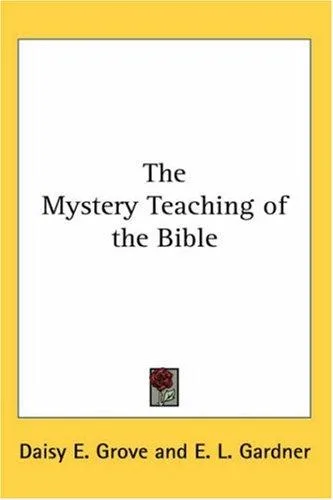
The Mystery Teaching of the Bible
 74
74

The Mystery Teaching of the Bible
Daisy E. Grove's 1925 volume, The Mystery Teaching of the Bible, attempts to unearth esoteric doctrines within scripture. The work's strength lies in its earnest endeavor to connect biblical passages with universal spiritual principles, offering a distinct perspective for those dissatisfied with purely literal interpretations. Grove's interpretation of the Garden of Eden narrative as an allegory for the soul's descent into materiality is particularly noteworthy. However, the book suffers from a dated, somewhat dogmatic presentation of its material. While it posits hidden meanings, it rarely engages with critical scholarship or alternative esoteric viewpoints contemporary to its publication, such as those emerging from G.I. Gurdjieff's teachings or the more academic comparative mythology of that era. The prose, though sincere, can be dense and lacks the analytical rigor found in later esoteric scholarship. It remains a curiosity for students of early 20th-century occultism but is less compelling as a primary text for contemporary spiritual seekers.
📝 Description
74
Daisy E. Grove's 1925 book reveals esoteric interpretations of biblical narratives and doctrines.
First published in 1925, The Mystery Teaching of the Bible by Daisy E. Grove offers a systematic look at biblical stories and beliefs through an esoteric viewpoint. Grove believed the Bible holds hidden meanings and spiritual allegories that require specific methods to understand. She suggested these teachings were once widely known but have since faded, needing careful study to rediscover them. The book is for readers interested in comparative religion, spiritual symbolism, and non-literal readings of sacred texts. It appeals to those wanting to connect religious faith with metaphysical ideas and explore the historical roots of esoteric traditions in Western thought. Individuals pursuing personal spiritual growth or academic study of older spiritual systems will find its approach valuable.
Grove approaches biblical narratives not as history but as symbols for internal spiritual processes. She discusses concepts like the 'Great Work' in relation to personal change, viewing the Christ principle as an inner divine spark, and the spiritual importance of various biblical figures and events. Her interpretations focus on the idea that scripture contains deeper, mystical truths waiting to be unlocked.
Published in the interwar period, Grove's work emerged during a time of increased interest in spiritualism, Theosophy, and occult studies. The early 20th century saw many authors reinterpreting religious texts through emerging esoteric frameworks. Grove's book fits this intellectual climate, responding to a cultural search for mystical meaning beyond conventional religious dogma. This era also produced significant scholarship in comparative mythology and religion, affecting how ancient texts were studied.
💡 Why Read This Book?
• You will learn to interpret biblical narratives as symbolic maps of spiritual development, gaining a new perspective on familiar stories by examining Grove's allegorical readings of figures like Adam and Eve. • You can gain insight into the esoteric milieu of the early 20th century by understanding how authors like Daisy E. Grove sought to reconcile religious texts with metaphysical concepts, evidenced by the book's 1925 publication date. • Discover the concept of the "inner Christ" as a symbolic principle for spiritual attainment, a core theme Grove explores to reveal a personal divinity within the biblical message.
⭐ Reader Reviews
Honest opinions from readers who have explored this book.
❓ Frequently Asked Questions
What is the primary goal of The Mystery Teaching of the Bible?
The book's main objective is to reveal the hidden, mystical, and spiritual meanings embedded within biblical texts, presenting them as allegories for inner transformation rather than literal historical accounts.
Who was Daisy E. Grove and when did she write this book?
Daisy E. Grove was an author interested in esoteric interpretations of religion. The Mystery Teaching of the Bible was first published in 1925, during a period of significant interest in spiritual and metaphysical studies.
Does the book discuss specific biblical stories or figures?
Yes, the work explores various biblical narratives, including the creation story, the life of Jesus, and the concept of the Exodus, interpreting them through symbolic and allegorical frameworks.
What kind of interpretive method does Grove use?
Grove employs an allegorical and symbolic method, treating biblical accounts as representations of inner spiritual processes and the soul's journey toward enlightenment, rather than historical events.
Is this book suitable for beginners in esoteric studies?
While accessible to those with an interest in spiritual symbolism, the book assumes some familiarity with metaphysical concepts and symbolic interpretation, making it most suitable for readers already exploring esoteric themes.
What is the historical period associated with this book?
The book was published in 1925, aligning with the early 20th-century surge in interest in Theosophy, spiritualism, and occultism, where many authors reinterpreted religious traditions.
🔮 Key Themes & Symbolism
Biblical Allegory
Grove reinterprets major biblical narratives, such as the Genesis account and the life of Christ, not as historical events but as symbolic representations of the soul's journey and spiritual development. She posits that the scriptures contain a universal language of spiritual truths, accessible through symbolic interpretation. This approach seeks to reveal a deeper, mystical stratum of meaning beneath the exoteric surface of the text, connecting the reader to an inner, divine reality.
The Inner Christ
A central theme is the concept of the 'Christ principle' not merely as a historical figure, but as an indwelling divine potential within every human being. Grove suggests that the biblical narrative of Christ's life serves as an allegory for the awakening and realization of this inner divinity. This internal Christ represents the soul's capacity for spiritual perfection and union with the divine, attainable through conscious effort and understanding.
Spiritual Transformation
The book frames biblical events and figures as metaphors for the stages of personal spiritual transformation, often referred to as the 'Great Work'. It illustrates how biblical characters and their struggles represent the challenges and triumphs of the individual on the path to spiritual illumination. This perspective encourages readers to view their own life experiences as part of a profound spiritual process, guided by ancient wisdom.
Lost Esoteric Tradition
Grove argues that the Bible originally contained explicit esoteric teachings, which have been largely lost or misunderstood over centuries. She aims to recover this 'mystery teaching' by demonstrating how to read scripture with an esoteric key, suggesting that this knowledge was once common but has since become the domain of select initiates or obscured by literalistic interpretations.
💬 Memorable Quotes
Direct passages from the work, attributed to the author.
“The Bible is a symbolic book, every story, every miracle, a lesson for the soul.”
— This statement expresses Grove's core thesis: that biblical accounts function as allegorical teachings designed to guide the individual's spiritual evolution, rather than purely historical records.
“The Garden of Eden represents the soul's initial state of spiritual unity before its descent into material consciousness.”
— This interpretation frames the Genesis narrative not as a literal garden, but as a metaphor for the soul's primordial spiritual innocence and its subsequent entanglement with the material world.
“The Christ is the divine potential within, waiting to be awakened and manifest.”
— Here, Grove shifts the focus from an external savior to an internal divine spark, suggesting that the Christ represents the highest spiritual faculty or potential residing within each person.
“Understanding the spiritual laws governing creation unlocks the Bible's true message.”
— This suggests that a specific set of metaphysical or esoteric laws are the key to deciphering the deeper, intended meaning of biblical texts, moving beyond surface-level comprehension.
💡 Key Ideas
Editorial paraphrase of the work's core concepts — not direct quotes.
The journey out of Egypt is the soul's liberation from the bondage of ignorance.
This paraphrased concept interprets the Exodus narrative as an allegory for the spiritual awakening process, where liberation signifies freedom from mental and spiritual limitations.
🌙 Esoteric Significance
Tradition
Grove's work aligns with the broader Western Esoteric Tradition, particularly drawing from Neoplatonic and Hermetic streams that emphasize allegory and symbolic interpretation of sacred texts. It shares common ground with Theosophical interpretations of world religions, seeking a universal spiritual core beneath diverse exoteric forms. However, its singular focus on the Bible as the primary vehicle for these teachings distinguishes it from more syncretic approaches.
Symbolism
Key symbols include the Garden of Eden, interpreted as the soul's original state of spiritual unity before material embodiment. The figure of Christ symbolizes the awakened inner divine potential, the 'higher self' that humanity can realize. The journey out of Egypt is often presented as the soul's liberation from ignorance and material bondage, representing a significant spiritual exodus.
Modern Relevance
Contemporary practitioners of contemplative Christianity and those exploring the intersection of psychology and spirituality may find Grove's allegorical approach valuable. Thinkers interested in the history of biblical interpretation outside of mainstream theology, particularly within occult and New Age studies, continue to reference such early 20th-century works for historical context and alternative perspectives.
👥 Who Should Read This Book
• Students of comparative religion seeking non-literal interpretations of biblical narratives, particularly those interested in how scripture has been viewed through esoteric and allegorical frameworks. • Individuals exploring personal spiritual development who wish to understand biblical stories as maps for inner transformation and self-realization. • Researchers of early 20th-century esoteric movements and literature, curious about how figures like Daisy E. Grove engaged with and reinterpreted religious texts during that era.
📜 Historical Context
The Mystery Teaching of the Bible emerged in 1925, a period when esoteric thought was flourishing in the West. Following the widespread interest in spiritualism and Theosophy, authors like Daisy E. Grove sought to reinterpret established religious traditions through a metaphysical lens. This era saw a proliferation of works attempting to find hidden wisdom in ancient texts, often challenging orthodox religious interpretations. Grove's book can be situated alongside contemporary explorations of Gnosticism and Kabbalah by figures like Eliphas Lévi and later by Manly P. Hall, though Grove’s approach appears more directly focused on a systematic esoteric reading of the Bible itself. While not explicitly engaging with radical scientific discoveries of the time, it reflected a broader cultural desire to reconcile faith with emerging philosophical and psychological understandings of the human psyche. The reception of such works was often divided, with some embracing them as spiritual revelations and others dismissing them as heretical or pseudoscientific.
📔 Journal Prompts
The symbolism of the Garden of Eden as the soul's initial state of unity.
Your understanding of the 'inner Christ' principle as presented by Grove.
The concept of biblical narratives functioning as allegories for spiritual awakening.
How the 'Great Work' relates to personal challenges described in biblical stories.
Reflecting on the 'soul's liberation from ignorance' as symbolized by the Exodus.
🗂️ Glossary
Allegory
A story, poem, or picture that can be interpreted to reveal a hidden meaning, typically a moral or political one. In this context, biblical narratives are seen as allegories for spiritual truths.
Esoteric
Intended for or likely to be understood by only a small number of people with a specialized knowledge or interest. Grove applies this to hidden spiritual meanings within the Bible.
Exoteric
Intended for or likely to be understood by the general public; the outward, literal meaning, as opposed to esoteric teachings.
The Great Work
A term often used in alchemy and esoteric traditions referring to the process of spiritual transformation, purification, and the attainment of enlightenment or divine union.
Inner Christ
The concept that the divine potential or spiritual essence of Christ resides within every individual, representing the capacity for spiritual realization and union with the divine.
Spiritual Unity
A state of perfect harmony and connection with the divine or universal consciousness, often symbolized by the Garden of Eden before the fall.
Spiritual Laws
Underlying principles or forces that govern the spiritual or metaphysical realms, believed by esotericists to be as consistent as natural laws.
🔮 Readers Also Liked
Browse all →





More by Daisy E. Grove, Daisy, E. Grove
All books →
More Free Theosophy & Anthroposophy Books
View all →