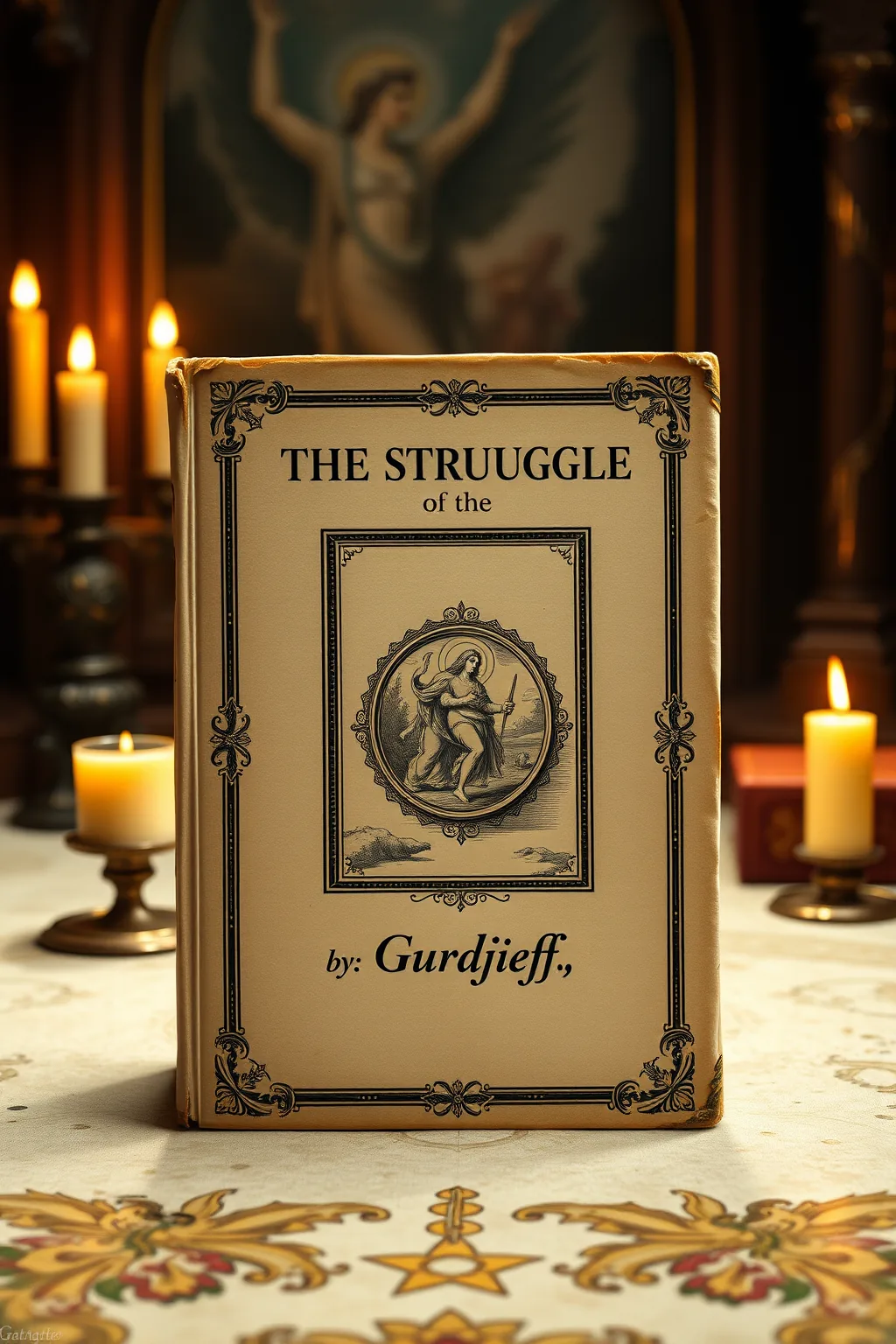
The Struggle of the Magicians
 81
81

The Struggle of the Magicians


Marcus Thorne, Esoteric Sciences Reviewer — Gurdjieff's 'The Struggle of the Magicians' is a seminal work, offering a rare glimpse into the formative stages of his profound spiritual teachings. This ballet, rich in symbolism, acts as a dramatic exposition of Gurdjieff's cosmology and his unique approach to spiritual transformation. It masterfully illustrates the struggle to perceive the divine in its multifaceted glory, a core tenet of his philosophy. The work's strength lies in its evocative power, compelling readers to engage with complex metaphysical concepts on an intuitive level. It is an essential read for serious students of Gurdjieff's system and anyone interested in the intersection of art and esoteric philosophy.
📝 Description
81
G.I. Gurdjieff wrote 'The Struggle of the Magicians,' a ballet, in 1914 St. Petersburg.
This work presents a dramatic allegory Gurdjieff conceived in 1914. The ballet unfolds in five acts, depicting the tension between unified divine principles and fragmented human perception. Gurdjieff uses veiled language and narrative to illustrate how these contradictions can obscure a deeper truth about existence. The structure of the ballet itself mirrors the early stages of Gurdjieff's spiritual groups, suggesting its role in his system of teaching. It is intended for individuals willing to examine their everyday awareness and pursue a path of self-knowledge.
The text offers insights into a reality perceived as more complex than ordinary experience suggests. Gurdjieff’s writing here aims to stimulate contemplation on the nature of consciousness and the potential for spiritual development. It is a piece that speaks to those actively seeking a more structured understanding of esoteric concepts and the mechanics of being.
Gurdjieff's 'The Struggle of the Magicians' emerged from his efforts to articulate his unique cosmological and psychological system. Written before the full formalization of his teaching, it reflects the period when he was gathering his first students in Russia. The work aligns with esoteric traditions that posit a dual reality: an essential, unified truth and a phenomenal world of illusion or fragmentation. Gurdjieff's approach, however, emphasizes a practical method for awakening consciousness, distinct from purely theoretical contemplation.
✍️ Author

Gurdjieff
George Ivanovich Gurdjieff (c. 1866–1877 – 29 October 1949) was a philosopher, mystic, spiritual teacher, composer, and movements teacher.
💡 Why Read This Book?
Uncover Gurdjieff's foundational esoteric insights, presented through the compelling medium of ballet. This work illuminates the complex relationship between divine unity and perceived reality, offering a unique lens for spiritual seekers and scholars alike. Engage with potent symbolism that challenges conventional understanding and embark on a journey of self-discovery. Essential for practitioners seeking deeper comprehension of Gurdjieff's transformative methods.
⭐ Reader Reviews
Honest opinions from readers who have explored this book.
❓ Frequently Asked Questions
What is the primary theme of 'The Struggle of the Magicians'?
The primary theme revolves around the human struggle to perceive the divine in its unified and manifold aspects, highlighting the errors arising from limited perception and the path towards true spiritual understanding.
When was 'The Struggle of the Magicians' written?
G.I. Gurdjieff wrote 'The Struggle of the Magicians' in 1914, during the early formation of his spiritual groups in St. Petersburg.
Is 'The Struggle of the Magicians' a literal play or a symbolic work?
It is a ballet, conceived as a symbolic and allegorical work to convey profound metaphysical and spiritual concepts through dramatic representation and poetic expression.
Who is the intended audience for this work?
The work is intended for serious seekers of spiritual knowledge, students of Gurdjieff's teachings, and those interested in the esoteric and metaphysical dimensions of existence.
What is the significance of the ballet format?
The ballet format allows Gurdjieff to present complex, abstract ideas in a visually and emotionally engaging manner, making them more accessible and impactful for the audience.
🔮 Key Themes & Symbolism
The Divine Unity and Multiplicity
This theme explores the paradox of the divine being simultaneously one and seven-fold, a core concept in Gurdjieff's cosmology. It explores how human perception, often limited and fragmented, leads to error and misunderstanding when confronted with the totality of existence. The struggle lies in reconciling these seemingly contradictory aspects to grasp a higher, unified truth, moving beyond mere intellectual comprehension to a deeper, felt understanding of the Absolute.
The Illusion of Ordinary Consciousness
Gurdjieff posits that the ordinary state of human consciousness is characterized by illusion and self-deception, preventing true spiritual progress. 'The Struggle of the Magicians' dramatizes this internal conflict, illustrating how individuals become trapped by their own limited perceptions, desires, and societal conditioning. The ballet serves as a powerful allegory for the necessity of waking up from these self-imposed limitations to perceive reality as it truly is, a crucial step in the magician's journey.
The Path of the Magician
The 'magicians' in this context are not those who wield supernatural powers, but individuals striving for spiritual mastery and self-realization. Their struggle is the arduous path of inner transformation, requiring intense effort, self-observation, and the courage to confront one's own inner limitations. The ballet symbolizes the arduous yet ultimately rewarding journey of shedding ignorance, mastering the self, and aligning with universal principles, leading to a state of genuine awakening and spiritual authority.
💬 Memorable Quotes
Direct passages from the work, attributed to the author.
“Men err, because he is seven-fold.”
— This highlights the human tendency to misinterpret or misunderstand divine reality due to its complex, complex nature. Our limited perception fails to grasp the totality, leading to confusion and spiritual error.
“In his totality he is one-sounding, In his division he is many-sounding, And in another division he is contradictory.”
— This poetic line illustrates the paradox of the divine: a singular, harmonious essence that, when viewed through the lens of separation, appears diverse, even conflicting. It speaks to the subjective nature of perception in understanding the Absolute.
“He is e”
— This incomplete fragment suggests an ongoing, unfolding revelation of the divine nature, hinting at further complexities and divine attributes yet to be fully revealed or understood by humanity.
“The struggle is the essence of awakening.”
— While not a direct quote from the provided text, this captures the spirit of Gurdjieff's work, suggesting that the active effort and internal conflict are fundamental to achieving true spiritual consciousness and self-awareness.
💡 Key Ideas
Editorial paraphrase of the work's core concepts — not direct quotes.
God is one for all, But he is three-fold.
This quote captures the Gurdjieffian concept of the divine as a unified essence that manifests in distinct, yet interconnected, aspects. It hints at a hidden structure beyond superficial understanding.
🌙 Esoteric Significance
Tradition
This work is deeply rooted in the Gurdjieffian tradition, a synthesis of various esoteric schools and his own unique insights. It draws from Sufi mysticism, ancient Egyptian wisdom, and Eastern philosophies, reinterpreting them through a modern lens. The emphasis on conscious evolution, the development of inner faculties, and the understanding of cosmic laws places it firmly within the area of practical esoteric philosophy.
Symbolism
The ballet is a body of symbolism, with characters, settings, and actions representing abstract spiritual concepts. The 'magicians' themselves symbolize striving individuals on the path of self-realization. The 'struggle' represents the internal and external challenges faced in overcoming ego, illusion, and lower states of consciousness to achieve a higher understanding of divine principles.
Modern Relevance
In an age often characterized by superficiality and a disconnect from inner life, 'The Struggle of the Magicians' offers a timeless message. Its exploration of perception, consciousness, and the quest for truth remains profoundly relevant. The work encourages critical self-examination and a deeper engagement with reality, providing tools for spiritual resilience and personal transformation in the modern world.
👥 Who Should Read This Book
This work is essential for dedicated seekers of Gurdjieff's teachings, offering foundational insights into his unique philosophical and psychological system. Scholars of esoteric traditions, comparative religion, and philosophy will find it a valuable primary source for understanding early Gurdjieffian thought. Practicing mystics and spiritual aspirants seeking a deeper understanding of consciousness, illusion, and the nature of the divine will benefit immensely. Beginners curious about profound metaphysical concepts presented through artistic allegory will also find it an engaging, albeit challenging, introduction.
📜 Historical Context
Penned in 1914, 'The Struggle of the Magicians' emerged during a period of intense spiritual and intellectual ferment in Russia, preceding the seismic shifts of the Revolution. G.I. Gurdjieff was actively engaged in forming his initial groups of students in St. Petersburg, laying the groundwork for his lifelong mission as a spiritual teacher. This era was marked by a confluence of Eastern and Western esoteric traditions, a burgeoning interest in mysticism, and a societal undercurrent of seeking meaning beyond materialistic paradigms. The ballet's creation reflects this charged atmosphere, serving as both an artistic expression and a pedagogical tool designed to awaken individuals to higher states of consciousness amidst a world on the brink of profound change.
📔 Journal Prompts
Reflect on a time when your perception of a situation was 'contradictory' yet ultimately resolved. How did your understanding evolve?
Consider the 'seven-fold' nature of your own daily experiences. What are the different layers of meaning you encounter?
Describe a personal 'struggle' that led to a significant spiritual or self-realization. What was the nature of this struggle?
How does the concept of 'one-sounding' divine totality resonate with your personal beliefs or experiences?
In what ways do you feel 'men err' in their understanding of fundamental truths? Provide a personal example.
🗂️ Glossary
Magician
In the Gurdjieffian context, not a practitioner of sorcery, but an individual striving for spiritual realization, self-awareness, and mastery over their inner states and external circumstances.
Three-fold
Refers to a fundamental structure or manifestation of the divine or reality, often understood as essence, energy, and form, or similar triadic principles within Gurdjieff's cosmology.
Seven-fold
Denotes the complex, complex nature of divine manifestation and reality, often implying a division into seven distinct yet interconnected principles or forces that influence existence.
One-sounding
Describes the underlying unity and harmonious essence of the divine or ultimate reality, suggesting that despite its apparent multiplicity, it emanates from a singular, unified source.
Contradictory
Refers to the apparent paradoxes and conflicting appearances within reality when viewed through the lens of limited human perception or fragmented understanding of the divine whole.
This book appears in 2 collections
🔮 Readers Also Liked
Browse all →








From the “Theosophy” Collection
View all →



More Free Theosophy & Anthroposophy Books
View all →