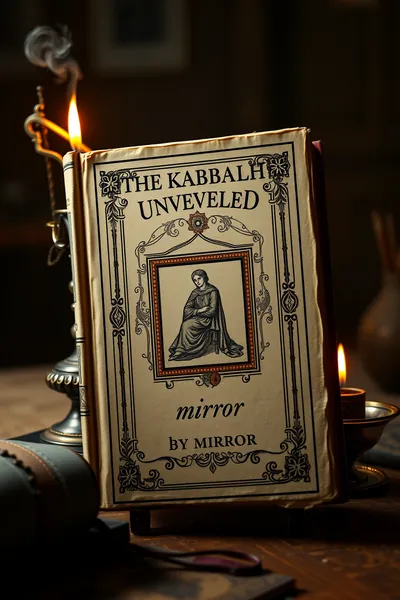
The Kabbalah And The Talmud - Pamphlet

 61
61

The Kabbalah And The Talmud - Pamphlet


Celeste Moreau (Divination & Symbolism Reviewer) — Charles William King's 'The Kabbalah And The Talmud' is a jewel of esoteric condensation. King possesses a rare talent for distilling profound Kabbalistic concepts into an easily digestible yet deeply resonant form. He expertly navigates the symbolic lexicon, offering illuminating insights into the Sephirotic Tree and its connection to Talmudic exegesis. This pamphlet is an indispensable resource for neophytes eager to grasp the foundational principles of Jewish mysticism, providing a clear and authoritative introduction. Its brevity belies its intellectual weight, making it an ideal companion for both solitary study and group exploration into these ancient, sacred texts.
📝 Description
61
Charles William King's 1889 pamphlet connects Kabbalah's mystical ideas with the Talmud's legal and ethical teachings.
Charles William King's pamphlet, 'The Kabbalah And The Talmud,' published in 1889, examines the relationship between Jewish mysticism and rabbinic literature. King focuses on how Kabbalistic concepts, such as divine emanations and the structure of the cosmos, are reflected in or can be understood through the Talmud. He attempts to make these complex ideas accessible to a general audience, outlining the symbolic language and philosophical foundations of Kabbalah.
The work covers key Kabbalistic notions like the sefirot, the ten divine attributes through which God is said to manifest, and the concept of the soul's journey. King also touches upon the Talmud's role as a source and context for these mystical traditions. The pamphlet aims to provide a clear introduction for those interested in Jewish esoteric thought without requiring prior deep knowledge of either subject.
This pamphlet situates itself within the study of Jewish mysticism, specifically Kabbalah, which developed centuries after the compilation of the Talmud. Kabbalah seeks to understand the divine nature and creation through esoteric interpretations of scripture and tradition. King's work bridges the gap between the rabbinic legal and narrative corpus of the Talmud and the more speculative, mystical teachings of Kabbalah, suggesting a continuity or interconnectedness between these two major streams of Jewish thought. It reflects an early 20th-century interest in making such esoteric traditions accessible to a wider readership.
💡 Why Read This Book?
Embark on a concise yet transformative journey into the heart of Jewish mysticism. 'The Kabbalah And The Talmud' offers a clear and compelling introduction to esoteric Kabbalistic principles and their rich connection to the Talmud. Ideal for seekers of hidden knowledge, students of comparative religion, and practitioners of contemplative arts who wish to explore the profound symbolic language and philosophical depth of this ancient tradition without overwhelming complexity.
⭐ Reader Reviews
Honest opinions from readers who have explored this book.
❓ Frequently Asked Questions
What is the primary focus of this pamphlet?
The pamphlet primarily focuses on introducing the fundamental concepts of Kabbalah and exploring its intricate relationship with the wisdom found within the Talmud, highlighting their shared esoteric dimensions.
Is this book suitable for beginners in Kabbalah?
Yes, it is exceptionally well-suited for beginners. King's writing is clear and accessible, providing a solid foundational understanding without requiring prior extensive knowledge of Jewish mysticism.
Does the pamphlet delve into specific Kabbalistic texts?
While not a deep textual analysis, it introduces key Kabbalistic ideas and their resonance with the broader teachings found in the Talmud, serving as an excellent primer for further study.
What is the historical significance of this work?
It offers insight into the scholarship and popularization of Kabbalistic thought during the period of its publication, making ancient esoteric traditions more accessible to a wider audience.
Can this pamphlet be used for personal spiritual practice?
Indeed. Its contemplative tone and emphasis on symbolic interpretation can inspire personal reflection and deepen one's understanding of spiritual interconnectedness and the divine.
🔮 Key Themes & Symbolism
The Tree of Life and Divine Emanations
This pamphlet illuminates the central Kabbalistic concept of the Tree of Life (Etz Chaim), a divine blueprint representing the ten emanations (Sephirot) through which the infinite Godhead (Ein Sof) reveals itself to creation. King explores how these Sephirot, from Keter (Crown) to Malkuth (Kingdom), form a pathway of divine energy and consciousness, linking the celestial realms to the earthly plane. The intricate symbolism of this cosmic structure offers a profound framework for understanding creation, the human soul, and the potential for spiritual ascent, inviting contemplation on the interconnectedness of all existence through divine grace.
Talmudic Foundations of Esoteric Thought
Beyond its mystical doctrines, the pamphlet emphasizes the deep roots of Kabbalistic thought within the vast corpus of the Talmud. King illustrates how the seemingly legalistic and narrative discussions within the Talmud often contain layers of hidden meaning, Gematria (numerical mysticism), and allegorical interpretations that foreshadow or directly inform Kabbalistic cosmology. This connection highlights the Talmud not merely as a legal compendium but as a rich source of esoteric wisdom, demonstrating that the pursuit of divine understanding was an integral part of rabbinic discourse, providing a fertile ground for the development of Jewish mysticism.
The Ascent of the Soul and Divine Illumination
A core theme explored is the Kabbalistic notion of the soul's journey towards divine illumination and reunion with the Godhead. King touches upon the stages of spiritual development, the purification of the self, and the practices, both intellectual and contemplative, that facilitate this ascent. The pamphlet suggests that through understanding the divine order and one's place within it, as revealed by Kabbalah and the Talmud, individuals can achieve higher states of consciousness and experience direct communion with the divine, transforming the mundane into the sacred and realizing their inherent spiritual potential.
💬 Memorable Quotes
Direct passages from the work, attributed to the author.
“Within the ancient words, cosmic truths lie dormant.”
— This highlights the idea that profound spiritual and metaphysical insights are embedded within traditional texts, waiting to be awakened and understood by those who delve beneath the surface meaning.
“The Sephirot form a ladder to the divine.”
— This succinctly captures the essence of the Tree of Life as a symbolic map for spiritual progression, illustrating how each divine emanation serves as a step in the soul's journey back to its source.
“Symbolism is the language of the soul.”
— This points to the profound importance of symbolic interpretation in esoteric traditions, suggesting that symbols provide a direct means of communication and understanding for the deeper, non-rational aspects of human consciousness.
“The Talmud, a rich source of veiled mysteries.”
— This emphasizes that the seemingly legalistic and narrative content of the Talmud conceals deeper, esoteric meanings that are crucial for a complete understanding of Jewish mystical thought.
💡 Key Ideas
Editorial paraphrase of the work's core concepts — not direct quotes.
The hidden paths of wisdom are revealed to the diligent seeker.
This quote emphasizes the active role of the student in uncovering esoteric knowledge, suggesting that divine truths are not passively received but actively pursued through dedicated study and contemplation.
🌙 Esoteric Significance
Tradition
This work is firmly rooted in the Western Esoteric Tradition, specifically within the framework of Jewish Kabbalah. It explores the mystical dimension of Judaism, focusing on the divine emanations, the structure of the cosmos, and the path of spiritual ascent as understood through ancient Hebrew texts. The pamphlet serves as an introduction to this rich and complex lineage, offering insights into the hidden meanings and symbolic interpretations that are central to Kabbalistic practice and philosophy.
Symbolism
The pamphlet explores key Kabbalistic symbols, most notably the Sephirotic Tree, which represents the divine attributes and the flow of creation. It also touches upon the symbolic significance of Hebrew letters, divine names, and the allegorical interpretations found within the Talmud. These symbols are not merely decorative but are understood as keys to unlocking deeper levels of reality, consciousness, and the divine presence, serving as a visual and conceptual language for esoteric understanding.
Modern Relevance
Despite its historical origins, the wisdom presented in 'The Kabbalah And The Talmud' remains profoundly relevant. The exploration of consciousness, the nature of reality, and the human soul's journey towards spiritual fulfillment resonates deeply with contemporary seekers. In an age often characterized by materialism and existential questioning, the Kabbalistic emphasis on interconnectedness, divine immanence, and the pursuit of inner wisdom offers a powerful counterpoint and a timeless path to spiritual growth and self-discovery.
👥 Who Should Read This Book
This pamphlet is an invaluable resource for a diverse range of readers. **Beginners** in Kabbalah will find it an accessible and clear entry point, providing foundational concepts without overwhelming complexity. **Scholars and students of comparative religion** will appreciate its concise overview and its emphasis on the interrelationship between major Jewish texts. **Spiritual seekers** drawn to esoteric traditions will discover clear insights into divine wisdom and the nature of reality. **Practitioners of contemplative arts** may find inspiration in its exploration of symbolism and the ascent of consciousness, offering new dimensions for their personal spiritual journeys.
📜 Historical Context
Published during an era of burgeoning interest in comparative religion and esoteric traditions, Charles William King's 'The Kabbalah And The Talmud' emerged as a valuable contribution to making complex mystical thought accessible. The late 19th and early 20th centuries witnessed a widespread fascination with ancient wisdom, occultism, and the spiritual underpinnings of various cultures. Scholars and enthusiasts alike sought to bridge the gap between academic study and personal spiritual exploration. This pamphlet, by focusing on the interrelationship between Kabbalah and the Talmud, reflects this broader intellectual current, aiming to explain Jewish mysticism and present it as a profound philosophical and spiritual system relevant to the modern seeker, continuing the legacy of earlier scholars who translated and interpreted these sacred texts.
📔 Journal Prompts
Reflect on the concept of divine emanations (Sephirot) and how they might manifest in your own life.
Consider a passage from the Talmud or a Jewish scripture and explore its potential symbolic or esoteric meaning.
How can the understanding of hidden knowledge empower personal growth and spiritual awareness?
Meditate on the idea of the soul's ascent; what steps can you take to move closer to your own spiritual aspirations?
Explore the relationship between outward forms (like text) and inner realities (like mysticism) in your own experiences.
🗂️ Glossary
Kabbalah
An esoteric tradition of Jewish mysticism that seeks to understand the nature of God, the universe, and the human soul through mystical contemplation and the interpretation of sacred texts.
Talmud
A central text of Rabbinic Judaism, comprising legal discussions, ethical teachings, and legendary narratives, considered a primary source of Jewish religious law and tradition.
Sephirot
The ten divine emanations or attributes through which the infinite Godhead (Ein Sof) is believed to manifest and interact with the created universe, forming the structure of the Kabbalistic Tree of Life.
Ein Sof
A Kabbalistic term meaning 'Without End' or 'Infinite,' referring to the unknowable, transcendent aspect of God that exists beyond all comprehension and manifestation.
Gematria
A method of interpreting Hebrew scriptures by assigning numerical values to letters and words, seeking hidden meanings and connections based on these equivalences.
This book appears in 1 collection
🔮 Readers Also Liked
Browse all →








More by Charles William King
All books →




From the “Kabbalah” Collection
View all →








More Free Kabbalah & Jewish Mysticism Books
View all →