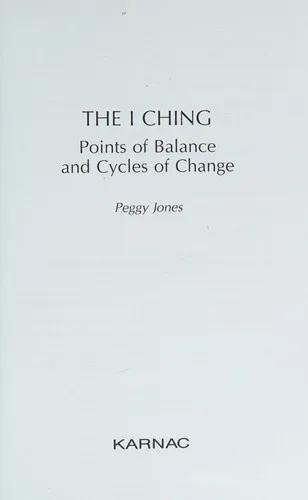
The I ching
 63
63

The I ching



Peggy Jones's rendition of the I Ching is a luminous beacon for the modern esoteric practitioner. Moving beyond simplistic fortune-telling, Jones masterfully translates the oracle's deep psychological currents, aligning its ancient wisdom with contemporary Jungian thought. Her lucid prose unveils the profound symbolism within each hexagram, offering unparalleled guidance for navigating personal transformation and achieving inner harmony. This is not merely a translation, but a profound reinterpretation, essential for serious students of divination, psychology, and the perennial philosophy. A truly invaluable addition to any serious occultist's library.
📝 Description
63
Peggy Jones's 1994 translation of the I Ching connects its hexagrams to Jungian psychology.
Peggy Jones, a Jungian analyst, translated the I Ching in 1994, focusing on its psychological dimensions. She treated the sixty-four hexagrams not as fortune-telling devices, but as representations of internal states and developmental processes. Jones's interpretation emphasizes how the I Ching's symbolic language can illuminate an individual's inner life and guide them toward greater self-awareness.
This edition aims to make the oracle accessible to contemporary readers. Jones's prose seeks to reveal the patterns and energies that influence human experience. The book offers a framework for understanding personal growth and finding balance through the I Ching's structured wisdom. It connects the ancient text to modern psychological concepts.
The I Ching, or Book of Changes, is one of the oldest Chinese classics, dating back over three millennia. It functions as a system of divination and a philosophical text, charting the dynamics of change in the cosmos and human affairs. Its sixty-four hexagrams, formed by combinations of yin and yang lines, represent archetypal situations and processes. Throughout history, various schools of thought have interpreted the I Ching, from Confucian commentaries on ethics and governance to Taoist insights on natural flow and balance, and more recently, psychological readings.
💡 Why Read This Book?
Embark on a journey of self-discovery with this insightful I Ching. Ideal for seekers of psychological depth, practitioners of ancient wisdom, and scholars of esoteric traditions. Discover profound guidance for navigating life's transitions, understanding subtle energies, and fostering inner balance through its lucid, psychologically resonant interpretations. Unlock the secrets of change and transformation.
⭐ Reader Reviews
Honest opinions from readers who have explored this book.
❓ Frequently Asked Questions
What makes Peggy Jones's I Ching translation unique?
Jones, a Jungian analyst, infuses the text with psychological depth, making the ancient oracle's wisdom accessible and directly applicable to contemporary inner and outer life challenges, focusing on balance and transformation.
Is this book suitable for beginners in divination?
Yes, while rich in esoteric depth, its clear language and psychological framing make it an excellent entry point for those new to the I Ching, offering practical guidance alongside profound contemplation.
How does this version connect to Jungian psychology?
Jones interprets the hexagrams and their associated texts through the lens of archetypes, the collective unconscious, and individuation, revealing the I Ching as a tool for psychological integration and self-awareness.
What is the core philosophy of the I Ching as presented here?
The core philosophy emphasizes the constant flux of existence and the importance of understanding these changes to maintain psychological equilibrium and navigate life's challenges with wisdom and insight.
Can this I Ching be used for daily guidance?
Absolutely. Its clear, insightful interpretations provide a powerful framework for daily reflection, decision-making, and understanding the subtle influences at play in one's life.
🔮 Key Themes & Symbolism
The Dance of Change and Stability
This edition illuminates the I Ching's central theme: the perpetual motion of the cosmos and the human experience. It reveals how understanding the dynamics of change, represented by the sixty-four hexagrams, is crucial for cultivating inner stability. Jones's psychological approach helps readers recognize patterns of transformation in their lives, enabling them to adapt with grace and wisdom, rather than resisting the inevitable ebb and flow of existence. It's a profound exploration of how to find equilibrium amidst constant flux.
The Oracle of the Psyche
Peggy Jones masterfully unveils the I Ching as a mirror to the soul, deeply rooted in Jungian archetypes and the collective unconscious. The hexagrams become potent symbols of psychological states, inner conflicts, and developmental pathways. This perspective transforms the ancient oracle into a sophisticated tool for self-exploration, helping readers understand their own inner landscapes, confront shadow aspects, and start the journey of individuation. It speaks to the hidden wisdom residing within the human psyche.
Symbolic Language of the Cosmos
The I Ching's power lies in its intricate range of symbols, from the dualistic nature of Yin and Yang to the nuanced imagery of each hexagram. Jones's interpretation breathes life into these ancient signs, revealing their profound connections to natural phenomena, human relationships, and spiritual truths. Readers are guided to perceive the underlying order and meaning within apparent chaos, understanding how the universe communicates its intentions through this rich, symbolic language. It's an invitation to read the whispers of the cosmos.
💬 Memorable Quotes
Direct passages from the work, attributed to the author.
“In the heart of change lies the seed of balance.”
— This highlights the central paradox of the I Ching: that true stability is found not in resistance to change, but in understanding and harmonizing with its inherent flow.
“The oracle speaks to the present moment, reflecting our deepest truths.”
— This underscores the I Ching's relevance and its capacity to provide immediate, insightful guidance by tapping into the subconscious and the current energies of the querent.
“To consult the I Ching is to engage in a dialogue with the universe.”
— This suggests a reciprocal and spiritual relationship with the oracle, positioning it as a sacred tool for communion and seeking higher wisdom beyond the mundane.
“Psychological balance is the ultimate form of divination.”
— This provocative statement elevates inner harmony and self-awareness to the highest form of insight, suggesting that true foresight comes from a centered and integrated self.
💡 Key Ideas
Editorial paraphrase of the work's core concepts — not direct quotes.
The hexagrams are not predictions, but maps of the soul's journey.
This quote emphasizes the book's focus on internal processes and personal growth, framing the I Ching as a guide for self-understanding rather than a deterministic fortune-telling device.
🌙 Esoteric Significance
Tradition
The I Ching is a foundational text within Chinese esoteric traditions, particularly Taoism and later syncretic forms of Chinese folk religion and occultism. Its principles of Yin and Yang, the Five Elements, and the cyclical nature of transformation are central to understanding cosmic order and human destiny. It's viewed as a living oracle, a conduit for celestial energies and archetypal patterns that govern both the macrocosm and the microcosm of the individual soul.
Symbolism
At its heart, the I Ching employs a rich symbolic language. The binary system of broken (Yin) and solid (Yang) lines forms trigrams, which are then combined into sixty-four hexagrams, each representing a fundamental situation or stage of development. These hexagrams, along with their associated imagery and commentary, symbolize universal forces, natural phenomena, human relationships, and psychological states, offering a profound symbolic map of existence.
Modern Relevance
In the modern era, the I Ching's relevance has expanded beyond its traditional cultural context. Its emphasis on adaptability, understanding change, and fostering psychological balance resonates deeply in a rapidly evolving world. Peggy Jones’s Jungian interpretation further bridges the gap, making its ancient wisdom accessible to contemporary seekers grappling with existential questions, personal growth, and the complexities of the human psyche.
👥 Who Should Read This Book
This edition of the I Ching is a treasure for a wide spectrum of readers. For **beginners** seeking an accessible yet profound introduction to divination and ancient wisdom, Jones's clear prose and psychological framing are invaluable. **Scholars** of Eastern philosophy, Jungian psychology, and comparative religion will find a rigorous and insightful reinterpretation. **Spiritual seekers** yearning for deeper self-understanding and guidance on their life's journey will discover a potent oracle. **Practitioners** of divination, tarot, and other esoteric arts will appreciate its unique perspective on archetypal patterns and symbolic interpretation.
📜 Historical Context
The I Ching, or 'Book of Changes,' is one of the oldest and most revered texts in Chinese civilization, with roots stretching back thousands of years. Its origins are deeply intertwined with ancient Chinese cosmology, philosophy, and early forms of divination. Originally used for augury and to understand the natural world, it evolved into a sophisticated philosophical work, particularly during the Zhou Dynasty and later influenced by Confucian and Taoist thought. Its profound exploration of change, duality (Yin and Yang), and the cyclical nature of existence has made it a core part of East Asian intellectual and spiritual traditions. The text's enduring appeal lies in its ability to offer guidance and insight across diverse eras and cultural contexts, making it a perennial source of wisdom.
📔 Journal Prompts
Reflect on a recent situation where you felt out of balance. How might the principles of Yin and Yang apply?
Consider a hexagram that has appeared for you recently. What psychological patterns or archetypes does it reveal in your life?
How does the concept of 'constant change' from the I Ching challenge or affirm your current worldview?
What does it mean to you to engage in a 'dialogue with the universe' through a text like the I Ching?
Identify a personal 'transformation' you are currently undergoing. What are the emerging 'seeds of balance' within this change?
🗂️ Glossary
Hexagram
A figure composed of six stacked horizontal lines, where each line is either solid (Yang) or broken (Yin). There are 64 unique hexagrams in the I Ching, each representing a specific state or situation.
Trigram
A figure composed of three stacked horizontal lines, each being either solid (Yang) or broken (Yin). There are eight basic trigrams, which are the building blocks of the hexagrams.
Yin
In the I Ching and Chinese philosophy, Yin represents the passive, feminine, dark, receptive, and yielding principle. It is often associated with the moon, water, and the earth.
Yang
In the I Ching and Chinese philosophy, Yang represents the active, masculine, light, assertive, and creative principle. It is often associated with the sun, fire, and the heavens.
Divination
The practice of seeking knowledge of the future or the unknown by supernatural means. In the context of the I Ching, it involves consulting the oracle to gain insight into current situations and potential outcomes.
This book appears in 3 collections
🔮 Readers Also Liked
Browse all →









From the “Tarot” Collection
View all →









More Free Divination & Tarot Books
View all →