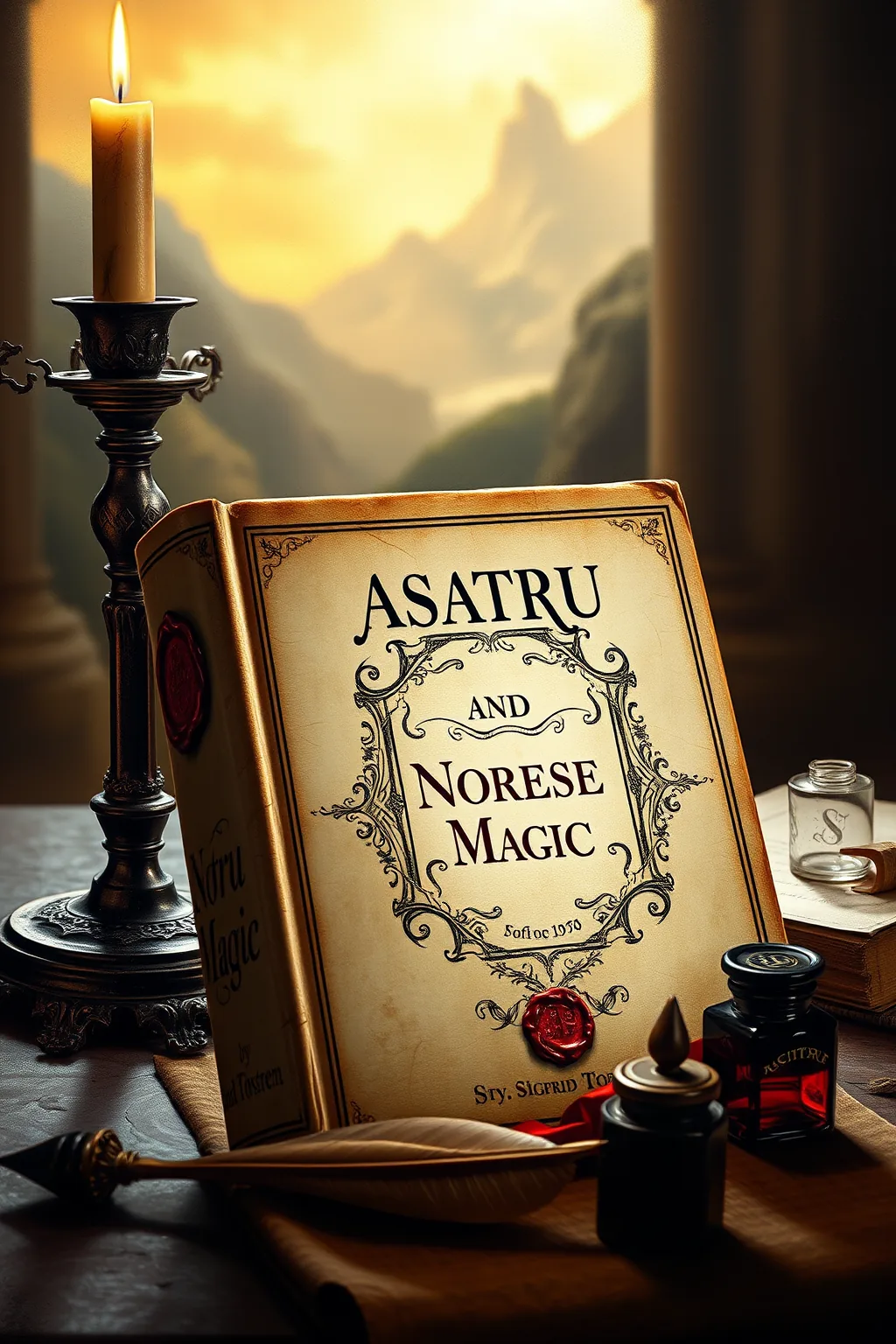
Asatru and Norse Magic
 62
62

Asatru and Norse Magic



Sigfrid Torsten's 'Asatru and Norse Magic' is a luminous exposition of a vital spiritual tradition. Torsten masterfully deciphers the intricate symbolism of runes and the ethereal currents of seidr, offering practitioners a rare glimpse into potent, often misunderstood, magical arts. The book eschews superficiality, delving into the philosophical core of Asatru with scholarly rigor and intuitive depth. Its strength lies in its ability to bridge the gap between historical understanding and practical application, making complex concepts accessible without sacrificing their profound esoteric essence. This volume is an indispensable resource for anyone seeking to connect with the ancestral magic of the North, be they neophyte or seasoned adept.
📝 Description
62
Sigfrid Torsten's 'Asatru and Norse Magic' details the philosophy and practice of Norse paganism.
This book examines the core beliefs and magical practices associated with Asatru, the modern revival of Norse paganism. Sigfrid Torsten discusses the gods of the Æsir and Vanir, the meaning and use of runes, and the practice of seidr, a form of Norse magic. The text also covers the cosmology of the Nine Worlds and the symbolism inherent in Norse mythology. Torsten aims to illuminate the philosophical foundations of Asatru, including its cyclical view of time, concepts of fate, and the responsible use of magical power.
The author presents Asatru not merely as a historical subject but as a living tradition. It connects the reader to primal energies and ancient narratives, suggesting a thinness between the mortal world and the divine. The book is written for individuals interested in esoteric knowledge and ancestral magic.
Asatru and Norse Magic sits within the broader category of modern pagan revivalism, specifically focusing on the reconstruction and practice of pre-Christian Norse religious beliefs. Unlike academic historical studies, this work engages with the spiritual and magical dimensions of these traditions. It connects contemporary practitioners to ancient myths and deities, emphasizing the experiential and personal relationship with the divine. The book draws upon a range of sources, from historical sagas to contemporary magical theory, to inform its approach to ritual and cosmology.
💡 Why Read This Book?
Uncover the potent magic of the Norse gods and runes. 'Asatru and Norse Magic' offers a deep dive into ancient practices, revealing hidden symbolism and esoteric wisdom. Ideal for spiritual seekers, historical enthusiasts, and practitioners of folk magic yearning for a tangible connection to ancestral power and a rich metaphysical framework.
⭐ Reader Reviews
Honest opinions from readers who have explored this book.
❓ Frequently Asked Questions
What is Asatru?
Asatru, meaning 'faith in the Æsir,' is a modern revival of the pre-Christian Germanic and Norse pagan religions. It centers on the worship of the Norse gods and goddesses, embracing their mythology and ethical values.
What are runes, and how are they used in Norse magic?
Runes are ancient Germanic alphabets, each with a name, symbol, and deeper esoteric meaning. They are used for divination, spellcraft, and as conduits of magical energy, representing cosmic forces and archetypes.
What is seidr magic?
Seidr is a form of Norse shamanic magic, often associated with prophecy, fate-weaving, and spirit journeys. It involves altered states of consciousness to interact with spiritual realms and influence events.
Is this book suitable for beginners interested in Norse mythology?
Yes, while it delves into advanced magical practices, the foundational elements of Norse mythology and Asatru are presented clearly, making it accessible for those new to the subject matter.
Does the book offer practical exercises for magic?
Indeed. The book provides practical guidance and exercises for engaging with runic divination, seidr techniques, and other magical practices, fostering a hands-on approach to learning.
🔮 Key Themes & Symbolism
Runic Divination and Wisdom
This section illuminates the profound significance of the Elder Futhark, delving beyond mere alphabetical symbols to reveal their archetypal meanings and divinatory applications. Torsten explores how each rune acts as a key to unlocking cosmic principles, personal insights, and the intricate range of fate. Readers will learn to interpret the whispers of the runes, not just as predictive tools, but as guides for self-understanding and spiritual growth, connecting them to the primal forces that shape existence and offering a roadmap for navigating life's challenges with ancient wisdom.
The Art and Practice of Seidr
Here, the ethereal and transformative practice of seidr is unveiled. Torsten guides the reader through the esoteric principles of this ancient Norse shamanism, detailing its connection to prophecy, spirit work, and the manipulation of fate. Emphasis is placed on the spiritual journey, the development of inner sight, and the ethical considerations of wielding such potent energies. This exploration provides a framework for understanding seidr not as a mere historical curiosity, but as a living tradition capable of profound personal and spiritual transformation for dedicated practitioners.
Cosmology and Mythology of the Nine Worlds
This theme studies the intricate cosmology of the Norse pantheon and the interconnectedness of the Nine Worlds. Torsten illuminates the detailed symbolism embedded within the myths of gods like Odin, Thor, and Freyja, and the giants and other beings. It explores the cyclical nature of existence, the concept of fate (Wyrd), and the underlying philosophical worldview of Asatru. Understanding this cosmic framework is presented as essential for grasping the context and power of Norse magic, offering a profound perspective on humanity's place in the universe.
💬 Memorable Quotes
Direct passages from the work, attributed to the author.
“Seidr combines the threads of fate, but with respect for the pattern.”
— Highlights the power and responsibility inherent in seidr, suggesting it allows influence over destiny while acknowledging the importance of cosmic order and ethical practice.
“In the heart of the storm, find the stillness of the Well.”
— A metaphorical call to find inner peace and spiritual grounding amidst chaos, drawing a parallel to ancient Norse concepts of cosmic wells and primal energies.
“The Ancestors speak in the rustle of leaves and the howl of the wind.”
— Suggests that spiritual connection and guidance from ancestral spirits can be found in the natural world, encouraging attunement to subtle environmental cues.
“To know yourself is to know the gods within.”
— Points to the inward journey of self-discovery as a path to understanding the divine, reflecting a core tenet of many esoteric traditions.
💡 Key Ideas
Editorial paraphrase of the work's core concepts — not direct quotes.
The runes are not mere letters, but keys to the cosmos.
This quote emphasizes the esoteric nature of runes, suggesting they are more than just an alphabet, but symbolic gateways to understanding universal laws and hidden knowledge.
🌙 Esoteric Significance
Tradition
This work is firmly rooted in the Germanic pagan tradition, specifically the revival known as Asatru. It encompasses the pre-Christian spiritual beliefs and practices of the Norse and Germanic peoples. Its esoteric significance lies in its reinterpretation and active practice of ancient magic, divination, and cosmology, offering a path to connect with the divine through the pantheon of the Æsir and Vanir, and the fundamental forces of nature.
Symbolism
The symbolism within Norse magic is profound and many-sided. Runes, as described in the book, are potent sigils representing cosmic forces, archetypes, and principles of creation and destruction. The Yggdrasil, the World Tree, serves as a central symbol of interconnectedness, linking the Nine Worlds and representing the cycle of life, death, and rebirth. Other symbols like Mjolnir (Thor's hammer) represent protection and power, while the Valknut signifies Odin and the passage of souls.
Modern Relevance
In an era often characterized by spiritual seeking and a desire for authentic connection, 'Asatru and Norse Magic' offers a potent and relevant path. It provides a framework for understanding and engaging with ancestral spiritual traditions, fostering a deep connection to nature, and exploring powerful archetypal energies. The book's emphasis on personal responsibility, self-reliance, and the cyclical nature of existence appeals to modern challenges, offering practical tools for divination, personal growth, and spiritual resilience.
👥 Who Should Read This Book
This book is a valuable collection for a diverse audience. **Beginners** curious about Norse mythology and paganism will find clear introductions to core concepts. **Spiritual seekers** desiring a connection to ancestral traditions and nature-based spirituality will be drawn to its depth and authenticity. **Practitioners of magic** looking to expand their repertoire with ancient runic and shamanic techniques will find valuable, actionable guidance. **Scholars and enthusiasts** of mythology, folklore, and esoteric history will appreciate the meticulous research and insightful interpretations presented within its pages.
📜 Historical Context
Emerging from the collection of Germanic and Scandinavian paganism, Asatru experienced a significant revival in the 20th century, offering a spiritual alternative to dominant monotheistic religions. Sigfrid Torsten's work is situated within this modern re-emergence, drawing upon ancient Eddic poetry, sagas, archaeological findings, and the interpretations of early scholars like Guido von List and Ernst E. Dietrich. The book bridges the gap between historical reconstruction and contemporary spiritual practice, acknowledging the societal shifts that led to the decline of indigenous European faiths and the subsequent desire to reclaim ancestral heritage and esoteric knowledge. It speaks to a post-industrial, often dislocated, modern world seeking grounded, nature-connected spirituality and a connection to primal, untamed forces.
📔 Journal Prompts
Reflect on a rune that appeals to your current life situation and explore its deeper meaning.
Describe a dream or vision that felt imbued with Norse mythological imagery. What message might it hold?
Imagine you are combining seidr. What energies are you calling upon, and for what purpose?
Consider the concept of Wyrd (fate) in your life. How do you perceive its influence and your agency within it?
Write a letter to one of the Norse gods or goddesses, expressing your questions, devotion, or seeking guidance.
🗂️ Glossary
Æsir
The principal pantheon of gods in Norse mythology, residing in Asgard. They are often associated with power, war, and cosmic order, including figures like Odin, Thor, and Frigg.
Vanir
A second pantheon of gods in Norse mythology, often associated with fertility, prosperity, and magic. Notable Vanir include Freyr, Freyja, and Njord.
Wyrd
The Norse concept of fate or destiny. It is a complex notion suggesting a range of past, present, and future events, influenced by the actions of gods, humans, and the Norns (fates).
Nine Worlds
The cosmologically significant realms interconnected by the World Tree, Yggdrasil. These include Asgard (gods), Midgard (humans), Jotunheim (giants), and others, each with its unique characteristics.
Blót
A ritual sacrifice or offering in Norse paganism, typically involving blood from animals or symbolic offerings, performed to honor the gods, ancestors, or spirits, and to ensure prosperity or favor.
This book appears in 3 collections
🔮 Readers Also Liked
Browse all →
More by Sigfrid Torsten
All books →
From the “Tarot” Collection
View all →

More Free Divination & Tarot Books
View all →
![The history of England from the accession of James the Second [2/5]](/img/thumb/the-history-of-england-from-the-accession-of-james-the-second-2-5-thomas-babington-macaulay.webp)