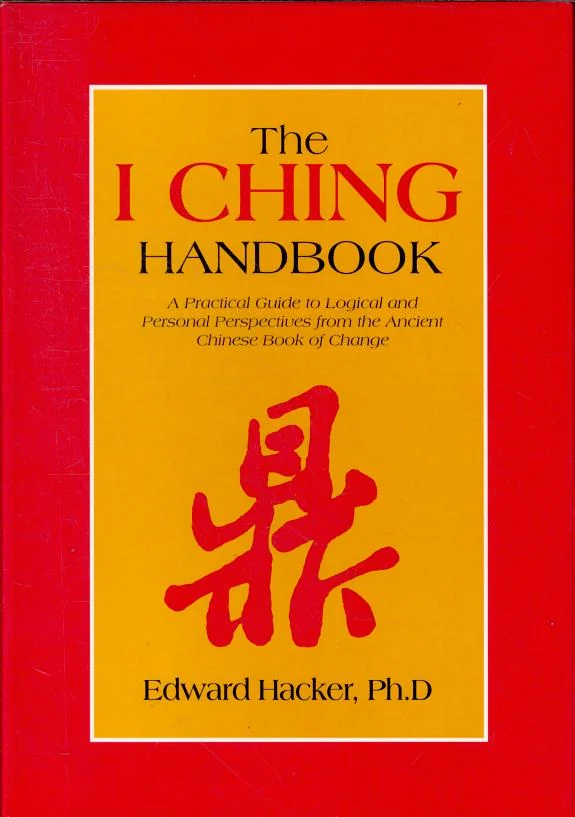
The I Ching Handbook
 76
76

The I Ching Handbook
Edward A. Hacker’s 'The I Ching Handbook' succeeds admirably in its stated goal: to serve as a thorough compendium for the 'Book of Changes.' The work’s strength lies in its systematic approach, breaking down the intricate symbolism and philosophical layers of this nearly 3000-year-old classic. Hacker’s 1993 publication provides a valuable synthesis of information that feels both scholarly and accessible. However, the handbook occasionally leans towards academic dryness, which might deter readers seeking a more immediately intuitive or divinatory experience. A particularly illustrative section details the interpretation of the 64 hexagrams, offering a structured method for understanding their varied meanings. While not a replacement for direct engagement with the 'I Ching' itself, Hacker’s guide offers a robust framework for study.
📝 Description
76
Edward A. Hacker's 'The I Ching Handbook' (1993) translates ancient Chinese divination for Western readers.
Published in 1993, Edward A. Hacker's 'The I Ching Handbook' serves as a practical guide to the ancient Chinese text. It aims to make the 'Book of Changes' understandable for a modern Western audience by compiling study aids and current information. The handbook is for those who want to go beyond simple interpretations and seek deeper meaning. It is useful for students of Chinese philosophy, divination practitioners, comparative religion enthusiasts, and anyone facing personal or philosophical questions who believes ancient texts can offer guidance.
Hacker's work appeared during a time of growing Western interest in Eastern philosophies. The 'I Ching,' with roots stretching back nearly three millennia, was already recognized in Western scholarship, notably through translations by Richard Wilhelm. Hacker sought to consolidate existing knowledge and offer usable methods for engaging with the text.
Hacker's handbook enters the Western esoteric tradition by demystifying the 'I Ching,' a central text in Chinese cosmology and philosophy. Its origins are tied to ancient Chinese divination practices and Taoist thought, which influenced its development as a system of insight and foresight. The book positions the 'I Ching' not just as a historical artifact but as a living system for understanding human experience and guiding personal decisions, reflecting a broader esoteric interest in applying ancient symbolic systems to modern life.
💡 Why Read This Book?
• You will learn a systematic method for interpreting the 64 hexagrams, a core element of the 'I Ching,' as detailed in Hacker's 1993 handbook, enabling structured divination. • You will gain an understanding of the Taoist philosophical underpinnings that inform the 'I Ching,' as explored in the text, providing a deeper context beyond mere fortune-telling. • You will discover practical applications for the 'I Ching' in resolving modern personal, social, and philosophical dilemmas, as presented through Hacker's analysis of its multi-metaphorical themes.
⭐ Reader Reviews
Honest opinions from readers who have explored this book.
❓ Frequently Asked Questions
What is the 'I Ching' and why is it significant?
The 'I Ching,' or 'Book of Changes,' is an ancient Chinese classic, nearly 3000 years old, renowned for its wisdom on personal, social, and philosophical matters. Its significance lies in its enduring applicability and its multi-metaphorical approach to understanding life's challenges.
Who was Edward A. Hacker and what is his contribution?
Edward A. Hacker authored 'The I Ching Handbook,' first published in 1993. His contribution is a comprehensive study aid that synthesizes information about the 'I Ching,' making its complex wisdom more accessible to a Western readership.
When was 'The I Ching Handbook' first published?
'The I Ching Handbook' by Edward A. Hacker was first published in 1993, offering contemporary readers a structured approach to the ancient Chinese classic.
What kind of information can I expect in Hacker's 'I Ching Handbook'?
The handbook provides study aids and state-of-the-art information on the 'I Ching,' focusing on its hexagrams, trigrams, and philosophical concepts, enabling deeper comprehension and application.
Is 'The I Ching Handbook' suitable for beginners?
Yes, the handbook is designed to be a compendium of study aids, making the ancient text more accessible. It aims to bridge the gap for those new to the 'I Ching' while offering depth for those with some familiarity.
How does the 'I Ching' offer solutions to modern problems?
The 'I Ching' offers solutions through its multi-metaphorical themes, providing insights applicable to personal, social, political, and philosophical issues. Hacker's handbook details how to draw these insights for contemporary relevance.
🔮 Key Themes & Symbolism
Hexagram Interpretation
The handbook meticulously dissects the 64 hexagrams that form the core of the 'I Ching.' Each hexagram, composed of six lines (trigrams), represents a fundamental situation or dynamic. Hacker provides a structured framework for understanding the symbolic language and prognostications associated with each, moving beyond simple fortune-telling to offer nuanced perspectives on causality and change, vital for navigating complex decisions.
Taoist Philosophical Roots
Central to the 'I Ching' are Taoist principles, emphasizing balance, flow, and the cyclical nature of existence. Hacker's work contextualizes the text within this philosophical tradition, explaining concepts like Yin and Yang, the constant flux of transformation, and the importance of aligning oneself with the natural order of the Tao. This grounding provides a deeper intellectual framework for the text's divinatory and ethical guidance.
Application to Modern Life
Despite its ancient origins, the 'I Ching' remains remarkably relevant. Hacker emphasizes how its multi-metaphorical narratives can be applied to contemporary personal, social, and political issues. The handbook guides readers in extracting actionable insights and solutions, viewing the text not as a rigid oracle but as a sophisticated tool for self-reflection and strategic thinking in the modern era.
The Nature of Change
The very title, 'Book of Changes,' highlights its primary concern: the inevitability and dynamics of transformation. Hacker explores how the 'I Ching' teaches acceptance of change, understanding its phases, and responding appropriately. This theme is crucial for developing resilience and wisdom, as the text illustrates that all situations are impermanent and subject to evolving circumstances.
💬 Memorable Quotes
Direct passages from the work, attributed to the author.
“The wisdom is still applicable to modern issues.”
— This highlights the enduring relevance of the 'I Ching,' suggesting that its ancient aphorisms and symbolic representations offer valuable perspectives for contemporary challenges, transcending the limitations of time and cultural context.
“One may find insights and solutions to personal, social, political and philosophical problems.”
— This underscores the practical utility of the 'I Ching,' positioning it as a many-sided guide capable of addressing a broad spectrum of human concerns, from individual choices to collective societal dynamics.
“Hacker's 'I Ching Handbook' is the best compendium of study aids.”
— This statement points to the handbook's strength as a resource for learning, indicating that it offers a comprehensive collection of tools and information designed to facilitate a deeper understanding of the 'I Ching.'
“Its multi-metaphorical themes.”
— This phrase emphasizes the layered and symbolic nature of the 'I Ching,' suggesting that its meanings are not literal but require interpretation and reflection, allowing for diverse applications and insights across various contexts.
“The Chinese classic that is best known and most widely read in Western civilization.”
— This positions the 'I Ching' as a significant cultural artifact with broad reach in the West, acknowledging its widespread influence and study beyond its Eastern origins.
🌙 Esoteric Significance
Tradition
The 'I Ching' is a foundational text for Taoism and Chinese folk religion, but its influence extends into Western esoteric traditions through its emphasis on divination, cyclical change, and cosmic order. It shares conceptual parallels with Hermeticism's 'As Above, So Below' principle and Kabbalistic numerology in its structured symbolic system, though its specific methodology and philosophical underpinnings are distinctly Chinese.
Symbolism
Key symbols include the Yin (receptive, dark, feminine) and Yang (active, light, masculine) trigrams, which combine to form the 64 hexagrams. These represent fundamental forces and situations in the universe. The lines themselves—solid (Yang) or broken (Yin)—and their permutations, are seen as a dynamic map of cosmic and human unfolding, reflecting states of being and potential transformations.
Modern Relevance
Contemporary practitioners of various forms of divination, Western ceremonial magic, and those exploring Jungian psychology often engage with the 'I Ching.' Its principles of change and cyclical patterns also resonate with modern systems thinking, ecological philosophy, and personal development methodologies that seek to understand complex, dynamic systems and adapt to evolving circumstances.
👥 Who Should Read This Book
• Students of Eastern philosophies and comparative religion seeking a structured introduction to the 'I Ching' beyond basic translations. • Individuals interested in divination and self-inquiry who desire a practical handbook for interpreting the hexagrams and their meanings. • Practitioners of esoteric traditions looking to integrate ancient Chinese wisdom and its symbolic language into their existing frameworks.
📜 Historical Context
Edward A. Hacker's 'The I Ching Handbook,' published in 1993, entered a Western intellectual landscape already familiar with the 'Book of Changes.' Key translations, such as Richard Wilhelm's German version rendered into English by Cary Baynes in 1950, had established the text's presence in comparative religion and philosophy circles. The late 20th century saw a continued surge of interest in Eastern mysticism and esoteric thought, influenced by figures like Carl Jung, who famously wrote a preface for the Wilhelm translation, exploring its archetypal symbolism. Hacker's handbook arrived as a practical guide, aiming to synthesize existing scholarship and provide accessible study tools for a readership increasingly drawn to non-Western wisdom traditions, differentiating itself from purely academic or deeply philosophical treatises by focusing on practical application and structured learning.
📔 Journal Prompts
The hexagrammatic shifts described in the handbook.
Reflecting on the balance of Yin and Yang in a current personal situation.
The concept of change as illustrated by specific hexagrams.
Applying the wisdom of a particular hexagram to a contemporary societal issue.
The multi-metaphorical nature of the 'I Ching' as presented by Hacker.
🗂️ Glossary
I Ching
An ancient Chinese classic, also known as the 'Book of Changes,' used for divination and as a source of philosophical wisdom concerning transformation and balance.
Hexagram
A figure composed of six stacked horizontal lines, representing a fundamental situation or state. Each line is either solid (Yang) or broken (Yin), creating 64 unique combinations.
Trigram
A figure composed of three horizontal lines, either solid (Yang) or broken (Yin). Two trigrams combine to form a hexagram.
Yin
In Taoist philosophy, the feminine, dark, receptive, and passive principle, represented by a broken line (--) in hexagrams.
Yang
In Taoist philosophy, the masculine, light, active, and creative principle, represented by a solid line (—) in hexagrams.
Tao
The fundamental principle of the universe in Taoism, often translated as 'the Way,' representing the natural order, flow, and underlying reality.
Compendium
A collection of concise but comprehensive information about a particular subject; a summary or abstract.
This book appears in 1 collection
🔮 Readers Also Liked
Browse all →








From the “I Ching” Collection
View all →








More Free Occult Philosophy Books
View all →