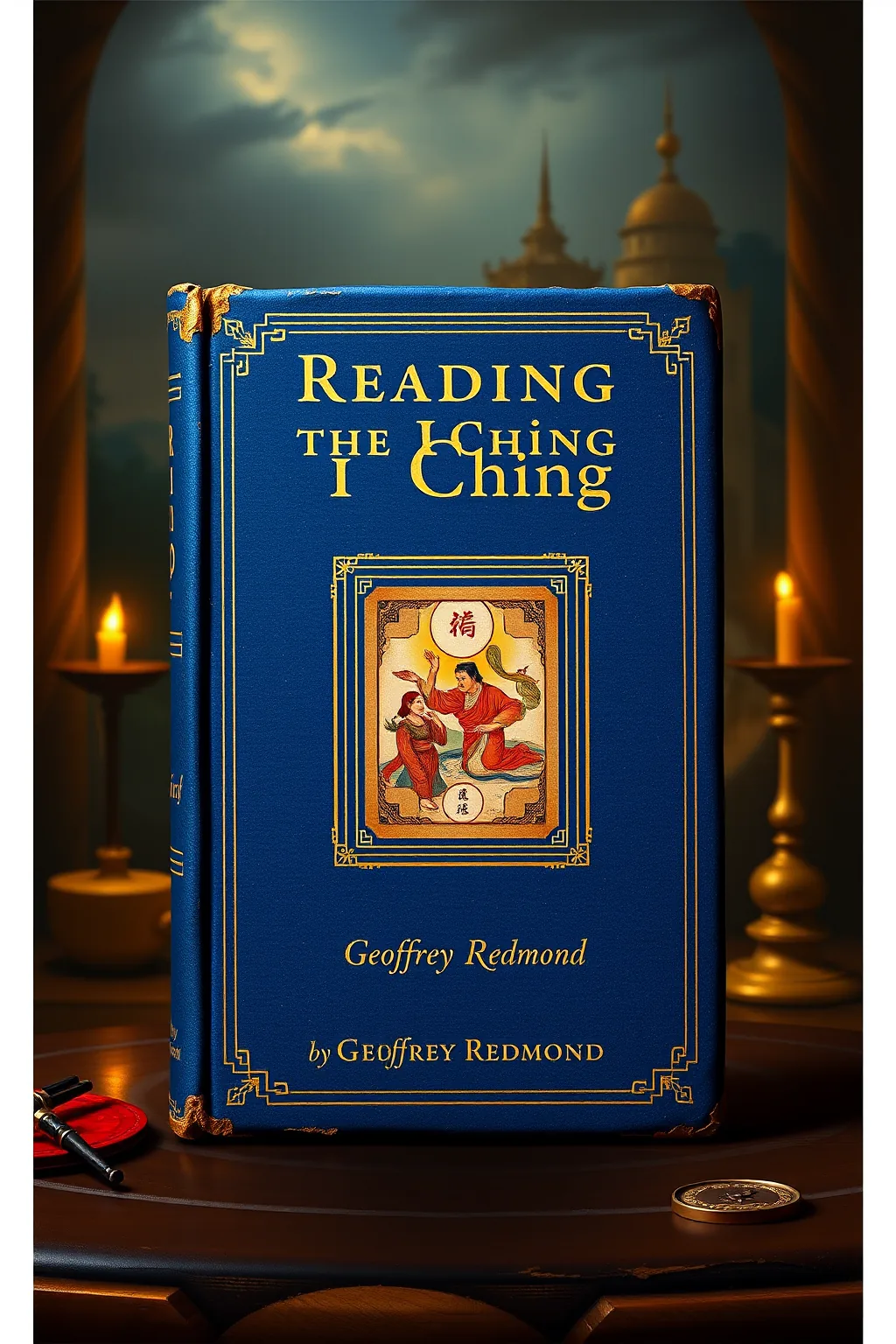
Reading the I Ching
 61
61

Reading the I Ching



Celeste Moreau, Divination & Symbolism Reviewer: Geoffrey Redmond's 'Reading the I Ching' stands as a beacon for those seeking authentic understanding of this ancient oracle. Redmond transcends mere translation, delving into the philosophical underpinnings and mystical resonance of each hexagram. His insightful interpretations illuminate the profound interconnectedness of human experience with cosmic cycles. This text is particularly valuable for its clarity in presenting complex concepts, making it accessible yet retaining its esoteric depth. It’s an indispensable guide for practitioners aiming to deepen their intuitive connection and for scholars eager to explore the rich symbolic language of the *I Ching*. A truly illuminating and authoritative resource.
📝 Description
61
Geoffrey Redmond's 2011 book decodes the I Ching's hexagrams as a map of universal patterns.
Geoffrey Redmond's 'Reading the I Ching' examines the *Book of Changes* not just as a divination tool, but as a system reflecting universal patterns. Published in 2011, the book breaks down the complexity of the hexagrams, showing their relevance to understanding transformation and human experience. Redmond emphasizes the interplay of Yin and Yang and how these forces are depicted within the text. The writing encourages a personal and philosophical engagement with the material. It aims to help readers connect their inner lives with a larger cosmic order.
The book guides readers toward self-discovery by aligning personal understanding with the principles presented in the I Ching. It facilitates a clearer perception of life's underlying currents and fosters a more informed approach to navigating challenges. Redmond's work is suited for those interested in applying the I Ching’s wisdom to their lives, moving beyond simple fortune-telling to a deeper philosophical understanding.
This book engages with the tradition of Chinese divination and cosmology, specifically the *Book of Changes* (I Ching). This text has been a cornerstone of East Asian thought for centuries, influencing philosophy, governance, and personal practice. Redmond's work places itself within this lineage, seeking to make its complex system accessible to a modern audience. It highlights the I Ching's role as a tool for understanding cosmic principles and human affairs, connecting it to broader esoteric interests in symbolic systems and universal order.
💡 Why Read This Book?
Unravel the timeless wisdom of the *I Ching*, a profound system of divination and philosophical inquiry. This book offers a clear, insightful path into understanding the dynamic forces of change and transformation. It is for the dedicated seeker, the curious scholar, and the seasoned practitioner yearning to deepen their connection to universal patterns and ancient knowledge. Discover practical guidance and profound philosophical insights to navigate life's challenges with clarity and wisdom.
⭐ Reader Reviews
Honest opinions from readers who have explored this book.
❓ Frequently Asked Questions
What is the I Ching?
The I Ching, or *Book of Changes*, is an ancient Chinese divination text and philosophical classic. It uses a system of 64 hexagrams, formed by combinations of six lines (broken or solid), to represent fundamental patterns of change and provide guidance.
How does one use the I Ching for divination?
Traditionally, one casts coins or yarrow stalks to generate hexagrams. The resulting hexagram, and any changing lines within it, are then interpreted using the text's commentary to offer insights into a current situation or question.
Is this book suitable for beginners?
Yes, Geoffrey Redmond's approach is known for its clarity, making 'Reading the I Ching' an excellent starting point for those new to this complex but rewarding system of divination and wisdom.
What is the philosophical significance of the I Ching?
The I Ching embodies a philosophy of constant flux and transformation, emphasizing the balance of opposing forces (Yin and Yang) and the importance of adapting to changing circumstances with wisdom and integrity.
Can the I Ching offer practical advice?
Absolutely. Beyond its spiritual and philosophical dimensions, the I Ching is renowned for offering practical, nuanced advice on how to approach situations, make decisions, and navigate the complexities of daily life.
🔮 Key Themes & Symbolism
The Dynamic Nature of Change
Fundamentally, the *I Ching* reveals that existence is in perpetual motion. Redmond's work meticulously unpacks the concept that nothing is static; all things are in a constant state of becoming, transforming, and evolving. Understanding these inherent shifts allows one to move with greater grace and foresight, anticipating challenges and opportunities by recognizing the underlying patterns of flux. This theme encourages a responsive and adaptive approach to life, moving beyond resistance to embrace the natural unfolding of events.
The Interplay of Yin and Yang
The fundamental dualistic forces of Yin (passive, dark, feminine) and Yang (active, light, masculine) are central to the *I Ching's* cosmology. Redmond expertly illustrates how these seemingly opposing energies are, in fact, complementary and interdependent, constantly interacting to create the myriad phenomena of the universe. Their dynamic balance and cyclical interplay are depicted through the hexagrams, offering a profound framework for understanding relationships, energies, and the nature of reality itself.
Symbolic Language and Archetypal Wisdom
The hexagrams of the *I Ching* are not mere abstract symbols but potent archetypes that resonate with deep psychological and spiritual truths. Redmond guides the reader to perceive the collection of imagery and metaphor embedded within each formation. This symbolic language serves as a key to unlocking hidden knowledge, providing insights into universal human experiences, challenges, and transformations. Engaging with these archetypes fosters self-awareness and a deeper understanding of one's place within the greater cosmic order.
💬 Memorable Quotes
Direct passages from the work, attributed to the author.
“Within the balance of opposites lies all potential.”
— Highlights the crucial role of Yin and Yang, suggesting that true understanding and creation emerge from the dynamic interplay of seemingly contrary forces.
“The hexagrams are mirrors reflecting the soul's journey.”
— Emphasizes the introspective and self-discovery aspect of the *I Ching*, positioning it as a tool for understanding one's inner landscape.
“Wisdom is found in yielding, not in resistance.”
— Promotes a key tenet of the *I Ching*: the power of flexibility and adaptability in navigating life's inevitable currents.
“Each line whispers a truth of the evolving moment.”
— Underscores the granular, moment-by-moment guidance offered by the *I Ching*, suggesting that clear insights are available at every stage of transformation.
💡 Key Ideas
Editorial paraphrase of the work's core concepts — not direct quotes.
The ceaseless flow of change is the only constant.
This quote expresses the *I Ching's* core philosophy: that impermanence is the fundamental nature of existence, urging acceptance and adaptation.
🌙 Esoteric Significance
Tradition
The *I Ching* is deeply rooted in Taoist philosophy and ancient Chinese cosmology, representing a sophisticated system of understanding the universe's fundamental principles. It aligns with esoteric traditions that seek to perceive the underlying order and interconnectedness of all things, utilizing symbolic language to access deeper layers of reality. Its methods of divination are seen as a means to attune oneself to the subtle energies and cosmic rhythms that govern existence, fostering spiritual development.
Symbolism
The hexagrams, composed of six lines (solid for Yang, broken for Yin), are the primary symbols. Each hexagram represents a specific archetypal situation or cosmic force, with the changing lines indicating points of transition. The trigrams (three-line combinations) further enrich this symbolic language, representing natural elements and core concepts. This intricate web of symbols acts as a universal language, allowing for nuanced interpretation of the forces at play in any given situation.
Modern Relevance
In the modern era, the *I Ching* offers a vital counterpoint to materialistic and linear thinking. Its emphasis on cyclical change, balance, and adaptability provides profound guidance for working through the complexities and uncertainties of contemporary life. It serves as a powerful tool for self-reflection, intuitive development, and fostering a deeper connection to nature and the cosmos. Its wisdom remains remarkably relevant for personal growth, decision-making, and understanding the ever-shifting range of human experience.
👥 Who Should Read This Book
This book is a treasure for a diverse range of individuals. **Beginners** will find Redmond's approach exceptionally clear, providing a gentle yet thorough introduction to the *I Ching*'s core concepts and methods. **Scholars** of Eastern philosophy and divination will appreciate the depth of insight and rigorous analysis. **Spiritual seekers** and those on a path of self-discovery will discover a profound tool for introspection and guidance. **Practitioners** of divination seeking to deepen their understanding and intuitive connection will find invaluable wisdom and practical application within these pages.
📜 Historical Context
The *I Ching* emerged from ancient Chinese shamanistic traditions, evolving over millennia into one of the world's oldest and most influential texts. Its origins are often traced to the Zhou Dynasty (c. 1046–256 BCE), where it was used for divination and governance. Confucian scholars later integrated it into their philosophical system, imbuing it with moral and ethical dimensions. Throughout its history, the *I Ching* has been a core part of Chinese intellectual and spiritual life, influencing everything from military strategy and political decision-making to personal philosophy and artistic expression. Its transmission across East Asia and eventually to the West has cemented its status as a universal repository of wisdom, continually reinterpreted and applied to new contexts.
📔 Journal Prompts
Reflect on a recent significant change in your life. How did the *I Ching*'s principles of flux apply?
Consider the interplay of Yin and Yang in a current relationship or situation. Where is the balance, and where is it lacking?
What archetypal imagery from the *I Ching* resonates most strongly with your current life challenges?
How can the wisdom of yielding, rather than resistance, be applied to a situation you are currently facing?
Meditate on the concept of 'constant change.' What does this mean for your personal definition of stability and progress?
🗂️ Glossary
Hexagram
A figure composed of six stacked horizontal lines, either solid (Yang) or broken (Yin). There are 64 unique hexagrams in the *I Ching*, each representing a distinct archetypal situation or cosmic pattern.
Trigram
A combination of three lines, either solid or broken. There are eight basic trigrams, each associated with fundamental elements, natural forces, and family roles.
Yin
The passive, dark, feminine, receptive principle in Taoist philosophy, often represented by broken lines in the *I Ching*. It is complementary and essential to Yang.
Yang
The active, light, masculine, creative principle in Taoist philosophy, often represented by solid lines in the *I Ching*. It is complementary and essential to Yin.
Changing Lines
Specific lines within a hexagram that are identified during a divination cast. These lines indicate movement and transformation, leading to a second hexagram and providing more specific guidance.
This book appears in 3 collections
🔮 Readers Also Liked
Browse all →







More by Geoffrey Redmond
All books →


From the “Tarot” Collection
View all →








More Free Divination & Tarot Books
View all →