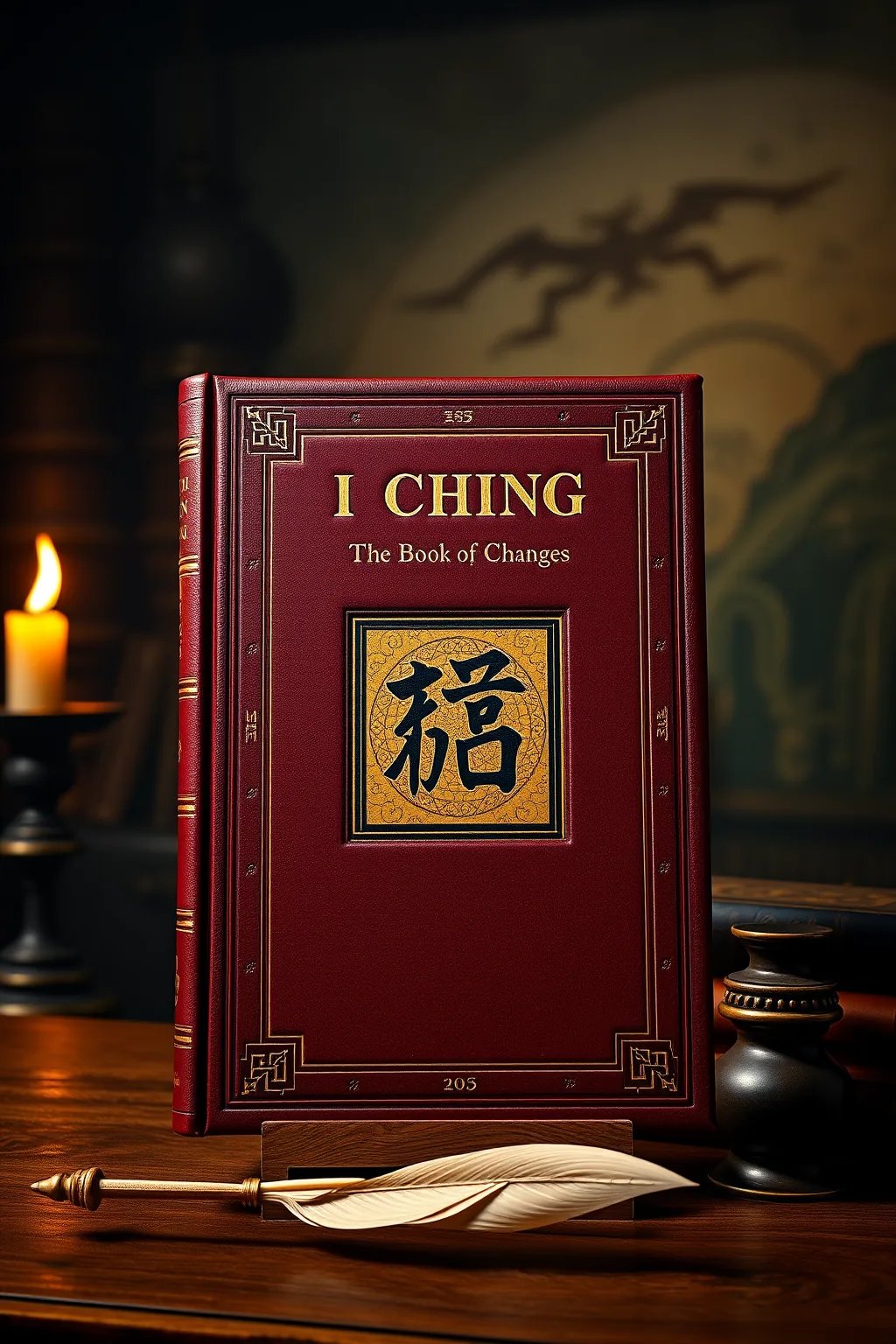
I Ching The Book Of Changes
 61
61

I Ching The Book Of Changes



Review by Marcus Thorne (Esoteric Sciences Reviewer) — The I Ching, attributed to Emperor Fu Hsi, stands as an unparalleled repository of ancient wisdom, a foundational text for divination and philosophical inquiry. Its 64 hexagrams, born from the elemental forces of Yin and Yang, offer a profound symbolic language to decipher the currents of fate and consciousness. This edition, a testament to clarity and depth, invites readers to engage with its intricate cosmology. For students of metaphysics, practitioners of ancient arts, and anyone seeking a deeper understanding of universal principles, the I Ching is an indispensable guide. It empowers readers not just to predict, but to participate consciously in the unfolding of reality, revealing the interconnectedness of all phenomena.
📝 Description
61
Emperor Fu Hsi is credited with compiling the I Ching, a foundational text of Chinese thought and divination, around 2800 BCE.
The I Ching, or 'The Book of Changes,' is a classical Chinese divination text. It comprises 64 hexagrams, each formed by six lines that can be either solid (Yang) or broken (Yin). These hexagrams symbolize universal situations and transformations. The text includes commentary on each hexagram, explaining its meaning and offering advice. Its origins are attributed to Emperor Fu Hsi, with later additions and interpretations by figures like King Wen, the Duke of Zhou, and Confucius. The I Ching is not merely a predictive tool; it is seen as a philosophical work that explores the principles of change and balance in the universe. It suggests that understanding these principles allows individuals to align themselves with the natural order, leading to wisdom and effective action.
This book uses a system of casting coins or yarrow stalks to determine which hexagrams apply to a given situation. The resulting hexagram, and any changing lines within it, are then interpreted using the accompanying texts. The goal is to gain insight into current circumstances, potential future developments, and the best course of action. Its influence extends across East Asian cultures, impacting philosophy, art, and personal practice for millennia.
The I Ching is a central text in Chinese esoteric traditions, deeply connected to Taoism and Confucianism. It is understood as a system for observing and aligning with the Tao, the fundamental principle of the universe. Its divinatory aspect is not about predicting a fixed future, but about understanding the dynamic flow of events and the forces at play. This allows practitioners to make choices that harmonize with natural patterns, fostering personal growth and ethical conduct. The text's emphasis on transformation and cyclical change provides a framework for understanding life's ups and downs within a larger cosmic order.
💡 Why Read This Book?
Delve into the I Ching to unlock ancient wisdom that transcends time. This text offers a profound method for understanding life's cycles, making informed decisions, and fostering personal growth. It is ideal for seekers of spiritual insight, scholars of ancient philosophies, and practitioners looking to enhance their intuitive abilities and connect with universal patterns.
⭐ Reader Reviews
Honest opinions from readers who have explored this book.
❓ Frequently Asked Questions
What is the I Ching?
The I Ching, or 'The Book of Changes,' is an ancient Chinese text that serves as a system of divination and a philosophical guide. It comprises 64 hexagrams, each formed by six lines representing Yin (broken) or Yang (solid), symbolizing the dynamic interplay of cosmic forces and life's transformations.
Who is Emperor Fu Hsi?
Emperor Fu Hsi is a legendary figure in Chinese mythology, credited with originating the I Ching. He is revered as one of the Three Sovereigns, considered the founder of Chinese civilization and the inventor of the trigrams that form the basis of the hexagrams.
How is the I Ching used for divination?
Divination with the I Ching typically involves casting coins or yarrow stalks to generate a hexagram, which then corresponds to a specific passage in the book. The text offers interpretations and advice based on the nature of the hexagram and its changing lines.
What are the core philosophical concepts of the I Ching?
The core concepts revolve around change, balance, and interconnectedness. It emphasizes the constant flux of the universe, the dynamic interplay of opposing forces (Yin and Yang), and the idea that understanding these principles can lead to wisdom and harmony.
Is the I Ching only for divination?
While widely used for divination, the I Ching is also a profound philosophical text. Its wisdom can be applied to personal development, decision-making, understanding relationships, and gaining a deeper insight into the nature of reality and the human condition.
🔮 Key Themes & Symbolism
The Dynamics of Change
The I Ching fundamentally teaches that change is the only constant. It presents a detailed cosmology where every situation, emotion, and event is in a perpetual state of flux. Understanding these cycles of growth, decline, and transformation is presented not as a passive observation, but as an active engagement with the universe. The text provides a framework for recognizing these shifts, anticipating future developments, and adapting one's actions to align with the natural flow of events, thereby fostering resilience and wisdom in the face of life's inevitable metamorphoses.
The Harmony of Yin and Yang
At the heart of the I Ching's symbolic system lies the profound principle of Yin and Yang. These dualistic yet complementary forces represent the fundamental polarities of existence: feminine and masculine, passive and active, dark and light, receptive and creative. The text illustrates how the interplay and balance of these forces govern all phenomena, from the smallest particle to the grandest cosmic movement. Achieving harmony involves recognizing, respecting, and integrating these opposing energies within oneself and one's environment, leading to equilibrium and auspicious outcomes.
The Art of Wise Counsel
The I Ching serves as an oracle, offering clear insights and guidance for navigating complex life decisions. Its hexagrams and accompanying texts act as mirrors, reflecting the underlying energies of a given situation. The wisdom lies not in predetermined fate, but in understanding the forces at play and making choices that are aligned with the Tao, the 'Way' of the universe. It encourages introspection, responsible action, and a deep connection to the subtle currents of life, empowering individuals to act with clarity and foresight.
💬 Memorable Quotes
Direct passages from the work, attributed to the author.
“When one is near to God, one is near to the people.”
— Suggests a spiritual connection that fosters empathy and universal well-being, linking divine proximity with social responsibility.
“The superior man is not a vessel.”
— This profound statement implies that an enlightened individual is not limited to a single purpose or function but possesses a broad capacity for adaptation and understanding.
“He who knows the Way does not worry.”
— Underscores the peace and confidence that comes from aligning oneself with universal principles and understanding the natural order of things.
“What is far away cannot be gotten by treading, and what is before you cannot be seen.”
— A paradoxical observation on perception and attainment, suggesting that true understanding often comes from inner reflection rather than external pursuit.
💡 Key Ideas
Editorial paraphrase of the work's core concepts — not direct quotes.
The superior man, when he is in the country, is humble and pure; when he is in the country, he is diligent and careful.
This quote emphasizes the importance of inner virtue and consistent conduct regardless of external circumstances, highlighting the duality of personal alignment.
🌙 Esoteric Significance
Tradition
The I Ching is a foundational text within Taoism, a major Chinese philosophical and religious tradition that emphasizes living in harmony with the Tao, the fundamental principle that governs the universe. It also holds significant importance in Confucianism, where it is viewed as a guide for moral cultivation and wise governance. Within esoteric circles, it is revered as a supreme oracle and a cosmological map, offering insights into the hidden workings of the universe and the interconnectedness of all things.
Symbolism
The core symbolism of the I Ching resides in its 64 hexagrams, each composed of six lines representing Yin (broken) and Yang (solid). These lines and their combinations create intricate symbolic representations of archetypal situations, natural phenomena, and human experiences. The trigrams (three-line figures) like Heaven, Earth, Water, and Fire are fundamental building blocks, each imbued with specific qualities and energies. The dynamic interplay and transformation of these symbols provide a rich lexicon for understanding the ever-shifting patterns of existence.
Modern Relevance
In the modern era, the I Ching continues to offer profound relevance as a tool for introspection, decision-making, and understanding personal growth. Its emphasis on change and adaptability resonates deeply in a rapidly evolving world. Psychologists, philosophers, and spiritual seekers alike turn to its wisdom for guidance in navigating personal challenges, fostering creativity, and developing a more profound connection to the universe. Its timeless principles offer a counterpoint to the often chaotic pace of contemporary life, promoting balance and mindful awareness.
👥 Who Should Read This Book
The I Ching is a treasure for a diverse audience. **Beginners** seeking a gentle introduction to ancient wisdom and divination will find its core principles accessible. **Scholars** of Eastern philosophy, history, and comparative religion will appreciate its depth and historical significance. **Spiritual seekers** yearning for profound self-understanding and guidance on their life path will discover a powerful oracle. **Practitioners** of various metaphysical arts, from meditation to energy work, will find its symbolic language and philosophical underpinnings useful for deepening their practice and connection to universal energies.
📜 Historical Context
Emerging from the mists of ancient China, likely during the Shang dynasty (c. 1600-1046 BCE) and further developed by the Zhou dynasty (c. 1046-256 BCE), the I Ching stands as one of the oldest continuously used books in the world. Its origins are deeply intertwined with early Chinese cosmology, divination practices, and philosophical thought. Attributed in part to legendary figures like Emperor Fu Hsi and King Wen, the text evolved over centuries, with Confucius and his disciples adding significant commentary that cemented its status as a classic of Chinese literature and wisdom. Its influence permeated not only religious and philosophical discourse but also art, governance, and daily life, shaping the cultural and intellectual range of East Asia for millennia.
📔 Journal Prompts
Reflect on a recent 'change' in your life. How did the I Ching's principles of flux apply to this situation?
Consider a significant decision you face. How might the symbolism of a relevant hexagram offer new perspectives?
Explore the balance of Yin and Yang within your own personality and daily life. Where can harmony be cultivated?
How can the wisdom of the I Ching inform your interactions with others and your role within your community?
Meditate on the concept of 'the Way' (Tao). How can you better align your actions with this natural flow?
🗂️ Glossary
Hexagram
A six-line figure in the I Ching, composed of six unbroken (Yang) or broken (Yin) lines. Each of the 64 hexagrams represents a specific situation, archetype, or phase of transformation.
Yin
The feminine, passive, dark, receptive, and yielding principle in Taoist philosophy. Represented by a broken line (--) in I Ching hexagrams.
Yang
The masculine, active, light, creative, and assertive principle in Taoist philosophy. Represented by a solid line (—) in I Ching hexagrams.
Trigram
A three-line figure, composed of Yin and Yang lines. The eight trigrams (e.g., Heaven, Earth, Water) are the building blocks of the 64 hexagrams.
Tao
Literally 'The Way.' In Taoism, it refers to the fundamental principle of the universe, the natural order, and the underlying force that guides all existence. Living in accordance with the Tao is considered the path to harmony and enlightenment.
This book appears in 2 collections
🔮 Readers Also Liked
Browse all →








From the “I Ching” Collection
View all →







More Free Divination & Tarot Books
View all →