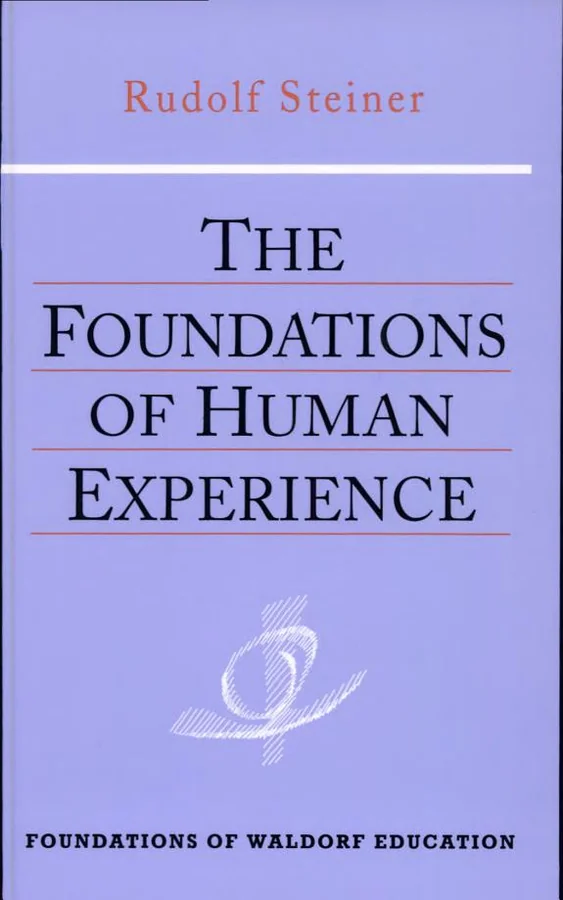
The Foundations of Human Experience
 77
77

The Foundations of Human Experience
Rudolf Steiner's *The Foundations of Human Experience* presents a challenging yet rewarding exploration of human existence from a spiritual-scientific viewpoint. The opening address of August 20, 1919, immediately sets a tone of urgency, urging awareness of the spiritual continuities that frame physical life. Steiner's insistence on viewing birth as a continuation, rather than just an beginning, is a powerful reorientation for the reader accustomed to linear, materialistic thinking. While the lectures, particularly those from the 1919 cycle (CW 293), offer profound perspectives on the soul's journey through incarnation, their dense philosophical language can be a significant hurdle for newcomers. A limitation lies in the inherent difficulty of grasping concepts like the 'spiritual continuation' of physical existence without a strong prior grounding in Steiner's cosmology. However, the clarity with which he dissects the relationship between the physical and the spiritual, particularly in the context of reincarnation, provides a unique framework for understanding human biography. This work is essential for serious students of Anthroposophy, though its accessibility remains a notable constraint.
📝 Description
77
Rudolf Steiner delivered lectures that became *The Foundations of Human Experience* in 1917 and 1919.
This collection gathers lectures Rudolf Steiner gave in Stuttgart and Berlin during 1917 and 1919. These talks consider the core aspects of human life, including consciousness and the spiritual world. Steiner approaches the human being not just as a biological entity tied to birth and death, but as a soul continually developing through spiritual growth and reincarnation. The material is drawn from his extensive lecture cycles, specifically cataloged as CW 293 and CW 66.
The lectures are for individuals interested in Anthroposophy and Rudolf Steiner's spiritual science. They appeal to those who seek to understand consciousness beyond purely materialist frameworks. Readers familiar with Steiner's wider body of work or those investigating the connection between the spiritual and physical will find this relevant. It also speaks to students of pedagogy, psychology, and medicine looking for a holistic, spiritual view of the human being.
These lectures were given in the period immediately following World War I, a time of significant global disruption and intellectual searching. Steiner's work provided a spiritual scientific alternative, aiming to offer a path for human understanding and renewal. His research stood apart from the scientific materialism and emerging psychological theories of the era. The lectures were delivered in Germany, where movements like Theosophy, from which Steiner had previously separated, still had sway.
This work is situated within the tradition of spiritual science, which Rudolf Steiner developed as Anthroposophy. Emerging from his earlier involvement with Theosophy, Steiner sought to establish a method of spiritual research accessible through clear thinking and imaginative perception. These lectures from 1917-1919 address fundamental questions about human nature and existence from this spiritual scientific perspective. They aim to guide the reader toward an understanding of the human being as a complex spiritual organism undergoing continuous development across multiple lifetimes, a core tenet of Anthroposophical thought.
💡 Why Read This Book?
• Gain a unique perspective on the continuity of human life beyond physical birth and death, as discussed in the 1919 Stuttgart lectures (CW 293), challenging conventional views of existence. • Understand the Anthroposophical view of the human being as a composite of body, soul, and spirit, informed by Steiner's spiritual science presented in these foundational talks. • Explore the concept of reincarnation and karma not as abstract doctrines, but as active forces shaping human experience and evolution, as outlined in the March 1917 Berlin lectures (CW 66).
⭐ Reader Reviews
Honest opinions from readers who have explored this book.
❓ Frequently Asked Questions
What is Rudolf Steiner's concept of the 'spiritual continuation' of human life?
Steiner posits that physical existence is a continuation of a spiritual pre-birth state and a preparation for a spiritual post-death state, emphasizing a continuous cycle of spiritual evolution.
What does CW 293 refer to in relation to The Foundations of Human Experience?
CW 293 designates a specific collection of 14 lectures delivered by Rudolf Steiner in Stuttgart between August 21 and September 5, 1919, which form a core part of this book.
Are these lectures suitable for someone new to Rudolf Steiner's work?
While foundational, the lectures can be dense. It is recommended for readers with some familiarity with Anthroposophy or a strong interest in esoteric philosophy, as they delve into complex spiritual concepts.
What is the historical significance of the 1919 lectures?
The 1919 lectures were given in the turbulent post-World War I era, offering a spiritual-scientific perspective on human renewal and consciousness amidst widespread societal and intellectual change in Germany.
How does this book relate to the concept of karma and reincarnation?
The book explores karma and reincarnation as active principles governing human life, explaining how past spiritual deeds influence present physical circumstances and future incarnations.
What is the 'threefold human being' according to Steiner?
Steiner describes the human being as comprising a physical body, a soul (or astral body), and a spirit (or 'I' consciousness), each with distinct roles and evolutionary paths.
🔮 Key Themes & Symbolism
The Continuity of Life
The lectures fundamentally challenge the notion of human existence beginning at birth and ending at death. Steiner argues for a continuous spiritual process, where physical life is a specific phase within a larger, unbroken sequence. This continuity involves pre-existence before birth and post-existence after death, linking earthly incarnations through spiritual realms and karmic processes. The work emphasizes understanding these connections to grasp the full picture of human destiny and development.
The Threefold Human Being
Steiner presents a model of the human being composed of three fundamental aspects: the physical body, the soul (or astral body), and the spirit (often referred to as the 'I' or ego). Each aspect has its own laws of development and interaction. The physical body is seen as inherited and subject to material laws, while the soul bridges the physical and spiritual, carrying consciousness and feeling. The spirit is the immortal core, the true individuality that evolves through multiple incarnations.
Spiritual Science and Consciousness
This collection is a core part of Steiner's 'spiritual science,' an epistemological approach aiming to investigate the spiritual world with the same rigor as natural science investigates the physical. The lectures explore how human consciousness can be trained to perceive these spiritual realities. This involves developing higher cognitive faculties beyond ordinary thinking, enabling direct experience of the spiritual hierarchies and the nature of karma.
Karma and Reincarnation
Karma and reincarnation are presented not as fatalistic destiny, but as the dynamic, ethical laws governing the evolution of individual human consciousness. The lectures explain how actions, intentions, and experiences in one life create karmic consequences that shape subsequent lives. Understanding these laws is crucial for comprehending human suffering, character development, and the purposeful progression of the human soul through its earthly sojourns.
💬 Memorable Quotes
Direct passages from the work, attributed to the author.
“We do not want to look only at what the human being experiences after death, that is, at the spiritual continuation of the physical.”
— This statement highlights the core Anthroposophical perspective: existence is not confined to the physical lifespan. It urges a consideration of the spiritual realities that precede birth and follow death, framing earthly life as a segment within a larger, continuous spiritual evolution.
“We want to be aware that physical existence is a continuation of what higher beings have done...”
— This concept suggests that human physical life is not an isolated event but is intrinsically linked to the activities of spiritual hierarchies. It implies a cosmic purpose behind incarnation and a connection to a larger spiritual economy guiding human development.
“Although we can physically see children only after their birth, we need to be aware that birth is also a continuation.”
— This emphasizes that birth is not an absolute beginning but a transition from a prior state of existence. It encourages contemplation of what precedes physical manifestation, viewing birth as a point within a continuous stream of being rather than a solitary commencement.
“The human being is not only a physical being, but also a spiritual being.”
— A fundamental tenet of Steiner's philosophy, this assertion underscores the dual nature of humanity. It calls for recognizing and cultivating the spiritual dimension alongside the physical, positing that true human understanding requires acknowledging both realms.
💡 Key Ideas
Editorial paraphrase of the work's core concepts — not direct quotes.
Physical existence is a continuation of what higher beings have done.
This paraphrased concept points to the idea that humanity's physical manifestation is not arbitrary but part of a larger, divinely orchestrated process involving spiritual entities. It suggests a cosmic plan that underpins earthly life.
🌙 Esoteric Significance
Tradition
This work is foundational to Anthroposophy, a spiritual philosophy developed by Rudolf Steiner. While drawing from diverse esoteric traditions including Hermeticism, Gnosticism, and Eastern philosophies, Anthroposophy presents itself as a unique, modern spiritual science. It aims to provide a systematic, verifiable path for individual spiritual development and understanding of cosmic evolution, differentiating itself from earlier movements like Theosophy by emphasizing individual clairvoyance and ethical development.
Symbolism
While specific symbols are less explicit in these lecture texts compared to some of Steiner's other works, the 'threefold human being' (body, soul, spirit) functions as a core symbolic structure. The concepts of 'birth' and 'death' themselves become potent symbols, representing not just biological events but thresholds between spiritual and physical states of existence. The 'higher beings' mentioned represent the angelic or spiritual hierarchies that orchestrate cosmic and human evolution.
Modern Relevance
Anthroposophy, as presented in this work, continues to influence various contemporary fields. Its principles inform Waldorf education, biodynamic agriculture, and anthroposophical medicine. Modern practitioners of esoteric studies and comparative religion often engage with Steiner's lectures to understand the spiritual underpinnings of human consciousness, ethics, and the evolutionary processes of both the individual and the cosmos.
👥 Who Should Read This Book
• Students of Rudolf Steiner's work: Those seeking to understand the core principles of Anthroposophy will find these lectures essential for grasping the fundamental nature of human existence and consciousness. • Individuals interested in esoteric philosophy: Readers exploring spiritual science, reincarnation, and the relationship between the material and spiritual worlds will gain a unique, systematic perspective. • Those questioning the limits of materialism: Anyone seeking a framework that addresses the spiritual dimensions of life, consciousness, and human development beyond purely scientific or philosophical materialism.
📜 Historical Context
The lectures comprising *The Foundations of Human Experience* were delivered in Germany during a period of profound societal and intellectual flux, primarily in 1917 and 1919. The aftermath of World War I left Europe grappling with widespread disillusionment and the collapse of old orders. In this climate, Rudolf Steiner presented his spiritual-scientific worldview as a path toward human renewal and understanding, distinct from prevailing materialistic philosophies and nascent psychological theories. His work offered a counterpoint to the era's prevalent positivism and the intellectual currents that would later coalesce into existentialism and modern psychology. While Steiner had previously been involved with Theosophy, by this time he had established his own independent spiritual research, the Anthroposophical Society, which aimed to provide a scientific method for exploring the spiritual world.
📔 Journal Prompts
The spiritual continuation of the physical.
Understanding the threefold human being.
The role of higher beings in human life.
Birth as a spiritual threshold.
The ethical implications of karma and reincarnation.
🗂️ Glossary
Anthroposophy
A spiritual philosophy founded by Rudolf Steiner, aiming to investigate the spiritual world through methods analogous to natural science, focusing on human spiritual development and cosmic evolution.
Spiritual Science
Steiner's term for his method of spiritual investigation, which seeks to access and understand the spiritual realms with clarity and precision, distinct from mere belief or imagination.
CW (Collected Works)
Abbreviation for 'Gesamtausgabe', referring to the comprehensive collection of Rudolf Steiner's lectures and writings, cataloged by volume number.
Karma
In Anthroposophy, the ethical law of cause and effect governing the evolution of the human soul, where actions and intentions in one life create consequences for subsequent lives.
Reincarnation
The process by which the human soul lives through multiple physical lifetimes, with each incarnation serving as an opportunity for spiritual development and karmic resolution.
Astral Body
One of the subtle bodies described in Anthroposophy, often associated with the soul, carrying consciousness, feelings, and impulses; it is considered the vehicle of life and consciousness.
The 'I' (Ego)
The spiritual core of the human being in Anthroposophy, the immortal individuality that experiences karma and reincarnates, striving for self-realization and spiritual freedom.
This book appears in 1 collection
🔮 Readers Also Liked
Browse all →




From the “Anthroposophy” Collection
View all →






More Free Theosophy & Anthroposophy Books
View all →