Theosophy Vol-III,No-9,July 1915

 82
82

Theosophy Vol-III,No-9,July 1915

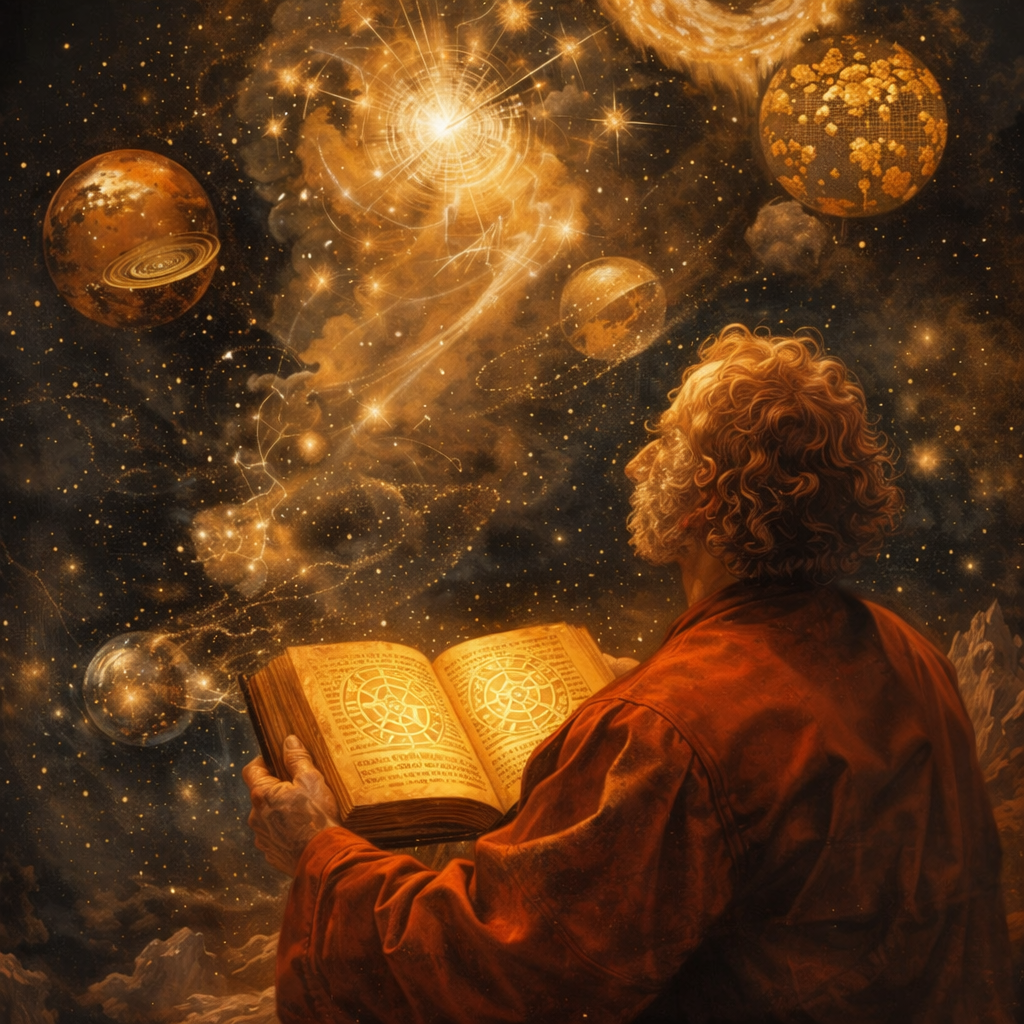

Isolde Whitaker, Sacred Texts Editor, hails 'Theosophy Vol-III, No-9, July 1915' as a vital portal into the foundational currents of modern occultism. This issue offers a rich tapestry of esoteric discourse, delving into themes of spiritual evolution and cosmic law with clarity and depth. Its strength lies in its ability to articulate complex metaphysical concepts in an accessible yet profound manner. Ideal for students of Theosophy, Anthroposophy, and comparative religion, this volume serves as an essential resource for those seeking to understand the philosophical underpinnings of these transformative movements and to deepen their own spiritual inquiry. A truly illuminating read for the discerning seeker.
📝 Description
82
The July 1915 issue of Theosophy magazine presents essays on cosmic architecture and consciousness.
This September 1915 issue of Theosophy magazine contains several essays. One piece discusses the hidden structure of the universe, while another examines the development of consciousness. The publication also touches upon the connections between the material world and unseen forces. It is written for individuals seriously interested in occult studies and philosophy.
The volume aims to help readers move beyond ordinary viewpoints. It encourages engagement with enduring philosophical ideas and suggests methods for personal discovery and broader comprehension. The tone fosters reflection and the development of inner awareness. Its importance relates to the broader Theosophical movement's effort to combine ancient knowledge with contemporary scientific and psychological ideas, providing a spiritual perspective during a time of significant global change.
Published in 1915, this issue of Theosophy magazine belongs to the early 20th-century spiritual renaissance. The Theosophical Society, founded by Helena Blavatsky, sought to synthesize Eastern and Western esoteric traditions with emerging scientific thought. This period saw a widespread interest in mysticism, spiritualism, and alternative philosophies, as people looked for meaning beyond conventional religious and materialist views. The magazine reflects this milieu by discussing concepts like the hidden structure of the cosmos and the evolution of consciousness, aligning with the movement's goal of uncovering universal truths and promoting human spiritual development.
💡 Why Read This Book?
Uncover lost spiritual knowledge and explore the profound symbolism that governs existence. This issue offers a unique window into the early 20th-century esoteric revival, providing foundational insights for seekers of truth, scholars of mysticism, and practitioners of spiritual disciplines. Engage with timeless philosophical questions and discover pathways to heightened consciousness and inner wisdom.
⭐ Reader Reviews
Honest opinions from readers who have explored this book.
❓ Frequently Asked Questions
What is Theosophy?
Theosophy is a spiritual philosophy that seeks to understand the underlying unity of all religions and philosophies, exploring the esoteric principles of nature and humanity, and the spiritual evolution of consciousness.
Who was the author of this specific issue?
This issue of 'Theosophy' is presented as a collection of essays and articles from various contributors within the Theosophical movement of the time, rather than a single attributed author.
What does 'esoteric' mean in this context?
Esoteric refers to knowledge or wisdom that is intended for or understood by a select group of people with a specialized understanding or initiation, focusing on inner, hidden, or spiritual truths.
What is the significance of the July 1915 publication date?
The July 1915 date places this issue within a pivotal period of the Theosophical Society's influence, during which it was actively disseminating its teachings globally and engaging with contemporary intellectual and spiritual currents.
Can beginners understand this material?
While some concepts may be advanced, the foundational principles of Theosophy are often presented in a way that encourages contemplation and gradual understanding for earnest beginners interested in spiritual philosophy.
🔮 Key Themes & Symbolism
The Unfolding of Consciousness
This volume explores the intricate journey of human consciousness, tracing its evolutionary path from primordial states to higher spiritual awareness. It explores the concept of the 'Divine Spark' within each individual and the potential for awakening latent psychic and spiritual faculties. The essays illuminate the idea that consciousness is not static but a dynamic force, continually expanding and evolving through successive stages of experience and understanding, guided by unseen laws and cosmic purpose.
Cosmic Laws and Universal Harmony
Central to this issue is the exploration of the fundamental laws that govern the cosmos, from the smallest atom to the grandest celestial bodies. It posits that underlying the apparent chaos of existence is a profound order and harmony, dictated by principles such as Karma and Reincarnation. Understanding these laws is presented as the key to navigating life's challenges, fostering inner peace, and aligning oneself with the greater divine plan, thereby achieving spiritual liberation.
The Language of Symbolism
The essays in this collection often employ strong symbolism as a vehicle for conveying profound truths that transcend ordinary language. Readers are invited to decipher the allegorical meanings embedded in myths, ancient texts, and natural phenomena. Symbolism is presented not merely as decorative but as a vital 'language of the soul,' capable of unlocking deeper layers of perception and facilitating direct intuitive understanding of spiritual realities and the interconnectedness of all things.
💬 Memorable Quotes
Direct passages from the work, attributed to the author.
“Within the mundane, the sacred whispers.”
— This evokes the idea that spiritual truths and divine presence are not separate from everyday life but can be found by those who cultivate inner awareness and learn to perceive beyond the superficial.
“The path of return is illuminated by inner light.”
— This highlights the journey of spiritual re-integration or enlightenment, emphasizing that the guidance for this return to one's true nature comes from within, through introspection and self-awareness.
“Every atom holds a universe of potential.”
— This speaks to the microcosmic-macrocosmic principle, suggesting that the fundamental essence and complexity of the entire universe are mirrored and contained within even the smallest constituent parts.
“Wisdom is the echo of eternal truths.”
— This posits that true wisdom is not newly created but a resonant understanding of timeless, universal principles that have always existed and continue to inform reality.
💡 Key Ideas
Editorial paraphrase of the work's core concepts — not direct quotes.
The universe breathes in cycles of divine intent.
This quote suggests a cosmic rhythm and purpose, implying that existence is not random but orchestrated by a higher intelligence that operates through natural cycles and laws.
🌙 Esoteric Significance
Tradition
This volume is deeply rooted in the Theosophical tradition, which draws heavily from ancient esoteric philosophies, Gnosticism, Neoplatonism, and Eastern mystical systems like Hinduism and Buddhism. It seeks to present a 'synthesis of science, religion, and philosophy,' aiming to uncover the universal spiritual truths underlying all human knowledge and experience. Theosophy emphasizes the divine potential within humanity and the cosmos, guided by a hierarchical structure of spiritual intelligences.
Symbolism
The essays herein are rich with symbolism, employing metaphors and allegories to convey profound spiritual concepts. Key symbols likely include the 'Lotus' representing spiritual unfolding, the 'Serpent' signifying wisdom and cyclic evolution, the 'Eye' as the seat of inner vision and divine consciousness, and various celestial bodies and mythological figures that represent cosmic principles and spiritual forces. These symbols act as keys to unlock deeper layers of understanding, guiding the aspirant towards intuitive perception.
Modern Relevance
In an age often characterized by information overload and spiritual fragmentation, the enduring relevance of 'Theosophy Vol-III, No-9, July 1915' lies in its call for inner coherence and the pursuit of timeless wisdom. Its exploration of consciousness, cosmic laws, and the interconnectedness of all things appeals to contemporary discussions in quantum physics, psychology, and environmentalism. The emphasis on personal spiritual evolution and the search for universal truths offers a grounding and inspiring perspective for those reading through the complexities of modern life.
👥 Who Should Read This Book
This volume is essential for students of Theosophy and Anthroposophy seeking to engage with foundational texts from the movement's formative years. Scholars of comparative religion, mysticism, and the history of occultism will find it an invaluable resource for understanding the intellectual field of the early 20th century. Aspiring practitioners of spiritual disciplines will benefit from its exploration of esoteric principles and symbolic language. Furthermore, any seeker of profound philosophical insights and a deeper understanding of the universe and humanity's place within it will find ample wisdom to contemplate.
📜 Historical Context
Published in July 1915, this issue of 'Theosophy' emerges from a period of immense global upheaval and profound intellectual and spiritual ferment. The early 20th century witnessed the burgeoning of the Theosophical Society, founded by Helena Blavatsky, Annie Besant, and others, which aimed to synthesize Eastern and Western esoteric traditions, science, and religion. This era was characterized by a widespread search for meaning beyond materialistic paradigms, fueled by advancements in physics, psychology, and a renewed interest in ancient philosophies. Theosophy offered a compelling alternative, proposing a spiritual interpretation of evolution, consciousness, and the cosmos, influencing countless thinkers, artists, and spiritual seekers who felt disillusioned by conventional doctrines and the looming shadow of World War I.
📔 Journal Prompts
Reflect on a recent event: How might the principle of Karma be seen at play?
Consider the concept of 'inner light': Where do you feel its presence most strongly in your life?
What recurring symbols have you noticed in your dreams or daily life? What might they represent?
How does the idea of 'cosmic harmony' challenge or affirm your current worldview?
Explore a mundane object: What hidden potential or 'universe of meaning' can you discover within it?
🗂️ Glossary
Theosophy
A spiritual philosophy seeking to unify science, religion, and philosophy by exploring the hidden laws of nature and the spiritual evolution of humanity and the cosmos.
Esoteric
Pertaining to hidden knowledge or wisdom intended for a select group of initiates, focusing on inner spiritual truths and mystical understanding.
Karma
The spiritual principle of cause and effect, where every action generates a consequence that influences future experiences, shaping the cycle of rebirth.
Reincarnation
The philosophical or religious concept that the non-physical essence of a living being starts a new life in a different physical form or organism after biological death.
Consciousness
In Theosophy, consciousness is seen as a fundamental aspect of the universe, capable of evolving through various states from rudimentary awareness to divine omniscience.
This book appears in 2 collections
🔮 Readers Also Liked
Browse all →






From the “Theosophy” Collection
View all →




More Free Theosophy & Anthroposophy Books
View all →