The foundations of Chinese medicine
 82
82

The foundations of Chinese medicine
Maciocia's *The Foundations of Chinese Medicine* is less a gentle introduction and more an immersion into the dense theoretical architecture of Traditional Chinese Medicine. The strength lies in its systematic approach, breaking down complex concepts like the Qi and blood systems with a clarity that, while demanding, is ultimately rewarding for the dedicated student. I found the detailed exploration of the *Jingluo* (meridian) pathways particularly illuminating, illustrating how TCM perceives the body as an integrated energetic network. However, the sheer volume of information can be daunting for newcomers; the book assumes a significant level of prior engagement or a willingness to grapple with unfamiliar terminology and philosophical frameworks without extensive simplification. A key passage that exemplifies its depth is the intricate differentiation of pulse qualities, each linked to specific organ imbalances. This text is a serious academic resource, not a casual read. It is a vital reference for serious TCM practitioners and scholars, providing a robust framework for understanding a medical system profoundly different from Western paradigms.
📝 Description
82
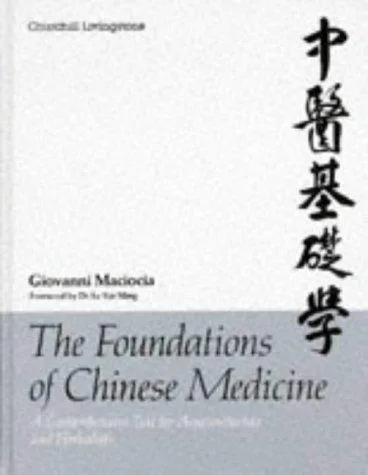
Giovanni Maciocia's 2005 book explains Traditional Chinese Medicine's theoretical and practical aspects.
Published in 2005, The Foundations of Chinese Medicine examines the theory and practice of Traditional Chinese Medicine (TCM). It moves beyond symptom treatment to detail the philosophical and energetic frameworks that have shaped Chinese healing for centuries. The book systematically covers diagnostic methods, therapeutic principles, and a wide range of herbal substances central to TCM.
This work is intended for students and practitioners of acupuncture, herbal medicine, and Qigong who want a thorough grasp of TCM's fundamental ideas. It helps readers understand the connections between body, mind, and spirit as viewed in classical Chinese thought. The book's depth also interests scholars of comparative medicine and philosophy.
Maciocia's synthesis integrates classical theory with modern clinical understanding. It presents an alternative to Western biomedical approaches, focusing on concepts like Qi, Yin and Yang, and the Five Elements to explain health and disease.
This book situates Traditional Chinese Medicine within a long history of thought that connects the physical body with energetic and spiritual principles. Drawing from texts like the *Huangdi Neijing*, it presents a view of health and illness that emphasizes balance and flow, concepts central to many esoteric traditions. The understanding of Qi, the vital life force, and its circulation through meridians forms a core aspect of this worldview, differing significantly from purely materialist explanations of the body.
💡 Why Read This Book?
• Gain a structured understanding of the Five Elements (Wu Xing) and their cyclical relationships, providing a framework for analyzing physiological and pathological processes that is distinct from Western physiology. • Master the diagnostic significance of pulse and tongue examination, learning how these observable phenomena are interpreted within the TCM diagnostic paradigm, a skill not typically found in Western medical texts. • Comprehend the concept of Qi and its pathways (meridians), understanding how energy flow is central to health and how imbalances manifest as disease according to classical Chinese medical theory.
⭐ Reader Reviews
Honest opinions from readers who have explored this book.
❓ Frequently Asked Questions
When was Giovanni Maciocia's 'The Foundations of Chinese Medicine' first published?
Giovanni Maciocia's *The Foundations of Chinese Medicine* was first published in 2005, establishing it as a significant modern text within the field of Traditional Chinese Medicine.
What are the core theoretical concepts covered in this book?
The book covers core TCM concepts including Qi, Yin and Yang, the Five Elements (Wu Xing), Zang-Fu organ theory, and the meridian system (Jingluo pathways).
Is this book suitable for complete beginners in Traditional Chinese Medicine?
While comprehensive, the book is dense and best suited for students or practitioners with some foundational knowledge or a strong academic inclination. Beginners might find it challenging without a guiding instructor.
What is the historical significance of the theories discussed in the book?
The theories discussed, such as those found in the *Huangdi Neijing* (Yellow Emperor's Inner Canon) from the Han Dynasty, represent thousands of years of medical observation and philosophy in China.
Does the book cover Chinese herbal medicine?
Yes, *The Foundations of Chinese Medicine* includes extensive coverage of the materia medica, detailing the properties and therapeutic actions of numerous Chinese herbs.
What diagnostic methods are explained in detail?
The book provides detailed explanations of key TCM diagnostic methods, most notably pulse diagnosis and tongue diagnosis, linking observations to underlying energetic patterns.
🔮 Key Themes & Symbolism
Qi and the Energetic Body
The concept of Qi, often translated as vital energy, is central to understanding how Traditional Chinese Medicine views health and disease. Maciocia's work meticulously details the flow of Qi through specific pathways known as meridians, or Jingluo. Imbalances in the production, circulation, or quality of Qi are seen as the root cause of illness. The book explores how various factors, from diet and emotions to external pathogens, can disrupt Qi, leading to stagnation or deficiency, and how therapeutic interventions aim to restore its harmonious movement.
Yin and Yang Dichotomy
The fundamental principle of Yin and Yang provides a framework for understanding the interdependent and opposing forces that govern all phenomena, including the human body. Maciocia illustrates how health is maintained through the dynamic balance of Yin (cool, passive, dark) and Yang (warm, active, light) energies within the body's systems. He explains how disease arises from an excess or deficiency of either Yin or Yang, and how diagnostic methods identify these imbalances to guide treatment strategies.
The Five Elements (Wu Xing)
Maciocia thoroughly explains the theory of the Five Elements – Wood, Fire, Earth, Metal, and Water – and their intricate cycles of generation (Sheng) and control (Ke). This framework is applied to understand the relationships between different organ systems, emotions, seasons, and even tastes. The book demonstrates how this elemental interplay influences physiological functions and provides a sophisticated system for diagnosing and treating complex conditions by addressing root imbalances within these elemental relationships.
Zang-Fu Organ Theory
Beyond the anatomical understanding of organs, TCM's Zang-Fu theory describes their energetic functions and interrelationships. Maciocia elucidates the roles of the six Fu (hollow) organs and five Zang (solid) organs, detailing their energetic properties, their connection to specific emotions and tissues, and how their functional harmony or disharmony manifests in health and disease. This holistic perspective sees organs not in isolation but as interconnected energetic entities within the body's complex system.
💬 Memorable Quotes
Direct passages from the work, attributed to the author.
“The pulse is the most important diagnostic method.”
— This statement highlights the important role of pulse diagnosis in Traditional Chinese Medicine. Maciocia emphasizes how feeling the subtle qualities of the pulse allows practitioners to assess the state of Qi and Blood, the condition of Zang-Fu organs, and the presence of pathological factors, offering a direct window into the body's energetic landscape.
“Imbalance of Yin and Yang is the fundamental cause of disease.”
— This core principle underscores the book's focus on energetic homeostasis. It suggests that illness arises not from external agents alone but from internal disharmony between opposing yet complementary forces, guiding the practitioner to restore balance rather than merely treating symptoms.
“The meridians are like rivers flowing through the body.”
— This analogy vividly conveys the concept of the meridian system. It illustrates Qi as a vital fluid circulating through defined channels, essential for nourishing tissues and maintaining physiological functions. Blockages or deficiencies in these 'rivers' are directly linked to disease patterns.
“The Five Elements provide a comprehensive system for understanding interrelationships.”
— This points to the broad applicability of the Wu Xing theory. Maciocia shows how it connects not only bodily functions but also aspects of nature, emotion, and pathology, offering a unified model for diagnosis and treatment.
“The tongue provides a map of the body's internal state.”
— This highlights the significance of tongue diagnosis in TCM. The color, coating, and shape of the tongue are presented as visual indicators reflecting the condition of Qi, Blood, and internal organs, serving as a crucial diagnostic tool.
🌙 Esoteric Significance
Tradition
While not strictly a text of Western esotericism (like Hermeticism or Kabbalah), *The Foundations of Chinese Medicine* engages with a lineage of profound philosophical and cosmological thought that shares deep resonances with esoteric traditions. Its emphasis on vital energy (Qi), the balance of opposing forces (Yin/Yang), and the interconnectedness of microcosm and macrocosm aligns with principles found in Taoism, which itself has significant esoteric dimensions. Maciocia's work acts as a bridge, presenting a system that, while empirical in its own right, is rooted in a worldview that perceives unseen energetic forces governing existence.
Symbolism
The book is rich with symbolic representation. Qi, as vital breath or energy, functions as a primary symbolic force, akin to the *pneuma* in Greek philosophy or the divine spark in Gnostic thought. Yin and Yang are perhaps the most recognizable symbols, representing the dynamic duality inherent in all things, a concept echoed in many esoteric cosmologies. The Five Elements (Wu Xing) also function symbolically, mapping relationships and transformations through archetypal correspondences (e.g., Wood associated with growth and spring, Water with depth and winter), providing a complex symbolic language for understanding the universe and the human body.
Modern Relevance
Contemporary practitioners of acupuncture, herbalism, and Qigong continue to rely on Maciocia's synthesis as a foundational text. Beyond clinical application, thinkers exploring holistic health, mind-body medicine, and comparative philosophy draw upon TCM principles as presented here. The work's detailed explication of energetic systems offers a valuable counterpoint to purely materialistic scientific paradigms, influencing modern discussions on consciousness, vitality, and the nature of healing within both academic and alternative wellness circles.
👥 Who Should Read This Book
• Aspiring acupuncturists and herbalists: Those beginning formal training in Traditional Chinese Medicine will find this an indispensable reference for mastering the theoretical framework, diagnostic methods, and herbal properties required for practice. • Comparative medical researchers: Scholars interested in understanding diverse approaches to health and disease will gain crucial insights into a sophisticated medical system distinct from Western biomedicine. • Students of Taoist philosophy and cosmology: Individuals seeking to understand the practical applications of Taoist principles in health and healing will find this book offers a detailed, system-based exploration of these concepts.
📜 Historical Context
Giovanni Maciocia's *The Foundations of Chinese Medicine*, published in 2005, emerged at a time when Traditional Chinese Medicine (TCM) was increasingly integrated into global healthcare discourse, yet often lacked rigorous theoretical grounding for Western practitioners. The work draws heavily from classical texts like the *Huangdi Neijing* (Yellow Emperor's Inner Canon), dating back to the Han Dynasty (206 BCE – 220 CE), and synthesizes centuries of medical knowledge. Maciocia's approach contrasts with the more simplified or 'TCM-lite' versions that had become prevalent, insisting on the philosophical depth and energetic nuances inherent in the system. His synthesis aimed to bridge the gap between ancient theory and modern clinical practice, providing a comprehensive resource that moved beyond the superficial adoption of techniques. Unlike purely biomedical approaches, TCM posits a holistic energetic model, and Maciocia's text champions this view, making it a reference for serious students and practitioners seeking to understand TCM's profound theoretical framework.
📔 Journal Prompts
The concept of Qi flow through the meridians.
Interpreting the balance of Yin and Yang in daily life.
The Five Elements (Wu Xing) and personal emotional patterns.
How Zang-Fu organ theory might explain psychosomatic responses.
Reflecting on the pulse diagnosis as an energetic map.
🗂️ Glossary
Qi (Chi)
Vital energy or life force that circulates throughout the body, animating all living things. It is fundamental to health and its imbalances lead to disease.
Yin and Yang
Two complementary and opposing fundamental forces or principles whose dynamic balance is essential for health and the functioning of the universe. Yin represents passive, cool, dark aspects; Yang represents active, warm, light aspects.
Jingluo
The network of channels or meridians through which Qi and Blood circulate in the body, connecting the Zang-Fu organs to the surface and to each other.
Wu Xing
The Five Elements or Phases (Wood, Fire, Earth, Metal, Water), a philosophical model used to explain the relationships and interactions between different phenomena in nature and the body.
Zang-Fu Organs
The system of organ theory in TCM, categorizing organs into Yin (Zang, solid) and Yang (Fu, hollow) types based on their energetic functions and interrelationships.
Materia Medica
A comprehensive description of the medicinal properties of substances, primarily herbs, used in Traditional Chinese Medicine, including their nature, flavor, and therapeutic actions.
Shen
Spirit, mind, or consciousness. It is considered to reside in the Heart and is essential for mental and emotional well-being, influenced by the balance of Qi and Blood.
🔮 Readers Also Liked
Browse all →








More by Giovanni Maciocia
All books →





More Free Occult Philosophy Books
View all →