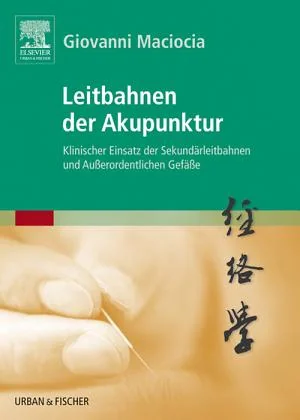
Leitbahnen der Akupunktur
 77
77

Leitbahnen der Akupunktur
Giovanni Maciocia’s *Leitbahnen der Akupunktur* provides an exceptionally detailed cartography of acupuncture's secondary energetic pathways. The book’s strength lies in its meticulous presentation of each meridian’s course, clinical utility, and historical citations, supported by over 450 illustrations. This visual and textual density is invaluable for anyone seeking to move beyond foundational meridian theory. However, the sheer volume of information, while a strength, can also be a limitation for beginners; the text demands focused study rather than casual perusal. A particularly striking section details the sinew channels (Jin Jin), offering a vivid connection between superficial anatomy and energetic flow, a concept Maciocia elucidates with clinical clarity. The work is an indispensable, if demanding, resource for advanced acupuncture practitioners.
📝 Description
77
Giovanni Maciocia's 2009 book details the secondary meridians of acupuncture.
Leitbahnen der Akupunktur, published in 2009, provides a thorough visual and textual examination of acupuncture's secondary meridians. Maciocia details the pathways, clinical uses, and historical indications of these less commonly discussed energetic channels. This work functions as a detailed atlas and reference for practitioners and students who want a clearer grasp of the complex network of acupuncture pathways beyond the main meridians. The book is mainly for Traditional Chinese Medicine (TCM) practitioners, acupuncturists, and advanced students. It is also useful for researchers studying TCM's anatomical and energetic links and those aiming to incorporate a more detailed understanding of meridian theory into their practice. Individuals focused on complex diagnostic and treatment strategies involving the collateral and divergent channels will find this resource especially helpful.
The origins of studying secondary meridians in acupuncture reach back to early TCM texts like the Ling Shu and Su Wen. Maciocia's 2009 publication appears at a time when TCM is widely known but often oversimplified. While other authors have made TCM accessible to Western audiences, Maciocia's focus stays on precise physiological and energetic anatomy, drawing from classical Chinese medical literature and current clinical experience. The book's detailed approach meets the need for exact knowledge in a field with varied interpretations.
The study of secondary meridians, as presented by Maciocia, connects to the deeper energetic anatomy described in classical Chinese medicine. These channels, distinct from the primary meridians, represent a more complex layer of the body's energetic system. Their exploration touches upon the subtle physiology that underlies both health and disease in TCM theory. Understanding these vessels offers insight into how Qi and Blood circulate through pathways that influence the musculoskeletal system, organ connections, and the overall energetic balance of the individual, moving beyond superficial symptom treatment.
💡 Why Read This Book?
• Gain a comprehensive understanding of the secondary meridians, including divergent channels and luo-connecting vessels, as detailed in Maciocia's 2009 publication, allowing for more refined diagnostic strategies. • Master the clinical applications and classical indications of each pathway, referencing original texts as presented in the book, to deepen your therapeutic efficacy. • Utilize the 450 detailed drawings and flowcharts to visualize complex energetic pathways, enhancing your spatial understanding of the acupuncture system beyond primary meridians.
⭐ Reader Reviews
Honest opinions from readers who have explored this book.
❓ Frequently Asked Questions
What are the primary secondary meridians covered in Leitbahnen der Akupunktur?
The book extensively covers the divergent channels (Jing Bie), luo-connecting vessels (Luo Mai), sinew channels (Jin Jin), and aspects of the eight extraordinary vessels (Qi Jing Ba Mai) related to secondary pathways.
What is the main clinical benefit of studying secondary meridians according to Maciocia?
Studying secondary meridians allows for a deeper understanding of complex disease patterns, systemic connections, and the regulation of primary meridians, leading to more targeted and effective treatments.
How does Leitbahnen der Akupunktur present information on classical indications?
For each secondary meridian, the book provides classical indications with direct quotes from original acupuncture and TCM texts, grounding the modern application in historical medical literature.
What kind of visual aids are included in the book?
The volume features approximately 450 clear drawings and flow diagrams, illustrating the course of the meridians, their connections, and clinical application points for enhanced comprehension.
Is this book suitable for beginners in acupuncture?
While comprehensive, the detailed nature of the secondary meridians makes this book more suitable for advanced students and practitioners of acupuncture who already possess a foundational knowledge of the primary channels.
When was Giovanni Maciocia's work on acupuncture meridians first published?
Giovanni Maciocia's 'Leitbahnen der Akupunktur' was first published in 2009, offering a detailed exploration of secondary meridians.
🔮 Key Themes & Symbolism
Divergent Channels (Jing Bie)
The divergent channels represent a crucial layer of the acupuncture system, branching from the primary meridians to connect internally and externally, and to the sinews and bones. Maciocia's work meticulously traces these pathways, highlighting their role in disease manifestation that affects deeper structures or presents with complex systemic symptoms. Understanding the Jing Bie is presented as key to treating conditions that might not respond to primary meridian treatments, offering a more profound level of energetic diagnosis and intervention.
Luo-Connecting Vessels (Luo Mai)
These smaller vessels, connecting the interior and exterior of meridians and linking paired meridians, are vital for regulating Qi and Blood flow. The book details the 15 primary luo-connecting vessels and their associated collateral branches. Maciocia emphasizes their function in transmitting sensations and their involvement in conditions characterized by stagnation, pain, or emotional disturbances. Their study provides insight into the subtle energetic network that maintains homeostasis and influences the surface presentation of internal imbalances.
Sinew Channels (Jin Jin)
Maciocia dedicates significant attention to the sinew channels, which follow the pathways of the muscles and tendons. This section elucidates how Qi and Blood flow through these superficial structures, influencing joint mobility and posture. The book illustrates their connection to the primary meridians and their role in musculoskeletal pain, stiffness, and functional disorders, offering a direct link between the energetic body and physical anatomy for therapeutic purposes.
Extraordinary Vessels' Secondary Roles
While the eight extraordinary vessels are often studied independently, Maciocia integrates their secondary functions within the broader meridian system. The book explores how these vessels act as reservoirs and regulators of Qi and Blood, influencing the primary and secondary channels. Their unique pathways and profound energetic influence are examined in relation to specific conditions, offering a more comprehensive view of their interconnectedness with the entire acupuncture energetic framework.
💬 Memorable Quotes
Direct passages from the work, attributed to the author.
“For each meridian, representation of course, clinical application possibilities, classical indications with quotes from original works, point description, and practical application example.”
— This statement captures the book's structured approach, promising a thorough, multi-faceted examination of each secondary meridian, blending theoretical grounding with practical clinical utility.
“450 illustrative drawings and flowcharts.”
— This quantifies the book's visual density, highlighting its commitment to providing clear, diagrammatic explanations essential for understanding complex anatomical and energetic pathways.
“Clinical application possibilities for each meridian.”
— This points to the practical, hands-on value of the text, emphasizing its utility for practitioners aiming to directly apply meridian theory to patient treatment.
“Classical indications with citations from original works.”
— This highlights the book's scholarly rigor, demonstrating its reliance on historical TCM texts to validate and inform the understanding of meridian functions and therapeutic uses.
💡 Key Ideas
Editorial paraphrase of the work's core concepts — not direct quotes.
Secondary meridians' pathways, clinical application, and indications.
This summarizes the core content, emphasizing the focus on the less commonly detailed secondary pathways and their direct relevance to acupuncture practice.
🌙 Esoteric Significance
Tradition
While acupuncture itself has ancient roots intertwined with Taoist philosophy and concepts of Qi, Maciocia's work, as a clinical text, primarily focuses on the physiological and energetic applications. Its esoteric significance lies in its detailed mapping of the body's subtle energy pathways, which can be seen as a form of energetic anatomy aligned with concepts found in various esoteric traditions that explore vital force and energetic circulation within the human form.
Symbolism
The meridians themselves, as depicted in the book, function as symbolic pathways of Qi. The divergent channels, for instance, can symbolize the body's capacity for deep connection and systemic regulation, while the luo-connecting vessels represent the intricate web of relationships within the energetic body. The sinew channels symbolize the interface between the energetic and the physical, illustrating how internal imbalances manifest as external structural issues.
Modern Relevance
Contemporary practitioners of acupuncture, bodyworkers, and even some somatic therapists draw upon Maciocia's detailed anatomical and energetic mapping. His work informs modern understandings of pain management, psychosomatic illness, and the interconnectedness of bodily systems, resonating with current trends in holistic health and functional medicine that seek to understand the body as an integrated energetic and physical whole.
👥 Who Should Read This Book
• Advanced acupuncture practitioners seeking to deepen their diagnostic and treatment skills by mastering the complex secondary meridian systems. • Students of Traditional Chinese Medicine (TCM) looking for a comprehensive, visually-aided reference to the divergent channels, luo vessels, and sinew channels. • Holistic health professionals interested in the energetic anatomy of the body and how subtle pathways influence physical and emotional well-being.
📜 Historical Context
Giovanni Maciocia's *Leitbahnen der Akupunktur*, published in 2009, emerged within a global landscape where Traditional Chinese Medicine (TCM) had gained significant traction but also faced ongoing efforts to standardize and Westernize its complex theoretical frameworks. While authors like Kaptchuk were making TCM accessible, Maciocia’s work maintained a deep dive into the intricate details of the meridian system. This period saw a growing academic interest in the historical evolution of TCM. Maciocia's meticulous approach, drawing heavily on classical texts and detailed anatomical descriptions, positioned his work as a rigorous counterpoint to more generalized introductions. The reception of such detailed works often comes from a dedicated professional community seeking to preserve and deepen their understanding of TCM's historical depth, contrasting with schools of thought that might prioritize simplified, symptom-based approaches.
📔 Journal Prompts
The intricate pathways of the divergent channels (Jing Bie) and their role in systemic illness.
Visualizing the luo-connecting vessels (Luo Mai) and their function in regulating Qi and Blood.
The relationship between the sinew channels (Jin Jin) and musculoskeletal pain.
Clinical application examples for treating complex conditions using secondary meridians.
Classical indications cited from original texts for specific secondary meridian pathways.
🗂️ Glossary
Divergent Channels (Jing Bie)
A set of 15 channels that branch off from the primary meridians, connecting the interior and exterior, and extending to the sinews and bones. They play a central role in systemic Qi and Blood circulation and disease manifestation.
Luo-Connecting Vessels (Luo Mai)
Smaller vessels that branch from the main meridians, connecting them to each other and to the interior/exterior. They are responsible for the smooth flow of Qi and Blood and are involved in transmitting sensations.
Sinew Channels (Jin Jin)
Superficial pathways following the distribution of muscles and tendons, responsible for movement and joint function. They are closely related to the primary meridians and influence musculoskeletal health.
Eight Extraordinary Vessels (Qi Jing Ba Mai)
A group of eight special meridians with unique functions, often considered reservoirs of Qi and Blood that regulate the primary meridians and influence development and constitution.
Classical Indications
The specific symptoms, diseases, or conditions for which a particular acupuncture point or meridian pathway was traditionally used, often documented in ancient medical texts.
Clinical Application
The practical use of acupuncture meridians and points in treating specific health issues, based on theoretical principles and empirical evidence.
Qi
The fundamental vital energy or life force that flows through the body, animating all physiological and psychological functions according to Traditional Chinese Medicine.
This book appears in 1 collection
🔮 Readers Also Liked
Browse all →







From the “Acupuncture” Collection
View all →





More Free Occult Philosophy Books
View all →