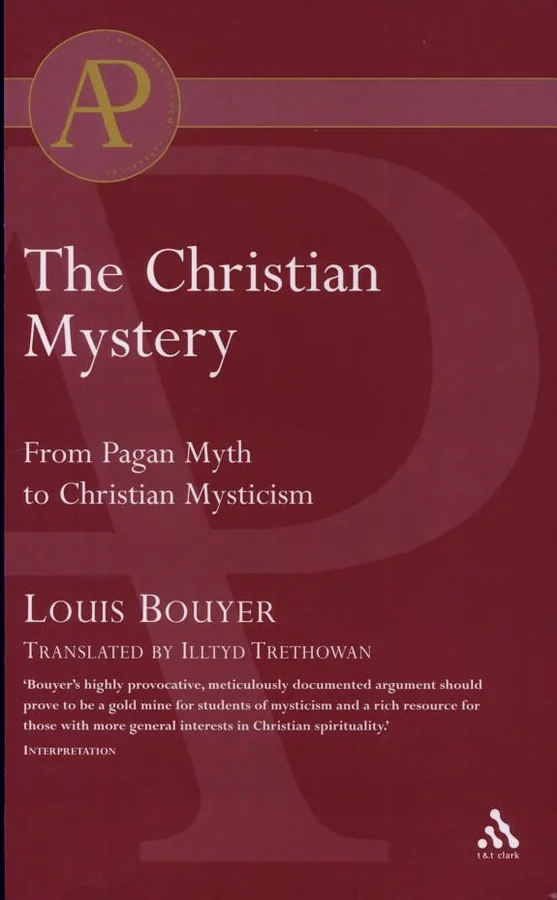
The Christian Mystery
 76
76

The Christian Mystery
Louis Bouyer's "The Christian Mystery" is a substantial academic undertaking that probes the very essence of Christian revelation through the lens of 'mystery.' Bouyer, a noted theologian, meticulously dissects how the concept of mystery functions not as an obscure secret, but as a divinely revealed truth central to Christian understanding and practice. His strength lies in the systematic dismantling of common misconceptions, grounding the idea of mystery in the historical events and salvific actions of Christianity, particularly as expressed through liturgy and sacraments. A point of contention, however, might be the density of the prose, which demands considerable reader concentration and theological background. A particularly striking passage details the 'sacramental mystery,' illustrating how bread and wine become the Body and Blood of Christ, a tangible yet transcendent reality. This work serves as a vital corrective for those who might reduce Christianity to mere historical or ethical propositions, reminding us of its fundamentally revelatory and salvific core.
📝 Description
76
Louis Bouyer's 2004 book argues that Christian mystery is central to revelation and practice.
First published in 2004, Louis Bouyer's "The Christian Mystery" undertakes a thorough study of the concept of 'mystery' within Christianity. The author moves beyond simple interpretations to show how mystery is fundamental to Christian revelation and practice. Bouyer argues that grasping Christian mystery is essential for understanding the richness of Christian spirituality throughout its history.
This book is for theology students, those studying comparative religion, and individuals interested in Christian spirituality. It is suited for readers who want to move beyond basic devotional ideas and engage with the intellectual and mystical foundations of their faith. Anyone who values careful academic analysis of religious concepts, especially concerning the historical development of Christian thought and its less obvious dimensions, will find significant value here.
Bouyer's work appeared in the early 2000s during a time of increased academic focus on the history of Christian thought and spirituality. It responded to theological conversations after Vatican II and to movements that might have secularized or stripped core Christian beliefs of their symbolic meaning. The book implicitly engages with scholars like Hans Urs von Balthasar, who were also examining the theological depth of revelation, offering a perspective that complements theirs on the crucial role of mystery.
Within Christian traditions, 'mystery' often refers to divine truths not fully comprehensible by reason alone, revealed through faith and divine action. Bouyer's work engages with this tradition, distinguishing it from mere secrecy. He connects it to the Church's sacraments and liturgy, viewing them as conduits for divine grace and encounter. This perspective places the book within a lineage of Christian thought that emphasizes the hidden, spiritual dimensions of faith accessible through specific practices and theological understanding, rather than solely through rational deduction.
💡 Why Read This Book?
• Gain a sophisticated understanding of "sacramental mystery," learning how Bouyer posits that the Church's liturgy and sacraments are not mere symbols but actual encounters with divine realities revealed through Christ, a concept distinct from secular interpretations of ritual. • Explore the theological grounding of Christian "mysticism" as presented in Bouyer's work, understanding it as an authentic response to divine revelation rather than an esoteric or private spiritual pursuit, differentiating it from non-Christian contemplative practices. • Grasp the historical trajectory of Christian thought concerning mystery, appreciating Bouyer's 2004 publication as a contribution to early 21st-century theological discourse that emphasizes the integral role of divine revelation in shaping Christian identity.
⭐ Reader Reviews
Honest opinions from readers who have explored this book.
❓ Frequently Asked Questions
What is the primary argument of Louis Bouyer's 'The Christian Mystery'?
Bouyer argues that 'mystery' in Christianity refers not to hidden secrets, but to divinely revealed truths central to Christian life and spirituality, particularly as encountered through sacraments and liturgy.
When was 'The Christian Mystery' first published?
The book was first published on September 10, 2004, positioning it within early 21st-century theological scholarship.
Who would benefit most from reading 'The Christian Mystery'?
Students of theology, comparative religion, and those seeking a deeper, academic understanding of Christian spirituality and its historical development would find this book particularly valuable.
How does Bouyer define Christian mysticism?
Bouyer defines Christian mysticism as a direct response to God's revelation, rooted in faith and the Church's sacramental life, rather than an individualistic or Gnostic pursuit.
What is the significance of liturgy and sacraments in Bouyer's view?
Liturgy and sacraments are presented as the primary means through which Christian mystery is actualized and encountered, serving as conduits of divine grace and revelation.
Does the book discuss specific historical figures or movements?
While primarily conceptual, the work engages with the broader sweep of Christian theological history and implicitly addresses contemporary theological trends of its publication era.
🔮 Key Themes & Symbolism
The Nature of Christian Mystery
This theme explores how 'mystery' in Christianity is not about secrecy but divine revelation. Bouyer distinguishes it from simply unknown facts, positing it as God's self-disclosure through historical events, particularly the life, death, and resurrection of Christ. The revelation is accessible through faith and the Church's life, emphasizing that mystery is an object of faith and participation, not solely intellectual assent.
Sacramental Realization
Central to Bouyer's argument is the role of sacraments and liturgy in making Christian mystery present and accessible. The book examines how elements like bread and wine, or water in baptism, become tangible vehicles for divine grace and encounter. This section details how the 'sacramental mystery' bridges the gap between the human and the divine, enacting salvation history in the present.
Christian Mysticism Defined
Bouyer clarifies Christian mysticism as an authentic response to God's revealed mystery. It is characterized by faith, hope, and love, lived within the community of the Church and expressed through prayer and participation in its life. This perspective contrasts with mystical traditions that might be perceived as detached from historical revelation or ecclesiastical structure.
Revelation and Faith
The interplay between divine revelation and human faith is a persistent theme. The book posits that Christian mystery is something revealed by God, which the human intellect and spirit apprehend through faith. This section discusses how faith is not blind adherence but an informed assent to the truth of God's self-communication, made possible by the mysteries themselves.
💬 Memorable Quotes
Direct passages from the work, attributed to the author.
“Christian mystery is not a secret to be guarded, but a divine reality to be revealed.”
— This interpretation highlights Bouyer's core argument: that the term 'mystery' in Christianity signifies God's self-disclosure, a truth made known through Christ and the Church, intended for all believers.
“Mysticism, in the Christian sense, is a response of faith to divine revelation.”
— This captures Bouyer's distinction between Christian mysticism and other forms. It's framed as an outgrowth of encountering God's revealed truth, rooted in the historical events of salvation.
“Sacramental signs are actual participations in the divine reality they signify.”
— This concept, central to the book, suggests that sacraments like the Eucharist are more than symbols; they are real encounters with the Body and Blood of Christ.
💡 Key Ideas
Editorial paraphrase of the work's core concepts — not direct quotes.
The liturgy is the primary place where Christian mystery is lived and encountered.
This paraphrase emphasizes the book's focus on the Church's worship. Bouyer asserts that the sacraments and liturgical celebrations are not mere representations but actual occasions where believers participate in God's salvific work.
Understanding mystery is fundamental to understanding Christian spirituality.
This paraphrased statement underscores the book's thesis: that a correct grasp of divine mystery is not peripheral but essential for comprehending the depth and trajectory of Christian spiritual life throughout history.
🌙 Esoteric Significance
Tradition
While rooted firmly in Catholic theology, "The Christian Mystery" engages with concepts that resonate with broader esoteric traditions by exploring the less-obvious layers of divine revelation. It shares with Gnosticism an interest in hidden knowledge, but Bouyer insists this knowledge is divinely bestowed and sacramentally mediated, not independently discovered. It departs from purely Hermetic or Kabbalistic interpretations by centering the mystery squarely within the historical person of Jesus Christ and the Church's sacramental life.
Symbolism
The book frequently references the symbolism inherent in Christian sacraments. The "bread and wine" of the Eucharist are prime examples, symbolizing not just the Body and Blood of Christ but also the transformation of ordinary elements into divine grace. Water, as a symbol in Baptism, represents purification and rebirth, signifying a death to the old self and a new life in Christ, bridging the material and spiritual realms.
Modern Relevance
Bouyer's work continues to inform contemporary discussions on sacramental theology and Christian spirituality. Thinkers and communities focused on liturgical renewal, the theology of the body, and neo-patristic studies often draw upon his rigorous analysis. His emphasis on mystery as revealed truth is relevant for modern movements seeking to articulate a robust, intellectually grounded faith in an increasingly secularized world, offering a counterpoint to purely psychological or sociological interpretations of religion.
👥 Who Should Read This Book
• Advanced students of Catholic theology and Church history seeking to understand the foundational role of 'mystery' in Christian doctrine and practice. • Comparative religion scholars interested in how Christian concepts of revelation and sacrament differ from other esoteric or mystical traditions. • Devout lay Catholics desiring a deeper, more academic grasp of their faith's sacramental and mystical dimensions beyond common devotional language.
📜 Historical Context
Louis Bouyer's "The Christian Mystery," published in 2004, entered a theological landscape shaped by post-Vatican II renewal and ongoing debates about the nature of revelation and tradition. Bouyer, a significant figure in 20th-century Catholic theology, was known for his engagement with patristics and his efforts to synthesize different streams of Christian thought. The work implicitly addresses a tendency within some theological circles to demythologize or rationalize Christian doctrine, reasserting the objective reality and salvific importance of divine mystery. It stands in dialogue with scholars like Hans Urs von Balthasar, who also emphasized the profound theological significance of revelation. While not necessarily facing direct censorship, Bouyer's rigorous approach often challenged less nuanced interpretations prevalent in popular religious discourse.
📔 Journal Prompts
The sacramental mystery of the Eucharist: how does Bouyer's concept inform your understanding of its significance?
Divine revelation as the source of Christian mysticism: reflect on specific instances where you felt God's presence responding to your faith.
The distinction between 'mystery' and 'secret' in Christian contexts: articulate a personal experience of encountering divine mystery.
How does the concept of "sacramental mystery" challenge secular views of ritual and symbolism?
Considering Bouyer's definition of Christian mysticism, how does it align with or diverge from your personal spiritual journey?
🗂️ Glossary
Mystery (Christian)
In Bouyer's context, this refers to divine realities revealed by God through Christ and the Church, accessible through faith and participation, not merely hidden knowledge.
Mysticism (Christian)
Defined as an authentic response of faith and love to God's revelation, lived within the Church's communal life and sacramental practice.
Sacrament
An outward and visible sign of an inward and spiritual grace, instituted by Christ, serving as a conduit for divine participation.
Liturgy
The official public worship of the Church, considered by Bouyer to be the primary arena for the experience and expression of Christian mystery.
Revelation
God's act of making Himself and His divine plan known to humanity, forming the basis of Christian mystery.
Faith
The assent of the intellect and will to the truths revealed by God, understood by Bouyer as the necessary response to Christian mystery.
Sacramental Mystery
The concept that sacraments are not mere symbols but actual encounters with and participations in the divine reality they signify.
This book appears in 1 collection
🔮 Readers Also Liked
Browse all →









From the “Christian Mysticism” Collection
View all →








More Free Mysticism & Contemplation Books
View all →