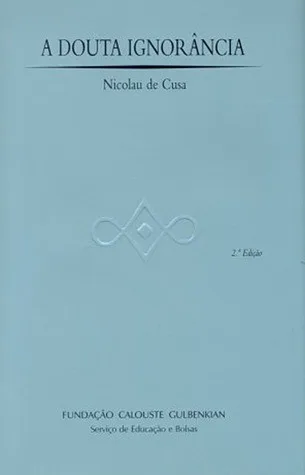
De docta ignorantia
 78
78

De docta ignorantia
Cardinal Nicholas of Cusa's *De docta ignorantia* is less a book to be read and more a labyrinth to be contemplated. Its strength lies in its audacious attempt to articulate the ineffable, particularly through the concept of 'learned ignorance.' Cusa daringly proposes that true understanding begins with acknowledging what we *cannot* know about God. However, this philosophical rigor becomes its primary limitation for the uninitiated. The dense prose, saturated with scholastic terminology and intricate logical progressions, demands considerable intellectual stamina. The section discussing the 'coincidence of opposites' in God, where infinity and finitude are paradoxically one, exemplifies this challenging yet rewarding density. The work is a formidable intellectual edifice, rewarding persistent study.
📝 Description
78
Cardinal Nicholas of Cusa published 'De docta ignorantia' in 1440, positing that true wisdom begins with recognizing ignorance.
Nicholas of Cusa's 'De docta ignorantia,' written around 1440, is a philosophical exploration of the limits of human knowledge and the nature of God. It is not a manual for practical magic but a deep dive into theological and philosophical thought. Cusa argues that the wisest approach is 'learned ignorance,' acknowledging that human intellect cannot fully grasp the divine. He proposes God as the ultimate unity, a 'coincidence of opposites' that transcends all human concepts. The book also discusses how the infinite God is present within finite creation, a concept he terms the 'contracted Absolute.'
This work is for individuals seriously studying Western philosophy, theology, and esoteric traditions. It will resonate with those interested in the intersection of Christian mysticism, Neoplatonism, and scholasticism, especially thinkers who wrestle with paradox and the ineffable quality of the divine. It is not intended for those seeking straightforward answers.
Written in the mid-15th century, 'De docta ignorantia' engages with scholastic traditions while leaning towards a more mystical apprehension of God. Cusa's thought was influenced by Neoplatonic ideas circulating at the time. His concept of learned ignorance, where recognizing the limits of human understanding is a path to wisdom, aligns with certain contemplative traditions that emphasize transcending rational thought to approach the divine. The idea of God as a unity of opposites also echoes mystical approaches that seek to reconcile apparent contradictions in the nature of ultimate reality.
💡 Why Read This Book?
• Gain a unique perspective on divine unknowability, understanding Cusa's concept of 'learned ignorance' as a path to wisdom, distinct from simple lack of knowledge. • Grasp the theological significance of the 'coincidentia oppositorum' (coincidence of opposites) as presented by Cusa, challenging conventional dualistic thinking about God and existence. • Explore the intellectual currents of the 15th century through Cusa's engagement with Neoplatonism and scholasticism, understanding the philosophical milieu that produced this esoteric work.
⭐ Reader Reviews
Honest opinions from readers who have explored this book.
❓ Frequently Asked Questions
What does 'learned ignorance' mean in Nicholas of Cusa's De docta ignorantia?
Learned ignorance, as articulated by Nicholas of Cusa in *De docta ignorantia*, is the wisdom gained from recognizing the ultimate limits of human intellect when confronting the divine. It's an active, cultivated awareness of our inability to fully grasp God's essence.
Who was Nicholas of Cusa and when did he write De docta ignorantia?
Nicholas of Cusa was a 15th-century German philosopher, theologian, and cardinal. He wrote *De docta ignorantia* around 1440, making it a significant work of late medieval and early Renaissance thought.
What is the 'coincidence of opposites' in Cusa's philosophy?
The 'coincidence of opposites' (coincidentia oppositorum) is a key concept in *De docta ignorantia*, describing how God is the unity where all apparent contradictions (like finite and infinite, beginning and end) are perfectly reconciled and are not truly separate.
Is De docta ignorantia a religious text or a philosophical one?
It is both. *De docta ignorantia* is a profound philosophical treatise deeply rooted in Christian theology. Cusa uses philosophical reasoning to explore theological mysteries, bridging scholasticism and mystical thought.
What is the primary goal of reading De docta ignorantia?
The primary goal is to confront the limits of rational understanding regarding the divine and to cultivate a form of intellectual humility. It aims to lead the reader towards a more mystical or apophatic understanding of God.
How does De docta ignorantia relate to Neoplatonism?
Cusa's work shows significant Neoplatonic influence, particularly in its concept of God as the ultimate unity from which all multiplicity emanates and its emphasis on the ineffability of the divine beyond all categories.
🔮 Key Themes & Symbolism
Learned Ignorance
The central tenet of *De docta ignorantia* is that true wisdom is achieved not through accumulating factual knowledge, but by recognizing the profound limits of human intellect when attempting to comprehend the absolute. Cusa argues that the greatest knowledge of God comes from understanding our own ignorance of His infinite nature. This concept posits a form of intellectual humility as a prerequisite for genuine spiritual insight, moving beyond mere intellectual assent to a deeper, more experiential understanding of divine transcendence.
Coincidence of Opposites
Cusa's exploration of *coincidentia oppositorum* posits that in God, all seemingly contradictory concepts are unified. The infinite is not separate from the finite; the beginning is not distinct from the end. This concept challenges dualistic thinking and suggests that divine reality transcends all dichotomies that our limited human minds impose. This idea is crucial for understanding how Cusa attempts to articulate the nature of an absolute, simple, and infinite God who is simultaneously the ground of all differentiated existence.
God as Absolute Maximum and Minimum
In *De docta ignorantia*, Cusa describes God as the 'maximum' and 'minimum' simultaneously. This paradoxical formulation suggests God is beyond all measure and comparison, representing the absolute limit of all that can be conceived, yet also the simple, undifferentiated source from which all things arise. This concept highlights God's absolute transcendence and immanence, acting as the ultimate unity that contains all possibilities without being limited by any single attribute or category we might apply.
The Contracted Absolute
This theme addresses how the infinite God, as the Absolute, manifests within the finite area of creation. Cusa suggests that creation is a 'contracted' form of the Absolute, a limited expression of divine infinity. This is not seen as a diminishment of God but as a necessary mode of divine existence in the world. Understanding this concept helps to bridge the gap between the transcendent divine and the immanent reality we experience, suggesting a profound connection between the ultimate source and its diverse manifestations.
💬 Memorable Quotes
Direct passages from the work, attributed to the author.
“Wisdom is nothing else than the measure of truth.”
— This statement from *De docta ignorantia* suggests that true wisdom is not arbitrary but is inherently tied to understanding reality's true nature, acting as a gauge or standard by which we apprehend truth.
“The closer the likeness, the greater the distance from the Absolute.”
— This interpretation points to the paradox that as created things become more defined and particular (more 'like' something specific), they move further away from the undifferentiated, absolute nature of God.
“Ignorance is the path to learned ignorance.”
— This aphorism reflects Cusa's core thesis: that the acknowledgment of our lack of complete knowledge is the first step toward a deeper, more profound, and 'learned' understanding of reality, especially concerning the divine.
💡 Key Ideas
Editorial paraphrase of the work's core concepts — not direct quotes.
The coincidence of opposites is the ultimate principle.
This paraphrased concept highlights Cusa's radical idea that ultimate reality, particularly God, is found where all apparent dualities and contradictions meet and are resolved into a single, unified truth.
God is the maximum and the minimum, the beginning and the end.
This paraphrase captures Cusa's assertion that God transcends all finite categories, embodying both the ultimate limit of all conceivable things and the simple, undifferentiated source from which they emerge.
🌙 Esoteric Significance
Tradition
Cusa's work bridges Neoplatonism and Christian mysticism within the Western esoteric tradition. While rooted in Catholic theology, his emphasis on apophatic theology (defining God by what He is not) and the paradoxical nature of the Absolute echoes Gnostic and Hermetic thought. He departs from purely scholastic methods by employing philosophical paradox to point towards divine transcendence, offering a pathway to understanding that transcends rational discourse and enters the area of mystical intuition.
Symbolism
The concept of the 'coincidence of opposites' (coincidentia oppositorum) is a potent symbolic motif, representing the divine unity that underlies all perceived dualities. The 'Absolute as maximum and minimum' symbolizes God's transcendence beyond all measure, being both the ultimate limit and the undifferentiated source. These symbols function not as literal descriptions but as conceptual tools to gesture towards the ineffable nature of the divine, pushing the mind beyond its usual conceptual boundaries.
Modern Relevance
Cusa's exploration of the limits of knowledge and the paradoxical nature of reality continues to influence contemporary thinkers in philosophy, theology, and mysticism. His ideas on 'learned ignorance' are revisited by those exploring contemplative practices and the philosophy of science, particularly in fields grappling with uncertainty and the nature of consciousness. Philosophers like Michel Foucault have referenced Cusa, and his work remains a touchstone for modern mystical theology and esoteric philosophy seeking to articulate the ineffable.
👥 Who Should Read This Book
• Advanced students of Western philosophy and theology seeking to understand the transition from medieval scholasticism to Renaissance thought, particularly Cusa's unique contribution. • Practitioners of contemplative prayer and mysticism interested in philosophical frameworks that support an apophatic or ineffable approach to the divine. • Scholars of comparative religion and philosophy of religion examining how different traditions grapple with the concept of an absolute, transcendent deity.
📜 Historical Context
Written around 1440, Nicholas of Cusa's *De docta ignorantia* emerged from the intellectual crucible of the late Middle Ages and the dawn of the Renaissance. Cusa, a central figure, was deeply engaged with scholastic philosophy but also influenced by the Neoplatonic currents re-emerging in intellectual circles. He was a contemporary of Johannes Gutenberg, whose printing press would soon revolutionize knowledge dissemination. Cusa's work stood in contrast to more scholastic, Aristotelian approaches that sought definitive knowledge through logical categorization. His ideas on the ineffability of God and the paradoxes inherent in divine understanding offered a mystical counterpoint. His participation in the Council of Florence (1439) also shaped his theological outlook, emphasizing unity and reconciliation.
📔 Journal Prompts
The paradox of God as the Absolute Maximum and Minimum.
Learned ignorance as a path to wisdom.
The nature of truth as measure.
The reconciliation of opposites in the divine.
The concept of the contracted Absolute in creation.
🗂️ Glossary
Docta ignorantia
Latin for 'Learned Ignorance.' The central concept in Cusa's work, signifying wisdom gained through the conscious recognition of the limits of human knowledge regarding the divine.
Coincidentia oppositorum
Latin for 'Coincidence of Opposites.' Cusa's doctrine that in God, all contradictory concepts (e.g., finite/infinite, beginning/end) are unified and non-dual.
Absolute
In Cusa's philosophy, the ultimate, infinite, and unconditioned reality, understood as God, which transcends all created distinctions and limitations.
Maximum and Minimum
Cusa's description of God as both the highest possible limit and the simplest, most fundamental essence, representing the paradoxical nature of the Absolute.
Contracted Absolute
The manifestation of the infinite, absolute God within the finite reality of creation, seen as a limited but essential expression of divine being.
Apophatic Theology
A theological approach that defines God by negation (what God is not) rather than by positive affirmations, emphasizing divine transcendence and ineffability.
Scholasticism
The dominant philosophical and theological method of medieval European universities, characterized by rigorous logical analysis and dialectical argumentation.
🔮 Readers Also Liked
Browse all →





More by Cardinal Nicholas of Cusa
All books →
More Free Mysticism & Contemplation Books
View all →