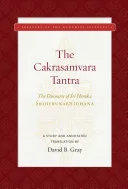
The Cakrasamvara Tantra (The Discourse of Sri Heruka)
 77
77

The Cakrasamvara Tantra (The Discourse of Sri Heruka)
David B. Gray's translation of The Cakrasamvara Tantra is a significant scholarly achievement, finally providing a comprehensive English rendition of this pivotal eighth-century Indian Buddhist scripture. Gray’s introductory essay effectively situates the text within its historical and intellectual milieu, offering crucial context for its complex doctrines. The strength of this work lies in its meticulous scholarship and faithful rendering of the original Sanskrit and Tibetan traditions, allowing for a deeper appreciation of the Cakrasamvara lineage. However, the text’s inherent complexity, particularly its dense ritualistic and philosophical terminology, may present a formidable barrier for readers unfamiliar with advanced Buddhist tantra. A particular passage detailing the Six Yogas, while central to the practice, requires considerable prior knowledge to fully grasp. Gray’s translation stands as an indispensable resource for dedicated scholars and practitioners, though its accessibility could be enhanced with more extensive annotation for a broader audience.
📝 Description
77
David B. Gray's 2019 translation makes the eighth-century Cakrasamvara Tantra fully accessible in English.
The Cakrasamvara Tantra, also known as Sriherukabhidhana and Laghusamvara, is a primary scripture for a major Indian Buddhist tantric tradition. Composed around the eighth century, this text offers insight into the philosophical and ritualistic ideas of its time. Gray's 2019 translation is the first complete, critical English version, giving direct access to the original teachings.
This work is important for students of Indian Buddhism, especially tantric traditions. It will interest scholars of religion, comparative philosophy, and those studying the history of esoteric practices. Advanced practitioners seeking to understand the theoretical basis of their path will also find value here.
Emerging from eighth-century India, the Cakrasamvara Tantra reflects Mahayana Buddhist philosophical developments and the codification of tantric thought. This period saw intense growth in tantric systems, with distinct methods and cosmologies forming. The text is situated within this milieu of developing complex views and ritual practices.
💡 Why Read This Book?
• Understand the foundational cosmology of one of India's most influential Buddhist tantric traditions, as detailed in the Cakrasamvara Tantra's descriptions of deities like Heruka. • Gain direct insight into complex tantric ritual practices and meditative techniques that were codified in eighth-century India, offering a historical perspective on esoteric methods. • Engage with the philosophical underpinnings of yogic systems, particularly the subtle body and energy channels, as presented in the original scripture, not merely secondary interpretations.
⭐ Reader Reviews
Honest opinions from readers who have explored this book.
❓ Frequently Asked Questions
What is the significance of the Cakrasamvara Tantra in Buddhist history?
Composed around the eighth century, the Cakrasamvara Tantra is a foundational scripture for one of the most important Indian Buddhist tantric traditions, offering insights into its early development and core doctrines.
Who is the translator of this specific edition?
David B. Gray is the translator of this edition, which was first published in 2019, providing the first complete, critical English translation.
What are some key deities mentioned in The Cakrasamvara Tantra?
The tantra frequently references deities such as Sri Heruka, who gives the text its alternative title, and is often associated with Vajrayogini in its ritualistic contexts.
When was The Cakrasamvara Tantra originally composed?
The original composition of The Cakrasamvara Tantra is dated to around the eighth century in India, making it an early and influential text in tantric Buddhism.
What does 'Sriherukabhidhana' mean in relation to this tantra?
'Sriherukabhidhana' is an alternative title for The Cakrasamvara Tantra, emphasizing the central deity Sri Heruka and signifying 'the explanation of Sri Heruka'.
What is a 'critical English translation' in this context?
A critical translation, like Gray's, involves not only rendering the text into English but also analyzing its textual history, variants, and historical context, offering scholarly interpretation.
🔮 Key Themes & Symbolism
Deity Yoga and Visualization
The text extensively details the practice of visualizing and internalizing deities, particularly Sri Heruka, as a means of realizing enlightened consciousness. This involves intricate iconographic understanding and the application of specific meditative techniques to embody the qualities of these potent figures. The process is not mere adoration but a transformative identification with awakened principles.
Subtle Body and Energy Systems
Central to the tantra is the understanding of the body's subtle energetic channels (nadis) and winds (prana). Practices described aim to manipulate these energies, purify them, and direct them towards spiritual awakening. This concept is crucial for understanding the physiological and energetic basis of tantric meditative states and rituals.
Ritual and Initiation
The Cakrasamvara Tantra outlines specific ritual procedures and initiation ceremonies essential for practitioners. These rites serve to empower the disciple, transmit spiritual lineages, and facilitate direct access to tantric teachings. Understanding these ceremonies provides insight into the transmission and practice of esoteric traditions.
Achieving Buddhahood
The ultimate aim articulated within the tantra is the attainment of Buddhahood, not as a distant goal but as a realization accessible through the tantric path. The text presents methods for transforming ordinary experience and the conventional self into the enlightened state, emphasizing direct experience over philosophical speculation alone.
💬 Memorable Quotes
Direct passages from the work, attributed to the author.
“The body is the temple of the Buddha.”
— This aphorism suggests that the physical form is not an obstacle to enlightenment but a vessel and a site for realizing Buddhahood. It underscores the tantric emphasis on utilizing all aspects of existence, including the body, in the spiritual path.
“All phenomena are the play of the Great Bliss.”
— This concept highlights the tantric understanding of reality as permeated by an inherent, ecstatic luminosity. It encourages practitioners to perceive the ultimate nature of existence not as mundane or suffering, but as an expression of profound joy and wisdom.
“The Six Yogas are the path to the union of bliss and emptiness.”
— This refers to a specific set of advanced tantric practices designed to integrate profound experiential states. The union of bliss (joy, luminosity) and emptiness (lack of inherent existence) is considered the hallmark of ultimate realization in these traditions.
“Visualize Heruka and become Heruka.”
— This captures the core practice of deity yoga. Through intense visualization and identification with the deity Sri Heruka, the practitioner aims to embody the enlightened qualities that Heruka represents, thereby transforming their own consciousness.
“Mantra is the essence of the enlightened mind.”
— This statement points to the power of sacred syllables (mantra) not as mere sounds, but as condensed expressions of profound spiritual states and wisdom. Recitation and internalization of mantra are considered vital for accessing and actualizing enlightened consciousness.
🌙 Esoteric Significance
Tradition
The Cakrasamvara Tantra is a central scripture within the Anuttarayoga Tantra class of Tibetan Buddhism, specifically belonging to the Yogatantra and Mahayoga categories. It represents a pinnacle of the 'mother tantra' classification, focusing on the generation stage of practice and the subsequent completion stage, particularly the Six Yogas of Naropa. This lineage emphasizes the integration of wisdom and method to achieve rapid enlightenment.
Symbolism
Key symbols include the wrathful deity Sri Heruka, representing the fierce compassion that overcomes obstacles and negative emotions, and Vajrayogini, symbolizing wisdom and the potential for realizing emptiness. The mandala, a cosmic diagram, serves as a symbolic representation of the enlightened universe and the practitioner's own purified mind, guiding visualization and ritual.
Modern Relevance
Contemporary practitioners and scholars of Tibetan Buddhism continue to engage deeply with The Cakrasamvara Tantra. Its profound meditations on subtle energy, deity visualization, and the nature of consciousness are explored in modern Vajrayana centers worldwide. Thinkers like the Dalai Lama and Chögyam Trungpa have referenced its teachings, indicating its enduring importance in both academic study and practical application.
👥 Who Should Read This Book
• Advanced practitioners of Tibetan Buddhism seeking to deepen their understanding of the Cakrasamvara lineage and its core practices, including the Six Yogas. • Scholars of religion and Asian studies interested in the historical development of Indian Buddhist tantra and its philosophical underpinnings in the eighth century. • Students of comparative esoteric traditions looking to understand the unique methods and cosmologies of Vajrayana Buddhism, distinct from Western esoteric systems.
📜 Historical Context
The Cakrasamvara Tantra emerged from the dynamic spiritual field of eighth-century India, a period characterized by the flourishing of Mahayana Buddhism and the concurrent rise of complex tantric systems. This era saw intense philosophical dialogue and competition among various schools, including the Mīmāṃsā, Nyāya, and early forms of Advaita Vedanta, as well as the development of esoteric Buddhist practices. Tantric Buddhism, particularly the Vajrayana tradition to which Cakrasamvara belongs, sought to integrate profound philosophical insights with potent ritual and meditative techniques. The text's composition positions it as a critical document in the codification of these practices, offering a counterpoint to more scholastic or devotional approaches. It reflects a broader cultural milieu where spiritual authority was often transmitted through direct initiation and embodied experience, influencing the development of later Buddhist lineages across Asia.
📔 Journal Prompts
The visualization of Sri Heruka as described in the text.
The concept of the subtle body (nadis and prana) within tantric practice.
The role of mantra in achieving enlightened states.
The significance of the Six Yogas for integrating bliss and emptiness.
How the mandala functions as a map of consciousness.
🗂️ Glossary
Cakrasamvara
A principal deity in Anuttarayoga Tantra, embodying the union of bliss and emptiness. Also known as Sri Heruka.
Tantra
A genre of esoteric literature and associated spiritual practices within Indian religions, particularly Buddhism and Hinduism, emphasizing ritual, meditation, and the transformation of the body and mind.
Heruka
A class of wrathful deities in Vajrayana Buddhism, representing the fierce aspect of enlightened mind that overcomes obstacles and delusions.
Nadis
Subtle energy channels within the body, central to tantric yogic practices, through which vital energies (prana) are believed to flow.
Prana
Life force or vital energy that circulates through the nadis. Its control and manipulation are key aspects of tantric yogic techniques.
Mandala
A symbolic diagram representing the universe, a deity's palace, or a purified cosmic environment, used in tantric meditation and ritual.
Six Yogas
A set of advanced tantric practices within the Cakrasamvara tradition, focused on achieving union of bliss and emptiness through control of vital energies.