The Art of Case Taking
 78
78

The Art of Case Taking
Schmidt's "The Art of Case Taking" offers a pragmatic, albeit narrowly focused, approach to remedy selection within esoteric healing practices. The author's insistence on a structured method for evaluating patient symptoms is a clear strength, particularly the detailed breakdown of remedy kingdoms. However, the original blurb's prescriptive advice – always trying a vegetable remedy first, save for Lycopodium – feels overly restrictive and potentially overlooks the immediate needs of certain acute conditions. The work's utility hinges on the practitioner's existing knowledge base; it serves more as a procedural refinement than a foundational text. Ultimately, it's a useful, if somewhat dogmatic, manual for those dedicated to the systematic practice of case analysis.
📝 Description
78
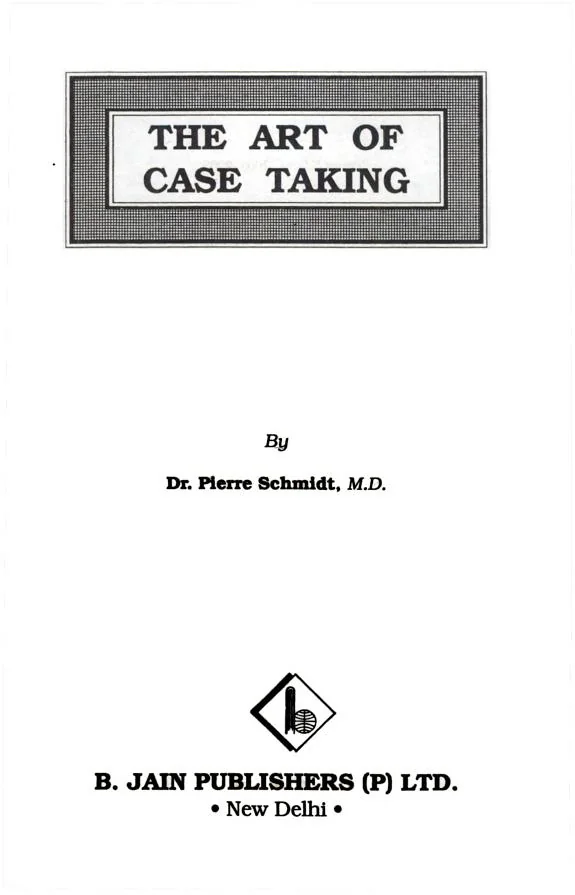
P. Schmidt's 2003 book, The Art of Case Taking, details a systematic approach to understanding patient ailments for remedy selection.
Published in 2003, The Art of Case Taking by P. Schmidt serves as a practical manual for practitioners in esoteric healing, particularly homeopathy. The book concentrates on the methodical process required to understand a patient's condition, moving past surface-level symptoms to grasp the root cause. This systematic method is designed to aid in choosing the most fitting remedy. The text is intended for students and practitioners within homeopathic and similar esoteric healing disciplines who wish to improve their diagnostic abilities. It is especially useful for those focusing on the precise selection of remedies derived from mineral, vegetable, or animal sources, including nosodes. Individuals confronting difficult cases or aiming to deepen their knowledge of how remedies are applied will find this work beneficial.
Schmidt's work emerged during a period of growing interest in alternative medicine. While homeopathy itself traces its origins to Samuel Hahnemann in the late 18th century, this book adds to the ongoing dialogue within that tradition. It addresses the practical needs of today's practitioner by providing a structured framework for choosing remedies, complementing other homeopathic texts.
The Art of Case Taking belongs to the homeopathic tradition, a system of alternative medicine developed by Samuel Hahnemann. Homeopathy is based on the principle of 'like cures like' and the potentization of substances through serial dilution and succussion. Schmidt's contribution lies in refining the art of case taking, a crucial element in classical homeopathy, by detailing a structured method for practitioners to elicit and interpret patient symptoms accurately. This approach emphasizes understanding the totality of symptoms to match the most similar remedy, a core tenet of the practice.
💡 Why Read This Book?
• Learn a structured methodology for analyzing patient symptoms, moving beyond superficial complaints to identify the core of an ailment, as detailed in the case-taking process. • Understand the nuanced differences and strategic applications of remedies derived from mineral, vegetable, and animal kingdoms, including nosodes, as outlined by P. Schmidt. • Gain insight into specific therapeutic strategies, such as the preference for vegetable remedies (with exceptions like Lycopodium) in initiating treatment, as presented in the book's guidance.
⭐ Reader Reviews
Honest opinions from readers who have explored this book.
❓ Frequently Asked Questions
What is the primary focus of P. Schmidt's "The Art of Case Taking"?
The book centers on the systematic process of gathering and interpreting patient information to select the most appropriate esoteric healing remedy, emphasizing a structured approach to diagnosis.
When was "The Art of Case Taking" by P. Schmidt first published?
The work by P. Schmidt, "The Art of Case Taking," was first published in 2003.
What types of remedies does the book discuss for case taking?
Schmidt's text covers remedies originating from the mineral, vegetable, and animal kingdoms, as well as nosodes, detailing how their origin influences their application.
Does the book offer specific advice on starting treatment?
Yes, the book suggests a strategic approach, often recommending starting treatment with a vegetable remedy, with Lycopodium being a notable exception to this rule.
Who would benefit most from reading "The Art of Case Taking"?
Students and practitioners of esoteric healing arts, particularly homeopathy, who wish to refine their diagnostic skills and deepen their understanding of remedy selection, will find this book beneficial.
What is a 'nosode' in the context of the book?
A nosode is a homeopathic remedy prepared from diseased tissue or morbid products. The book considers these alongside mineral, vegetable, and animal remedies in the case-taking process.
🔮 Key Themes & Symbolism
Systematic Remedy Kingdoms
The work meticulously categorizes potential remedies based on their origin: mineral, vegetable, animal, or nosode. This classification is not merely academic but forms the bedrock of Schmidt's diagnostic strategy. By understanding the inherent properties and energetic signatures associated with each kingdom, practitioners can more precisely match a remedy to the patient's specific state. The book details how to differentiate between these broad categories during the case-taking process, providing a foundational framework for effective therapeutic intervention.
Strategic Case Initiation
A core concept presented is the strategic approach to initiating treatment. Schmidt advocates for a deliberate order in remedy selection, often prioritizing vegetable remedies due to their perceived gentler or more universally applicable nature. This approach is not without its caveats, as the text explicitly notes exceptions, such as Lycopodium, which may be indicated irrespective of the general rule. This nuanced guidance highlights the importance of flexibility within a structured system, ensuring practitioners consider all angles before administering a remedy.
The Art of Observation
Beyond mere symptom cataloging, "The Art of Case Taking" underscores the importance of deep observation and intuitive understanding. The process described goes beyond superficial complaints to uncover the vital essence of the illness. Practitioners are guided to look for patterns, understand the totality of symptoms, and discern the characteristic peculiarities of the case. This analytical rigor, combined with an intuitive grasp of remedy pictures, forms the 'art' in case taking, enabling the selection of truly individualized and potent therapeutic agents.
Nosodes in Practice
The inclusion of nosodes as a distinct category of remedies is significant. Prepared from pathological products, nosodes often address deeper, chronic, or miasmatic conditions. Schmidt's work integrates the consideration of nosodes into the comprehensive case-taking methodology. This acknowledges their a central role in complex cases where conventional remedies might fall short, providing practitioners with a vital tool for addressing ingrained disturbances within the patient's vital force.
💬 Memorable Quotes
Direct passages from the work, attributed to the author.
“The Remedy You Select May Be Of Mineral Or Vegetable Or Animal Origin Or A Nosode.”
— This statement concisely outlines the foundational categories of remedies discussed in the text, emphasizing the broad scope of potential therapeutic agents available to the practitioner.
“If You Are Considering A Mineral Remedy, Before Giving A Mineral Remedy, Please Try To Begin The Treatment Of Your Case Always With A Vegetable Remedy Except Lycopodium.”
— This prescriptive advice illustrates a key strategic principle for initiating treatment, suggesting a hierarchical preference for vegetable remedies unless specific indications for Lycopodium or other exceptions arise.
“The work explores the systematic gathering and interpretation of patient information.”
— This highlights the book's central theme: the meticulous process of case taking, focusing on analytical methods to understand the patient's condition comprehensively.
“Understanding the essence of a case guides the selection beyond superficial symptoms.”
— This interpretation underscores the book's focus on uncovering the deeper, fundamental nature of an illness to achieve a more accurate and effective remedy choice.
💡 Key Ideas
Editorial paraphrase of the work's core concepts — not direct quotes.
Schmidt emphasizes differentiating between remedies based on their kingdom of origin.
This paraphrased concept points to the practical application of classifying remedies (mineral, vegetable, animal, nosode) as a crucial step in the diagnostic and selection process.
🌙 Esoteric Significance
Tradition
This work firmly resides within the homeopathic tradition, a system developed from the principles of 'like cures like' (similia similibus curentur) by Samuel Hahnemann. While not strictly Hermetic or Kabbalistic, homeopathy draws upon vitalistic philosophies common in esoteric thought, positing a 'vital force' or life energy that is disturbed in illness. Schmidt's contribution refines the practical application of this tradition, focusing on the meticulous observation and analysis necessary to discern the energetic signature of disease and match it with a potentized remedy.
Symbolism
While the book is highly practical, its underlying symbolism relates to the alchemical concept of 'solve et coagula' (dissolve and coagulate), applied metaphorically to the process of breaking down a complex case into constituent parts (solve) and then reconstituting the understanding into a coherent picture for remedy selection (coagula). The categorization into mineral, vegetable, and animal kingdoms also echoes ancient elemental and vitalistic cosmologies, reflecting a belief in the correspondence between the natural world and human health.
Modern Relevance
Contemporary practitioners of homeopathy and related energetic medicine systems continue to draw upon the principles of systematic case taking that Schmidt elaborates. Schools teaching homeopathic methodology often incorporate similar structured approaches to patient interviewing and remedy analysis. The emphasis on discerning the 'totality of symptoms' and the 'genius of the case' remains central to modern practice, making foundational texts like this relevant for students and experienced practitioners alike seeking to hone their diagnostic acumen.
👥 Who Should Read This Book
['• Students of homeopathy seeking a structured framework for patient interviews and remedy analysis, particularly regarding the differentiation of mineral, vegetable, and animal-based remedies.', '• Experienced homeopathic practitioners looking to refine their case-taking techniques and explore strategic approaches to initiating treatment in complex or chronic conditions.', '• Practitioners of other vitalistic or energetic healing modalities interested in comparative methods of diagnosis and remedy selection as presented within the homeopathic tradition.']
📜 Historical Context
Published in 2003, "The Art of Case Taking" by P. Schmidt emerged in an era marked by a resurgence of interest in holistic health and alternative medicine. While homeopathy itself dates back to Samuel Hahnemann's work in the late 18th and early 19th centuries, Schmidt's publication contributes to the ongoing refinement of its practice. This period saw numerous practitioners and authors re-examining classical homeopathic principles with a contemporary lens. The work participates in a lineage that includes figures like Kent and Boericke, who also emphasized detailed case analysis and the precise matching of remedies to disease pictures. Unlike purely theoretical explorations, Schmidt's text focuses on the practical mechanics of case gathering, aiming to equip practitioners with a robust methodology. Its reception likely resonated within homeopathic circles seeking structured guidance, though it may have been viewed by more eclectic practitioners as adhering strictly to established, rather than innovative, homeopathic schools of thought.
📔 Journal Prompts
The initial presentation of the case: how does its 'origin' (mineral, vegetable, animal, nosode) influence your initial diagnostic considerations?
Lycopodium's exception: Reflect on a time when a known 'rule' in your practice was superseded by a more potent indication.
The totality of symptoms: How can you ensure your case-taking captures the complete picture, not just isolated complaints?
Distinguishing kingdoms: Describe the process of identifying whether a case leans towards mineral, vegetable, or animal energetic expression.
The patient's narrative: How does actively listening to the patient's story contribute to the 'art' of case taking beyond symptom listing?
🗂️ Glossary
Case Taking
The systematic process of interviewing a patient, gathering detailed information about their symptoms, history, and overall state of being, to determine the most appropriate remedy.
Remedy
In this context, a substance, typically potentized, used in esoteric healing systems like homeopathy to stimulate the body's self-healing mechanisms.
Mineral Remedy
A homeopathic remedy derived from substances belonging to the mineral kingdom, such as salts, metals, and earths.
Vegetable Remedy
A homeopathic remedy prepared from plants, herbs, flowers, roots, or other parts of the vegetable kingdom.
Animal Remedy
A homeopathic remedy derived from animal products, secretions, or substances, such as milk, venom, or organs.
Nosode
A homeopathic remedy prepared from diseased tissue, morbid products, or contagious matters, used to address deeper pathological states or miasms.
Lycopodium
A specific homeopathic remedy derived from the Club Moss plant, often indicated for certain types of chronic ailments and digestive issues, and noted as an exception in the book's general strategy.
This book appears in 1 collection
🔮 Readers Also Liked
Browse all →







From the “Homeopathy” Collection
View all →









More Free Occult Philosophy Books
View all →