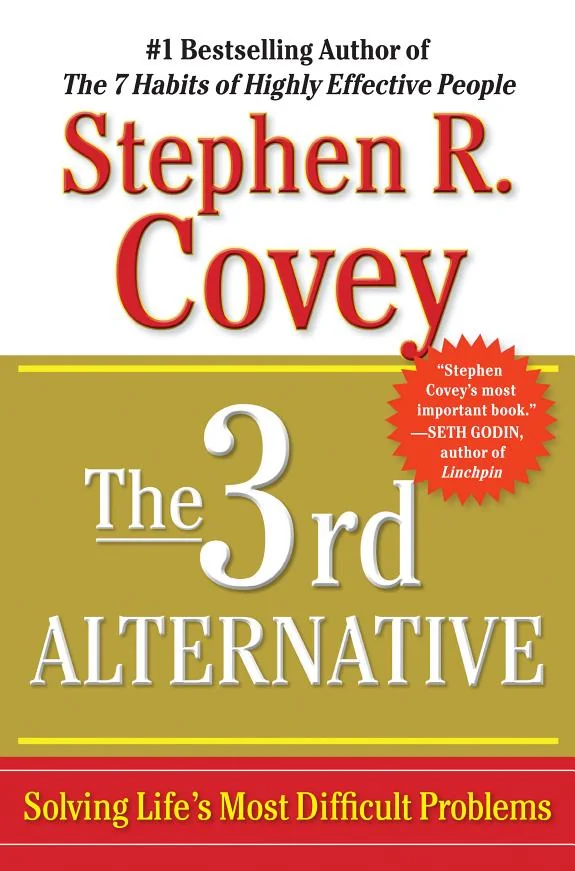
The 3rd Alternative
 83
83

The 3rd Alternative
Stephen R. Covey, with Breck England, offers a compelling expansion on his "win-win" philosophy in The 3rd Alternative. The book’s strength lies in its methodical breakdown of achieving synergistic solutions, moving beyond mere compromise to genuine integration of diverse ideas. It provides a structured process that feels applicable to a range of complex problems, from interpersonal disputes to organizational strategy. However, the sheer breadth of disciplines referenced, while ambitious, occasionally risks diluting the core message with too many illustrative examples. A particular passage detailing the "Paradigm Shift" required to even conceive of a Third Alternative effectively captures the book's intent, highlighting the mental reorientation necessary. Ultimately, this is a practical guide for those seeking to elevate conflict resolution beyond simple agreement.
📝 Description
83
Stephen R. Covey and Breck England published The 3rd Alternative in 2011.
The 3rd Alternative offers a method for solving problems and creating new solutions by combining different viewpoints. Instead of settling for 'win-lose' or simple compromise, the book details a process to find a better outcome that benefits everyone involved. This approach uses structured problem-solving techniques that draw on the combined intelligence of a group.
The book is for anyone facing difficult challenges, whether in personal life, work, or society. It is particularly useful for leaders, negotiators, mediators, and educators who want to improve how they make decisions. Readers interested in developing better communication and collaboration skills will find practical advice within its pages.
While not strictly esoteric in the occult sense, The 3rd Alternative engages with traditions of thought that seek deeper, unifying principles beyond surface-level conflict. Its emphasis on synergistic solutions that transcend binary oppositions echoes patterns found in various philosophical and spiritual systems that aim for integration and wholeness. The book's call for moving beyond entrenched positions to discover novel, mutually beneficial outcomes can be seen as a secular application of principles found in mystical traditions that emphasize unity and the dissolution of dualistic thinking.
💡 Why Read This Book?
• Learn to move beyond compromise to true synergy, as illustrated by the structured problem-solving process outlined in the book, enabling you to find solutions that satisfy all parties more fully. • Develop the ability to identify and integrate diverse viewpoints, a skill crucial for navigating complex challenges, as demonstrated through the book's emphasis on collaborative intelligence. • Understand the psychological shift needed to embrace a "Third Alternative" mindset, moving beyond binary thinking, a concept central to achieving breakthrough outcomes in any negotiation or decision-making scenario.
⭐ Reader Reviews
Honest opinions from readers who have explored this book.
❓ Frequently Asked Questions
What is the core difference between the Third Alternative and compromise?
The Third Alternative seeks to create a new, superior solution that integrates the best of all viewpoints, going beyond a simple give-and-take. Compromise, conversely, often involves sacrificing elements of each party's original position.
When was The 3rd Alternative first published?
The 3rd Alternative was first published on October 4, 2011, reflecting a modern approach to conflict resolution and problem-solving.
Who are the authors of The 3rd Alternative?
The book is authored by Stephen R. Covey, known for his work on effectiveness, and Breck England, who collaborated on this exploration of synergistic solutions.
What kind of problems does The 3rd Alternative address?
The book is designed to address complex problems where traditional win-lose or compromise approaches are insufficient, including interpersonal conflicts, business negotiations, and team collaboration challenges.
Does The 3rd Alternative offer practical steps for implementation?
Yes, the work outlines a systematic process and principles for achieving the Third Alternative, providing actionable guidance for readers seeking to apply its concepts.
What disciplines influence the methodology presented in The 3rd Alternative?
The book draws from a wide array of disciplines, including psychology, organizational behavior, negotiation theory, and systems thinking, to build its synergistic problem-solving framework.
🔮 Key Themes & Symbolism
Synergy Beyond Dichotomy
The central theme is transcending binary thinking, where options are limited to 'my way,' 'your way,' or a watered-down compromise. The 'Third Alternative' proposes a higher, synergistic outcome achievable through dedicated effort. This approach appeals to esoteric principles of synthesis and the creation of something greater than the sum of its parts, akin to alchemical transmutation where disparate elements combine into a new, elevated substance.
Shift in thinking for Solutions
Achieving the Third Alternative requires a fundamental shift in perception, a change in one's 'paradigm.' This reflects the Gnostic emphasis on gnosis, or direct knowledge, as a transformative force that alters one's understanding of reality. The book suggests that problems often appear intractable due to our limited viewpoints, and true resolution comes from expanding these perspectives, much like an initiate gaining new sight.
Integrative Communication
Effective communication is paramount, not merely for conveying information but for understanding underlying needs and values. This theme aligns with Hermetic ideals of understanding the 'true' nature of things and the power of language to manifest reality. The book advocates for deep listening and empathetic dialogue as tools to unlock creative solutions, mirroring the alchemical process of separating and recombining for greater clarity.
The Power of Collective Intelligence
The work champions the idea that diverse minds, when brought together with a shared intention for synergy, can unlock solutions unattainable by individuals alone. This concept finds parallels in collective consciousness theories and the understanding of emergent properties in complex systems. It suggests a unified field of intelligence available to those who can harmonize their individual perspectives.
💬 Memorable Quotes
Direct passages from the work, attributed to the author.
“The Third Alternative is not a compromise. It is a better way.”
— This statement crystallizes the book's core thesis: moving beyond mere concession towards a genuinely superior outcome. It challenges the common assumption that resolving conflict inevitably involves sacrificing something essential.
“We are not in competition with each other; we are in collaboration.”
— This reorients the perspective from adversarial encounters to cooperative endeavors. It suggests that viewing others as partners rather than rivals unlocks greater potential for mutual benefit and creative problem-solving.
“The quality of any decision is in inverse proportion to the level of the paradigm from which it is made.”
— This highlights the critical role of one's worldview or 'paradigm' in shaping the quality of solutions. A limited perspective yields limited results, while a broader, more integrated view allows for more effective outcomes.
“Seek first to understand, then to be understood.”
— A foundational principle of effective communication, this emphasizes prioritizing empathetic listening. Truly grasping another's perspective is presented as a prerequisite for finding common ground and generating synergistic solutions.
“When you have a synergistic encounter, you create something new.”
— This speaks to the generative power of synergy, where the outcome is not just a combination but an innovation. It implies that collaborative efforts, when truly synergistic, yield results that transcend the original inputs.
🌙 Esoteric Significance
Tradition
The 3rd Alternative aligns with esoteric traditions that emphasize synthesis and the creation of a 'higher' reality through the integration of opposites. It shares conceptual ground with Hermeticism's principle of 'As Above, So Below,' suggesting that understanding and harmonizing different levels of reality (individual, interpersonal, societal) leads to unified solutions. It also echoes Gnostic ideas of achieving higher consciousness through the integration of seemingly contradictory spiritual and material principles.
Symbolism
The primary symbolic motif is the 'Third Alternative' itself, representing a point of synthesis beyond duality (represented by two opposing forces or viewpoints). This can be seen as analogous to the alchemical symbol of the union of opposites (e.g., sun and moon, king and queen) to create the Philosopher's Stone. The concept of 'synergy' also functions symbolically, pointing towards an emergent property greater than the sum of its parts, a common theme in mystical cosmologies where creation arises from divine union.
Modern Relevance
Contemporary thinkers in fields like organizational psychology, mediation, and conflict resolution continue to draw upon the principles of synergistic problem-solving. The work's emphasis on collaborative intelligence and paradigm shifts remains relevant for leaders navigating complex, multi-stakeholder environments. Practices such as nonviolent communication and restorative justice echo the book's focus on deep understanding and integrative solutions, demonstrating its enduring influence on approaches seeking harmony and mutual benefit.
👥 Who Should Read This Book
• Leaders and managers seeking to foster innovation and resolve complex team conflicts by moving beyond simple compromises and finding truly synergistic solutions. • Mediators and conflict resolution professionals looking for advanced frameworks to facilitate breakthroughs in intractable disputes, drawing on the book's systematic approach. • Individuals interested in personal growth and improved interpersonal dynamics, who wish to develop a more effective and collaborative method for addressing disagreements in all areas of life.
📜 Historical Context
Published in 2011, The 3rd Alternative arrived at a time when the efficacy of traditional negotiation and problem-solving models was increasingly questioned in an interconnected world. It built upon the legacy of figures like Mary Parker Follett, whose early 20th-century work on 'integration' foreshadowed the book's core concept of finding a synergistic solution superior to compromise. Covey's own prior work, notably 'The 7 Habits of Highly Effective People' (1989), had already established him as a leading voice in personal and organizational effectiveness. The book's approach can be seen as a direct counterpoint to purely adversarial negotiation tactics, emphasizing collaboration and mutual understanding in an era where global communication facilitated diverse viewpoints but also amplified potential conflict. While not facing significant censorship, its reception aligned with a broader academic and practical interest in non-zero-sum approaches to conflict resolution.
📔 Journal Prompts
The Third Alternative's requirement for a shift in thinking: How does your current view of conflict limit potential solutions?
Identifying underlying needs: Reflect on a recent disagreement and list the core needs of each party beyond their stated positions.
Synergistic creation: Consider a situation where two seemingly incompatible ideas could be integrated into something new and superior.
The collaborative mindset: How can you actively shift from a competitive to a collaborative stance in your next challenging interaction?
Evaluating 'compromise' outcomes: Assess a past compromise; was it truly the best possible solution, or was a Third Alternative missed?
🗂️ Glossary
Third Alternative
A problem-solving approach that seeks a synergistic solution superior to any compromise or unilateral decision, integrating the best aspects of all viewpoints.
Paradigm
A fundamental model or pattern of thinking; a worldview or set of assumptions that shapes perception and behavior.
Synergy
The principle that the whole is greater than the sum of its parts; in this context, a collaborative outcome that exceeds the capabilities or contributions of individuals working separately.
Win-Win
A resolution where all parties feel their needs are met and they have achieved a favorable outcome, often a precursor or component of the Third Alternative.
Compromise
A settlement of differences by mutual concession; an agreement where each party gives up something to reach a middle ground.
Integrative Solutions
Outcomes that combine and elevate the essential elements of differing perspectives, creating a novel solution that satisfies underlying needs more effectively than traditional methods.
Win-Lose
A resolution where one party achieves their goals at the expense of the other party's goals.
This book appears in 1 collection
🔮 Readers Also Liked
Browse all →








From the “Self-Realization” Collection
View all →





More Free Occult Philosophy Books
View all →