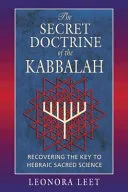
The Secret Doctrine of the Kabbalah
 78
78

The Secret Doctrine of the Kabbalah
Leonora Leet's "The Secret Doctrine of the Kabbalah" makes a robust attempt to bridge the gap between the esoteric depths of Kabbalah and the modern spiritual seeker. Its strength lies in its detailed exposition of the Tree of Life, presenting it as a living, operative system rather than a static diagram. Leet is particularly adept at explaining the interrelation of the Sephiroth and their corresponding paths, offering a framework for understanding cosmic and psychological architecture. A limitation, however, is the density of the material, which at times can feel overwhelming for those entirely new to Kabbalistic concepts. The section detailing the practical methods, especially those involving Hebrew letters and sacred names, is where the book truly distinguishes itself, offering concrete, albeit challenging, avenues for practice. Leet's meticulous approach to Hebraic sacred science provides a valuable resource for serious students.
This book serves as a rigorous guide for those committed to understanding the operational mechanics of the Kabbalah.
📝 Description
78
Leonora Leet's The Secret Doctrine of the Kabbalah, published in 1999, reintroduces Kabbalistic principles for contemporary seekers.
First published in August 1999, Leonora Leet's The Secret Doctrine of the Kabbalah aims to clarify the core concepts of this ancient Hebrew mystical tradition. Leet structures the work to be approachable for modern individuals interested in spirituality. The book moves beyond theoretical discussions to focus on the active use of Kabbalistic ideas, connecting them to practical, experimental methods within the framework of Hebraic sacred science.
This text is particularly suited for students and practitioners of Western esotericism who wish to understand the Kabbalah more deeply. It offers insights for those seeking to grasp the significance of the Tree of Life, a fundamental cosmological model in Kabbalistic thought and Western occultism. Readers who value a scholarly yet hands-on approach to mysticism, and who want to link historical wisdom with present-day spiritual exploration, will find this book beneficial.
This book is part of a Western esoteric scholarship that grew significantly in the late 19th and 20th centuries, following thinkers like Eliphas Lévi and Dion Fortune. Leet's work supports a renewed interest in traditional Kabbalistic studies, often distinguishing itself from more generalized New Age spiritual movements. It incorporates scholarly interpretations of Kabbalistic texts while stressing the importance of personal practice and experience.
💡 Why Read This Book?
• Gain a structured understanding of the Kabbalistic Tree of Life, moving beyond its common symbolic representation to grasp its function as a cosmological and psychological map, as detailed in the book's exploration of the Sephiroth. • Learn experimental methods of Hebraic sacred science, including specific meditative techniques and the application of divine names, offering a practical pathway for spiritual development not commonly found in introductory texts. • Connect with the historical lineage of Western esotericism by understanding how Leonora Leet, in her 1999 publication, revitalized classical Kabbalistic teachings for contemporary practitioners.
⭐ Reader Reviews
Honest opinions from readers who have explored this book.
❓ Frequently Asked Questions
What is the primary focus of Leonora Leet's "The Secret Doctrine of the Kabbalah"?
The book's primary focus is on resurrecting and explaining the practical application of Kabbalistic knowledge, particularly through the lens of Hebraic sacred science and the cosmological diagram of the Tree of Life.
When was "The Secret Doctrine of the Kabbalah" first published?
The book was first published in August 1999, marking a significant contribution to esoteric literature at the close of the 20th century.
What makes the Kabbalistic Tree of Life important in this book?
The Tree of Life is presented as the central cosmological diagram of the Western esoteric tradition, and the book explores experimental methods to understand its profound meaning.
Does the book offer practical exercises for readers?
Yes, "The Secret Doctrine of the Kabbalah" explores experimental methods of practicing Hebraic sacred science, aiming to provide readers with tangible ways to engage with Kabbalistic principles.
Who is Leonora Leet?
Leonora Leet was an author and scholar focused on esoteric traditions, particularly the Kabbalah, aiming to make its complex doctrines accessible and applicable to modern spiritual seekers.
What is 'Hebraic sacred science' as discussed in the book?
It refers to the systematic study and practice of the mystical and occult principles embedded within Hebrew language, scripture, and tradition, as explored through experimental methods in Leet's work.
🔮 Key Themes & Symbolism
The Tree of Life
This central tenet of Kabbalistic cosmology is meticulously detailed, presented not merely as a symbolic chart but as a functional map of creation and consciousness. Leet elaborates on the ten Sephiroth and the twenty-two paths connecting them, illustrating their correspondence to various aspects of existence, from the divine emanations to the human psyche. The work emphasizes understanding the dynamic interplay between these spheres as a key to unlocking deeper spiritual comprehension and practical application in one's life.
Hebraic Sacred Science
Leet's approach revitalizes the concept of Hebraic sacred science, advocating for experimental methods rather than purely academic study. This involves engaging directly with the esoteric dimensions of Hebrew letters, divine names, and scriptural symbolism. The book seeks to demonstrate how these elements form a coherent system for spiritual transformation and cosmic understanding, offering a pathway to direct experience of the divine principles described in Kabbalistic literature.
Esoteric Practice and Application
Moving beyond theoretical exposition, "The Secret Doctrine of the Kabbalah" is deeply concerned with the practical application of Kabbalistic principles. It guides readers toward methods that can be incorporated into personal spiritual practice, aiming to facilitate a lasting impact on contemporary spirituality. The emphasis is on experiential learning, encouraging the reader to actively engage with the teachings to achieve personal growth and a more intimate connection with universal truths.
Cosmological Diagrams
The book positions the Kabbalistic Tree of Life as a foundational cosmological diagram within the Western esoteric tradition. Leet explains how this intricate symbolic structure serves as a framework for understanding the universe, its creation, and the divine order. By dissecting this diagram, readers are invited to perceive the underlying patterns and principles that govern reality, connecting the microcosm of the individual to the macrocosm of the universe.
💬 Memorable Quotes
Direct passages from the work, attributed to the author.
“The Kabbalistic Tree of Life is the cosmological diagram of the entire Western esoteric tradition.”
— This statement highlights the foundational importance of the Tree of Life, positioning it not just within Kabbalah but as a universal key to understanding Western mystical thought and its underlying structures.
“Experimental methods of practicing Hebraic sacred science are explored.”
— This indicates the book's practical orientation, suggesting it offers more than theoretical knowledge, and provides actionable techniques for readers to engage directly with Kabbalistic principles.
“Eternal truths that profoundly impact contemporary spirituality.”
— This emphasizes the enduring relevance of Kabbalistic teachings, suggesting that ancient wisdom holds significant power to inform and transform modern spiritual beliefs and practices.
“The meaning of the cosmological diagram... is explained, as never before.”
— This implies a novel or uniquely insightful approach to interpreting the Tree of Life, promising readers a fresh perspective on this well-known esoteric symbol.
“Resurrects this ancient body of knowledge.”
— This phrase suggests the book aims to revive and reintroduce potentially overlooked or less accessible aspects of Kabbalistic tradition, making them vital for current understanding.
🌙 Esoteric Significance
Tradition
This work firmly belongs to the Western esoteric tradition, with a specific focus on the Kabbalistic lineage originating from Jewish mysticism. It aligns with Hermetic Kabbalah, which historically integrated Kabbalistic concepts with Hermetic philosophy, as developed by figures like Eliphas Lévi. Leet's contribution lies in her attempt to present a coherent system of practice rooted in Hebraic sacred science, seeking to restore a perceived integrity and depth to Kabbalistic study.
Symbolism
The primary symbol explored is the Kabbalistic Tree of Life, representing the divine emanations (Sephiroth) and the pathways connecting them. Leet studies the meaning of each Sephirah, such as Kether (Crown) and Malkuth (Kingdom), and the paths linking them, often associated with Hebrew letters and Tarot cards. Another significant symbolic element is the use of divine names and Hebrew letters as tools for meditation and manifestation, integral to Hebraic sacred science.
Modern Relevance
Contemporary practitioners of Western esotericism, particularly those engaged with Hermeticism, ceremonial magic, and modern Kabbalistic studies, draw heavily on works like Leet's. Thinkers and groups focusing on practical Kabbalah, psychological astrology, and somatic approaches to mysticism often reference or build upon the frameworks presented in such detailed explorations of the Tree of Life and sacred Hebrew practices.
👥 Who Should Read This Book
• Students of Western Esotericism seeking a structured and practical introduction to Kabbalah, particularly those interested in the Tree of Life as a foundational diagram. • Practitioners of Hermeticism and ceremonial magic looking to deepen their understanding of Kabbalistic principles and their operative applications. • Comparative religion scholars and researchers interested in the development and interpretation of mystical traditions within Judaism and their influence on Western thought.
📜 Historical Context
Published in 1999, Leonora Leet's "The Secret Doctrine of the Kabbalah" emerged during a period of renewed academic and popular interest in esoteric traditions, building on the foundations laid by earlier scholars and practitioners. The late 20th century saw a significant engagement with Kabbalah, often filtered through the lens of Western Hermeticism and Theosophy, influenced by figures like Aleister Crowley and Helena Blavatsky. Leet's work distinguishes itself by focusing on specific Hebraic sacred science and practical application, moving beyond the more generalized interpretations prevalent in some New Age circles. While not explicitly a response to a specific contemporary movement, it implicitly offered a more rigorous and traditional approach compared to some of the syncretic spiritualities gaining traction. The reception of such works often varied, with some esoteric circles embracing them for their depth while mainstream academia might view them with skepticism, a dynamic common in the study of occult traditions.
📔 Journal Prompts
The Sephiroth as archetypal forces within consciousness.
The significance of divine names in Hebraic sacred science.
Mapping personal spiritual progression onto the paths of the Tree of Life.
The practical application of Hebrew letter correspondences.
Reconciling ancient Kabbalistic cosmology with modern scientific understanding.
🗂️ Glossary
Sephirah (pl. Sephiroth)
The ten divine emanations or attributes described in Kabbalistic cosmology, forming the structure of the Tree of Life and representing stages of creation and divine manifestation.
Tree of Life
A central diagram in Kabbalah, consisting of ten interconnected spheres (Sephiroth) and twenty-two paths, symbolizing the divine structure of the universe and the path of spiritual ascent.
Hebraic Sacred Science
A term referring to the esoteric study and practice of Kabbalistic principles, often involving the mystical interpretation of Hebrew letters, divine names, and scriptural texts.
Kether
The first Sephirah on the Tree of Life, representing the primordial point of creation, the Divine Will, or the highest spiritual essence; often translated as 'Crown'.
Malkuth
The tenth and final Sephirah on the Tree of Life, representing the material world, the Kingdom, and the physical manifestation of the divine energies.
Path
The connections or bridges between the Sephiroth on the Tree of Life, typically numbering twenty-two, often associated with the Hebrew alphabet and symbolic imagery.
Divine Name
Specific combinations of Hebrew letters believed to hold divine power and used in Kabbalistic meditation, ritual, and invocation for spiritual connection and manifestation.