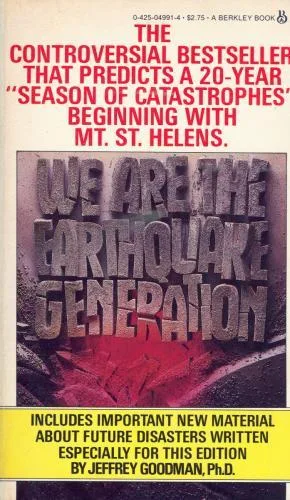
We are the earthquake generation
 77
77

We are the earthquake generation
Jeffrey Goodman’s "We are the Earthquake Generation" arrives with a title that promises seismic upheaval, and in many ways, it delivers on that premise through its exploration of consciousness. The book’s strength lies in its direct, almost prophetic tone, identifying a nascent generation poised to reshape societal structures. Goodman’s assertion that certain individuals are born with an inherent sensitivity to societal tremors and the potential to initiate change feels particularly potent when revisited decades later. However, the work's primary limitation is its occasionally abstract presentation; specific mechanisms or detailed psychological frameworks underpinning this 'earthquake generation' can feel underdeveloped, leaving the reader to bridge interpretive gaps. A passage discussing the inherent questioning of authority by this emergent group, while conceptually sound, could benefit from more concrete examples to illustrate its practical manifestation. Despite this, the book offers a compelling, if somewhat speculative, framework for understanding societal evolution through the lens of individual consciousness.
📝 Description
77
Jeffrey Goodman published 'We are the Earthquake Generation' in 1978, suggesting a new wave of humanity was emerging.
Published in 1978, Jeffrey Goodman's 'We are the Earthquake Generation' posits that a distinct group of people, the 'earthquake generation,' is emerging. These individuals possess an innate sensitivity to societal and consciousness shifts, questioning existing norms and sensing a deeper interconnectedness. Goodman frames this not as a historical record but as a philosophical look at potential futures and the internal readiness of those poised to shape them. The book speaks to readers feeling uneasy with the current state of affairs, driven to grasp underlying societal movements, and seeking alternative thought systems. It resonates with those interested in consciousness studies, newer spiritual paths, and the psychological aspects of social change. People who feel they are ahead of their time or are actively challenging conventional structures will find common ground within its pages.
The work emerged during a period of introspection following the counterculture movement and the rise of New Age ideas. It reflects a broader cultural search for meaning beyond established religious and political structures. This era also saw increased interest in parapsychology, Eastern philosophies, and human potential movements. Goodman's book contributes to this intellectual climate by offering a specific view of global psychological and spiritual transformations.
Goodman's work fits within the broader context of 1970s explorations into human potential and consciousness. It shares an intellectual space with the burgeoning New Age movement, which sought alternative spiritual frameworks and investigated phenomena beyond conventional scientific understanding. The book's focus on individuals attuned to societal shifts echoes themes found in movements that explored collective consciousness and psychological evolution, such as those influenced by Teilhard de Chardin or early transpersonal psychology.
💡 Why Read This Book?
• Understand the emergence of a 'conscious catalyst' archetype, learning how individuals born with heightened societal awareness might drive fundamental change, a concept Goodman frames as the "earthquake generation." • Gain insight into the psychological and spiritual currents of the late 1970s, a period ripe with inquiry into consciousness and societal restructuring, as evidenced by the book's 1978 publication date. • Explore the metaphor of societal "earthquakes" as a force for renewal, providing a framework for interpreting disruptive periods as necessary evolutions rather than mere chaos.
⭐ Reader Reviews
Honest opinions from readers who have explored this book.
❓ Frequently Asked Questions
When was "We are the Earthquake Generation" first published?
Jeffrey Goodman's "We are the Earthquake Generation" was first published in 1978, positioning it within the burgeoning New Age and consciousness studies movements of that era.
What is the central idea of the 'earthquake generation'?
The 'earthquake generation' refers to individuals believed to possess an innate sensitivity to societal shifts and a potential to initiate profound, disruptive, yet ultimately constructive, change within consciousness and social structures.
What kind of societal changes does the book suggest?
The book suggests shifts away from established norms and materialistic worldviews towards a more holistic, intuitive understanding of reality, driven by individuals who are catalysts for this transformation.
Who is Jeffrey Goodman, the author?
Jeffrey Goodman was an author and researcher interested in consciousness, parapsychology, and the evolution of human potential. His work often explored the intersection of psychology and emergent spiritual ideas.
Is this book related to the New Age movement?
Yes, "We are the Earthquake Generation," published in 1978, is closely aligned with the intellectual and spiritual currents of the New Age movement, exploring themes of consciousness evolution and societal transformation.
What historical events or figures are contemporary to this book's publication?
Published in 1978, the book emerged during a period influenced by post-counterculture thought and the rise of human potential movements, contemporary with figures like Marilyn Ferguson and her work on societal change.
🔮 Key Themes & Symbolism
Emergent Consciousness Catalysts
The book posits the existence of an 'earthquake generation'—individuals inherently attuned to profound societal shifts. These are not passive observers but active agents, possessing a unique capacity to instigate fundamental reorientations in human consciousness. Goodman suggests this emergent group is characterized by a deep questioning of existing paradigms and a natural inclination towards holistic, intuitive understanding, moving beyond purely materialistic frameworks. The work explores the inner field of these individuals and their role in ushering in new eras of thought and being.
Metaphor of Societal Upheaval
The 'earthquake' serves as a potent metaphor for the disruptive yet necessary forces of change Goodman identifies. It represents the seismic shifts occurring within collective consciousness, challenging established structures and belief systems. This upheaval is presented not as mere chaos, but as a transformative process, analogous to geological shifts that reshape the landscape. The book encourages readers to view these periods of intense societal flux as opportunities for growth and the emergence of new potentials for humanity.
Questioning Established Norms
A core tenet of the 'earthquake generation' is their inherent skepticism towards conventional societal structures, beliefs, and authority. Goodman explores how these individuals naturally challenge the status quo, seeking deeper meaning and more authentic ways of living. This theme reflects the broader cultural questioning prevalent in the late 1970s, a period of introspection following major social movements. The book suggests this critical stance is not destructive but a vital precursor to building more evolved systems.
Holistic and Intuitive Understanding
The work contrasts the emergent consciousness with prevailing materialistic viewpoints, advocating for a more integrated understanding of reality that embraces intuition and interconnectedness. Goodman suggests the 'earthquake generation' is naturally inclined towards perceiving these deeper connections, fostering a sense of unity and shared purpose. This emphasis on a holistic worldview points towards a spiritual or metaphysical dimension of human potential, moving beyond purely rational or empirical modes of knowing.
💬 Memorable Quotes
Direct passages from the work, attributed to the author.
“We are the seismic points of transformation.”
— This phrase captures the core concept of the 'earthquake generation' as individuals who are not just experiencing change but are actively embodying and driving it, acting as focal points for societal and consciousness shifts.
“The old structures crumble under the weight of new awareness.”
— This highlights the idea that established societal norms and belief systems are becoming obsolete as collective consciousness evolves, leading to their inevitable breakdown and replacement.
“Intuition becomes the compass in a world of shifting certainties.”
— This emphasizes the growing importance of inner knowing and intuitive perception as a guide for individuals navigating a rapidly changing world, moving beyond reliance on external or purely logical frameworks.
“To be born now is to inherit the tremors of change.”
— This suggests that individuals coming into existence in the current era are inherently connected to and influenced by the profound societal and consciousness shifts underway, positioning them as inheritors and participants.
“The earthquake generation questions everything, seeking authentic foundations.”
— This speaks to the critical and investigative nature of the emergent generation, driven by a desire to dismantle superficialities and uncover deeper, more genuine truths and structures for living.
🌙 Esoteric Significance
Tradition
While not strictly adhering to a single esoteric lineage, "We are the Earthquake Generation" draws heavily from concepts prevalent in modern Western esotericism, particularly within the broader New Age and consciousness studies movements of the mid-to-late 20th century. It echoes Gnostic ideas of emergent spiritual consciousness and Theosophical notions of evolving humanity. The work positions itself as a commentary on a planetary shift, aligning with esoteric philosophies that view history as cyclical and marked by evolutionary leaps in human awareness.
Symbolism
The primary symbol is the 'earthquake' itself, representing not destruction but a profound, transformative upheaval of consciousness and societal structures. It signifies the shattering of old paradigms to make way for new growth. Another motif is the 'generation' as a collective force, suggesting that change is not solely individual but a generational inheritance and responsibility, imbued with a unique energetic signature for societal recalibration.
Modern Relevance
Goodman's concept of an 'earthquake generation' finds resonance in contemporary discussions about generational consciousness, societal awakening, and the impact of social media on collective awareness. Thinkers and movements focused on conscious evolution, systemic change, and the rise of intuitive intelligence can draw upon the book's framework. It remains relevant for those seeking to understand the psychological underpinnings of widespread social and spiritual transformation in the 21st century.
👥 Who Should Read This Book
• Individuals experiencing a profound sense of societal unease and seeking to understand their role as catalysts for change, particularly those drawn to concepts of emergent consciousness. • Students of late 20th-century esoteric thought and the New Age movement, offering a specific perspective on consciousness evolution contemporary to 1978. • Seekers interested in the psychology of social transformation and alternative paradigms of human potential, looking for frameworks that challenge conventional societal structures.
📜 Historical Context
Published in 1978, "We are the Earthquake Generation" emerged during a period of significant cultural introspection and the burgeoning of the New Age movement. The late 1970s were marked by a widespread questioning of established societal norms, a growing interest in Eastern philosophies, parapsychology, and human potential. Goodman's work tapped into this zeitgeist, offering a specific interpretation of the psychological and spiritual shifts occurring globally. It can be seen as a contribution to a broader discourse on societal evolution, contemporary with figures like Marilyn Ferguson, whose "The Aquarian Conspiracy" (1980) also documented emergent social trends. While not directly engaging with academic psychology or sociology of the time, Goodman's ideas resonated with those exploring alternative paradigms and seeking frameworks for understanding personal and collective transformation.
📔 Journal Prompts
The concept of the 'earthquake generation' and your personal resonance with societal tremors.
Reflect on the 'crumbling of old structures' in your life and society.
How does 'intuition becoming the compass' guide your decisions?
Identify one 'authentic foundation' you seek in a world of shifting certainties.
Explore the 'seismic points of transformation' you embody.
🗂️ Glossary
Earthquake Generation
A term coined by Jeffrey Goodman to describe a cohort of individuals believed to possess an innate sensitivity to societal shifts and the potential to instigate profound change in consciousness and social structures.
Consciousness Shift
A fundamental alteration in the collective or individual awareness, perception, and understanding of reality, often involving a move towards more holistic, intuitive, or spiritually-attuned states of being.
Societal Tremors
Metaphorical disturbances or significant shifts within the fabric of society, indicating underlying tensions and the potential for larger-scale transformation or upheaval.
Emergent Consciousness
The idea that human awareness is evolving and giving rise to new forms of perception, understanding, and connection, often characterized by greater interconnectedness and intuitive insight.
Shift in thinking
A fundamental change in the basic concepts and experimental practices of a scientific discipline or, more broadly, a significant alteration in the underlying assumptions and frameworks of a worldview or society.
Holistic Understanding
An approach to knowledge and experience that emphasizes the interconnectedness of all parts and the understanding of systems as a whole, rather than focusing on individual components in isolation.
Authentic Foundations
The core, genuine principles or truths upon which one builds their life, beliefs, or societal structures, in contrast to superficial or imposed norms.
🔮 Readers Also Liked
Browse all →









More Free Occult Philosophy Books
View all →