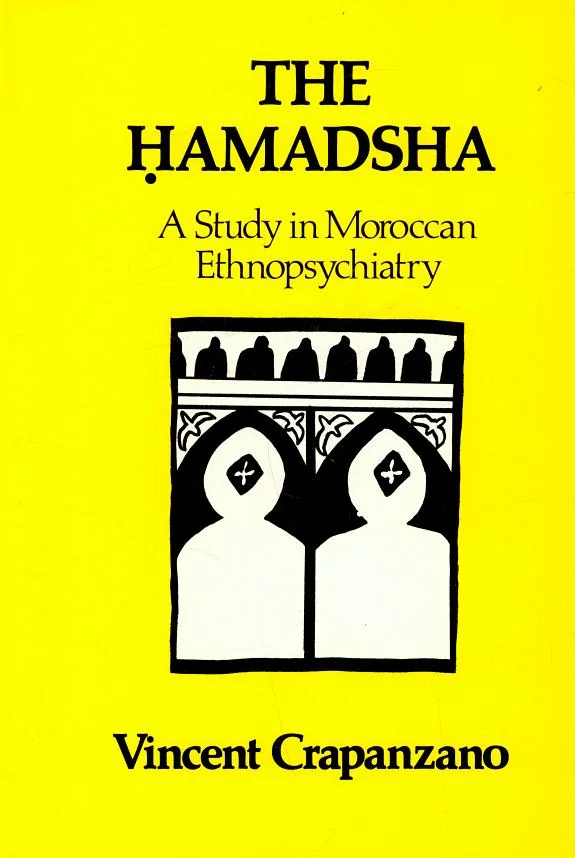
The Ḥamadsha
 71
71

The Ḥamadsha
Vincent Crapanzano's 1973 study of the Ḥamadsha offers a sober ethnographic account of a Moroccan religious brotherhood whose public face was dominated by sensationalistic accounts of self-mutilation. The strength of the work lies in its meticulous detail, moving beyond the lurid to explore the underlying social and spiritual logic of the group's practices. Crapanzano’s careful delineation of the roles of Sidi 'Ali ben Hamdush and Sidi Ahmed Dghughi as founding figures provides a crucial historical anchor. A limitation, perhaps inherent to the era of its writing, is the analytical framework which, while descriptive, can feel somewhat detached from the lived experience of the practitioners. The passage detailing the "head-slashing" rituals, though disturbing, serves to illustrate the group's unique engagement with pain as a spiritual conduit, a concept Crapanzano unpacks with academic rigor. The Ḥamadsha is an essential, if challenging, ethnographic document.
📝 Description
71
Vincent Crapanzano's 1973 book examines the Ḥamadsha, a Moroccan religious brotherhood.
The Ḥamadsha describes a loosely organized Moroccan religious brotherhood whose origins are traced to the late 17th and early 18th century saints Sidi 'Ali ben Hamdush and Sidi Ahmed Dghughi. This confraternity is known for its distinctive ritual practices, which can include extreme acts like self-mutilation. Crapanzano's work brings scholarly attention to a group that had been relatively overlooked.
The book is relevant for scholars of North African ethnography, religious studies, and comparative mysticism. Anthropologists studying ritual, altered states of consciousness, and the sociology of religious movements will find it particularly valuable. It also appeals to readers interested in the diverse expressions of Islamic Sufism, especially its syncretic elements within the Maghreb.
Emerging in Morocco during the post-Sultanate period and into the early colonial era, the Ḥamadsha's practices reflect currents of ecstatic devotion and intermediary roles common in popular Islamic piety. The late 19th and early 20th centuries saw increased European ethnographic interest in the region, making Crapanzano's study a contribution to understanding these less-documented traditions.
This study situates the Ḥamadsha within the broader spectrum of Islamic mysticism, specifically Sufism. It examines how ecstatic devotion manifests through ritual, including altered states of consciousness often associated with spirit invocation. The confraternity's practices, while extreme, can be understood as a form of intermediary engagement with the sacred, connecting members to saintly lineages and spiritual forces within the Moroccan context.
💡 Why Read This Book?
• Understand the ritualistic dimension of Moroccan Sufism by examining the specific practices of the Ḥamadsha, detailing their trance states and ecstatic performances, particularly those associated with the cult of Sidi 'Ali ben Hamdush. • Gain insight into the anthropological study of religious brotherhoods through Crapanzano's fieldwork, learning how he contextualized the Ḥamadsha within North African social structures in the early 1970s. • Explore the concept of spirit possession and its role in devotional expression, analyzing how the Ḥamadsha members interpret and experience their connection to spiritual entities in their rituals.
⭐ Reader Reviews
Honest opinions from readers who have explored this book.
❓ Frequently Asked Questions
What are the core beliefs of the Ḥamadsha brotherhood?
The Ḥamadsha are a Moroccan religious confraternity venerating saints Sidi 'Ali ben Hamdush and Sidi Ahmed Dghughi. Their beliefs center on invoking spirits, achieving ecstatic states through ritual, and often employ self-mutilation as a devotional practice.
When was Vincent Crapanzano's The Ḥamadsha first published?
The initial publication of Vincent Crapanzano's seminal work on the Ḥamadsha brotherhood was in 1973.
What makes the Ḥamadsha unique compared to other religious groups?
Their notoriety stems from distinct ritualistic practices, most notably head-slashing and other forms of self-mutilation, which serve as a means of spiritual expression and connection to the divine.
Where does the Ḥamadsha religious brotherhood originate?
The Ḥamadsha originate in Morocco, tracing their spiritual lineage back to two prominent saints of the region from the late 17th and early 18th centuries.
What kind of ethnographic research does the book present?
The book presents detailed ethnographic research into the structure, rituals, and beliefs of the Ḥamadsha, offering scholarly analysis of a group often misunderstood due to sensationalized accounts of their practices.
Who are the key saints associated with the Ḥamadsha?
The two primary saints credited with founding the spiritual heritage of the Ḥamadsha are Sidi 'Ali ben Hamdush and Sidi Ahmed Dghughi.
🔮 Key Themes & Symbolism
Spirit Possession and Ecstasy
The work meticulously details how the Ḥamadsha utilize spirit possession as a central element in their devotional practices. This is not merely a passive state but an active invocation, often leading to profound ecstatic experiences. The book explores the phenomenology of these states, linking them to the invocation of specific spirits and the ritualistic performances designed to induce them, offering a lens into altered states of consciousness within a religious framework.
Ritualistic Self-Mutilation
A defining characteristic examined is the practice of self-mutilation, particularly head-slashing. Crapanzano dissects the symbolic and spiritual significance behind these acts, moving beyond sensationalism to understand them as expressions of devotion, penance, or a means to transcend physical pain and connect with the divine. The research provides context for these extreme rituals within the broader spectrum of Sufi devotionalism.
Sainthood and Lineage
The spiritual heritage of the Ḥamadsha is firmly rooted in the veneration of two key Moroccan saints: Sidi 'Ali ben Hamdush and Sidi Ahmed Dghughi. This theme explores the concept of sainthood (wali) in Islamic traditions and how the lives and legacies of these figures shape the identity, rituals, and social organization of the confraternity. It highlights the importance of spiritual lineage in maintaining group cohesion.
Ethnographic Methodology
The book stands as an example of early ethnographic engagement with less-documented religious groups in North Africa. It showcases the challenges and rewards of studying communities whose practices may appear alien or extreme to external observers. Crapanzano's approach emphasizes detailed observation and attempts to understand the internal logic and meaning systems of the Ḥamadsha.
💬 Memorable Quotes
Direct passages from the work, attributed to the author.
“The Hamadsha are members of a loosely and diversely organized religious brotherhood.”
— This foundational statement emphasizes the decentralized nature of the group, highlighting that it's not a monolithic entity but a collection of individuals and sub-groups united by shared spiritual heritage and practices.
“They trace their spiritual heritage back to two Moroccan saints of the late seventeenth and early eighteenth centuries.”
— This points to the historical anchoring of the confraternity, identifying the key figures of Sidi 'Ali ben Hamdush and Sidi Ahmed Dghughi as the source of their spiritual authority and tradition.
“Despite a certain notoriety due to their head-slashing and other practices of self-mutilation, the Hamadsha have received comparatively little attention in the literature.”
— This highlights the academic gap the book aims to fill, noting the public fascination with their extreme rituals contrasted with the scarcity of scholarly analysis prior to its publication.
“The Hamadsha have received comparatively little attention in the literature, ethnographic or other, on Morocco and North Africa.”
— This emphasizes the book's contribution to scholarship, positioning it as a crucial source for understanding a marginalized yet significant aspect of Moroccan religious and cultural life.
“The confraternity... traces its spiritual heritage back to two Moroccan saints.”
— This succinctly defines the group's identity through its lineage, underscoring the importance of hagiography and spiritual ancestry in the formation and maintenance of religious brotherhoods.
🌙 Esoteric Significance
Tradition
While not strictly aligned with Western esoteric traditions like Hermeticism or Theosophy, the Ḥamadsha study fits within the broader esoteric interest in ecstatic states, shamanic practices, and the phenomenology of altered consciousness. It engages with Sufi mysticism, a rich vein of esoteric thought within Islam, exploring how saints and spirit veneration manifest in ecstatic devotionalism. The work departs from more codified esoteric systems by focusing on a specific, localized manifestation of popular religious fervor.
Symbolism
Key symbols include the saint cults of Sidi 'Ali ben Hamdush and Sidi Ahmed Dghughi, representing spiritual authority and intercession. The practice of head-slashing itself functions as a potent symbol, representing extreme devotion, transcendence of the ego, and a visceral connection to spiritual forces. The confraternity's rituals often involve specific invocations and trance states, where the physical body becomes a vessel for spiritual experience, symbolizing the porous boundary between the material and spiritual realms.
Modern Relevance
Contemporary scholars of religious studies and anthropology continue to cite Crapanzano's work when examining altered states of consciousness, ritual violence, and the dynamics of religious brotherhoods. Thinkers interested in the anthropology of the body, the phenomenology of religion, and comparative mysticism find the detailed ethnography of the Ḥamadsha relevant for understanding the diversity of spiritual expression and the enduring power of ecstatic traditions.
👥 Who Should Read This Book
• Anthropologists and ethnographers: Those studying North African cultures, religious movements, or the sociology of ritual will find detailed fieldwork and analysis. • Students of Sufism: Readers interested in the diverse expressions of Islamic mysticism, particularly popular and ecstatic forms, will gain specific insights into the Ḥamadsha tradition. • Researchers of altered states: Scholars and practitioners interested in the phenomenology of trance, possession, and ecstatic experience in religious contexts will find valuable case study material.
📜 Historical Context
Published in 1973, Vincent Crapanzano's study of the Ḥamadsha emerged during a period of heightened anthropological interest in ecstatic religious movements and the sociology of religion worldwide. In North Africa, this era saw scholars grappling with the complexities of popular Islam, Sufi orders, and the impact of modernity on traditional social structures. Crapanzano's work provided a much-needed ethnographic counterpoint to earlier, often sensationalized, accounts of the Ḥamadsha, particularly those focusing on their self-mutilating rituals. While contemporary scholars like Ernest Gellner were analyzing Berber society and Islam in the Atlas Mountains, Crapanzano focused on the granular details of ritual practice and belief within this specific confraternity. The book’s reception contributed to a growing academic understanding of the diverse expressions of Islamic piety beyond orthodox interpretations, challenging simplistic views of religious uniformity in the Maghreb.
📔 Journal Prompts
The concept of spirit possession within the Ḥamadsha's ecstatic rites.
The symbolic meaning of head-slashing rituals for practitioners.
The role of saints Sidi 'Ali ben Hamdush and Sidi Ahmed Dghughi.
How the confraternity's structure facilitates ritual participation.
Interpreting the phenomenology of trance states observed in the fieldwork.
🗂️ Glossary
Ḥamadsha
A Moroccan religious brotherhood or confraternity tracing its spiritual lineage to saints Sidi 'Ali ben Hamdush and Sidi Ahmed Dghughi, known for ecstatic rituals.
Sidi 'Ali ben Hamdush
One of the two primary Moroccan saints from the late 17th/early 18th century to whom the Ḥamadsha trace their spiritual heritage.
Sidi Ahmed Dghughi
The second key Moroccan saint from the late 17th/early 18th century, alongside Sidi 'Ali ben Hamdush, revered by the Ḥamadsha.
Confraternity
A religious brotherhood or society, often with a shared spiritual leader, rituals, and organizational structure, like the Ḥamadsha.
Self-mutilation
The practice of inflicting injury upon oneself, which in the context of the Ḥamadsha includes acts like head-slashing, seen as a devotional or spiritual act.
Ecstatic rites
Rituals designed to induce intense spiritual emotion and altered states of consciousness, often involving trance, possession, or heightened sensory experiences, as practiced by the Ḥamadsha.
Spirit possession
The belief that a spirit or supernatural entity can enter and control a person's body, a phenomenon central to the rituals of the Ḥamadsha.
This book appears in 1 collection
🔮 Readers Also Liked
Browse all →









From the “Sufism” Collection
View all →




More Free Occult Philosophy Books
View all →