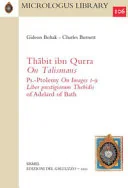
Thabit Ibn Qurra «On Talismans» and Ps.-Ptolemy «On Images 1-9». Together with the «Liber Prestigiorum Thebidis» of Adelard of Bath
 71
71

Thabit Ibn Qurra «On Talismans» and Ps.-Ptolemy «On Images 1-9». Together with the «Liber Prestigiorum Thebidis» of Adelard of Bath
The scholarly presentation of Thabit Ibn Qurra’s “On Talismans” alongside Pseudo-Ptolemy’s “On Images” and Adelard of Bath’s “Liber Prestigiorum Thebidis” is a significant contribution to the study of operative magic. Bohak and Burnett have meticulously curated these texts, offering translations that respect the original’s technical language while remaining accessible. The introduction and commentary provide crucial context, situating these works within the intellectual currents of the Islamic Golden Age and medieval Europe. A particular strength lies in the tracing of the transmission of knowledge, demonstrating how these complex ideas about image magic moved across cultures. The inclusion of Adelard of Bath’s Latin compilation is invaluable for understanding the reception and adaptation of these Hellenistic and Arabic concepts in the West. If there is a limitation, it is that the sheer density of the scholarly apparatus might prove challenging for readers new to the field, requiring a dedicated engagement with the historical and philosophical background. The section discussing the astrological conditions for creating images, detailed in both Thabit and Pseudo-Ptolemy, is particularly compelling, illustrating a sophisticated understanding of celestial influence. This volume is essential for serious researchers of pre-modern magical traditions.
📝 Description
71
Published in 2019, this volume presents critical editions of three key texts on talismans and magical images.
This book contains critical editions and translations of three important works on the creation and activation of talismans and magical images. It includes Thabit Ibn Qurra’s "On Talismans," a significant text from the Islamic Golden Age, and Pseudo-Ptolemy’s "On Images 1-9," a central Hellenistic treatise on the subject. The collection is rounded out by Adelard of Bath’s "Liber Prestigiorum Thebidis," a medieval Latin compilation that brought these ideas to Western Europe.
Scholars of ancient and medieval magic, historians of science and philosophy, and practitioners of Western esotericism will find this collection useful. It is particularly relevant for those interested in how magical knowledge moved between cultures and languages, from Arabic and Greek to Latin. The detailed scholarly notes are helpful for anyone researching the intellectual history of image magic.
This collection situates itself within the history of operative magic, specifically focusing on the creation of potent objects through astrological and sympathetic principles. The texts trace a lineage from Hellenistic astrological traditions, through their development in the Islamic world, and into their reception and adaptation in medieval Christian Europe. It shows how concepts of celestial influence on earthly matters were applied to construct magical devices, bridging cosmology, natural philosophy, and ritual practice.
💡 Why Read This Book?
• Gain a precise understanding of talismans and magical images, as articulated by Thabit Ibn Qurra and Pseudo-Ptolemy, moving beyond modern interpretations to the source material. • Trace the intellectual lineage of image magic from the Hellenistic period through the Islamic Golden Age and into medieval Latin Europe, understanding Adelard of Bath’s role in this transmission. • Learn about the specific astrological and material requirements for imbuing images with power, as detailed in the original treatises, offering practical insights into ancient and medieval magical theory.
⭐ Reader Reviews
Honest opinions from readers who have explored this book.
❓ Frequently Asked Questions
What is the primary focus of Thabit Ibn Qurra's "On Talismans"?
Thabit Ibn Qurra's "On Talismans" focuses on the theory and practice of creating magical objects, or talismans, by imbuing them with specific virtues derived from celestial influences and planetary hours.
Who was Adelard of Bath and what is his contribution in this book?
Adelard of Bath was a 12th-century English scholar who translated numerous Arabic scientific and philosophical texts into Latin. His "Liber Prestigiorum Thebidis" in this volume is a compilation that transmitted ideas on talismans and images from Arabic sources to medieval Europe.
What historical periods do the texts in this collection span?
The texts span the Hellenistic period (Pseudo-Ptolemy), the Islamic Golden Age (Thabit Ibn Qurra, 9th-10th century), and the High Middle Ages in Europe (Adelard of Bath, 12th century).
What is Pseudo-Ptolemy's "On Images 1-9" about?
Pseudo-Ptolemy's "On Images 1-9" deals with the creation of magical images, detailing how to construct representations that can influence events or people through astrological alignment and occult virtues.
What is the significance of the "Liber Prestigiorum Thebidis"?
The "Liber Prestigiorum Thebidis" is significant because it served as a conduit for transmitting sophisticated Arabic magical and astrological knowledge, including concepts of talismans, into the Latin West during the 12th century.
What kind of knowledge is transmitted regarding the creation of talismans?
The texts transmit knowledge about the necessity of astrological timing, the selection of appropriate materials, the use of specific forms and inscriptions, and the role of the operator's intent in activating the talisman's power.
🔮 Key Themes & Symbolism
Astrological Image Magic
The collection centrally explores the practice of imbuing images and objects with occult virtues through precise astrological configurations. Thabit Ibn Qurra and Pseudo-Ptolemy detail how specific planetary hours, celestial alignments, and the timing of an image’s creation are crucial for its efficacy. This wasn't mere symbolism; it was a sophisticated understanding of celestial mechanics influencing terrestrial phenomena through sympathetic principles, a central to Hellenistic and Islamic occult sciences.
Transmission of Esoteric Knowledge
A significant theme is the cross-cultural and chronological transmission of magical lore. The volume highlights how Thabit Ibn Qurra's work, rooted in Arabic occultism, was later filtered through Adelard of Bath's Latin "Liber Prestigiorum Thebidis" into medieval European thought. This process reveals the challenges and adaptations involved in preserving and disseminating complex philosophical and magical ideas across linguistic and religious divides.
The Nature of Talismans
The texts investigate the fundamental nature of talismans as objects designed to capture and direct celestial forces for specific purposes. This involves understanding the material composition, the inscribed figures or names, and the operative ritual required to 'activate' the talisman. It presents a worldview where the cosmos is imbued with inherent powers that can be harnessed through carefully crafted intermediaries.
The Philosophy of Representation
Beyond mere magical recipes, the works engage with the philosophical underpinnings of images and their power. Pseudo-Ptolemy, in particular, explores how an image, when properly configured with celestial influences, can become a conduit for spiritual or material effects. This touches upon Neoplatonic ideas about the soul of the world and the efficacy of imitative magic, where representation holds genuine causal power.
💬 Memorable Quotes
Direct passages from the work, attributed to the author.
“When creating a talisman, the astrologer must consider the planetary hour and the ascendant.”
— This highlights the critical role of astrological timing in operative magic. It suggests that the efficacy of a magical image or object is not inherent but contingent upon its alignment with cosmic cycles, as understood by practitioners in the Islamic and Hellenistic traditions.
“The image must be formed when the star that governs it is ascendant.”
— This principle underscores the sympathetic relationship between celestial bodies and their terrestrial manifestations. The act of creating an image under the dominion of a specific star aims to directly channel that star's influence into the object.
“Adelard’s compilation aimed to make accessible the knowledge of images and the celestial spheres.”
— This points to Adelard of Bath's crucial role as an intermediary, translating complex Arabic occult and scientific texts into Latin. His work facilitated the integration of these sophisticated ideas into the intellectual range of medieval Europe.
“The virtue of the talisman is derived from the celestial bodies and the operator’s intention.”
— This statement expresses the dual nature of talismanic magic: it requires both the proper cosmic alignment and the focused will of the practitioner to imbue the object with its intended power and function.
“Images can capture the souls of the planets or stars.”
— This interpretation reflects a belief in the animistic or spiritual essence of celestial bodies. Talismans, in this view, are not just passive objects but active agents capable of containing and wielding cosmic spiritual forces.
🌙 Esoteric Significance
Tradition
The works presented are deeply rooted in the Hermetic and Neoplatonic traditions of Hellenistic Egypt and later synthesized within Islamic occult sciences. They form a crucial link in the transmission of astral magic and theurgy from antiquity through the medieval period into Western esotericism. This lineage emphasizes the interconnectedness of the celestial and terrestrial realms and the potential for human agency to interact with cosmic forces through sympathetic means.
Symbolism
Key symbols include planetary figures, astrological symbols, and divine names, all used to imbue talismans with specific virtues. The 'image' itself, whether a drawing, statue, or ring, acts as a focal point for celestial energies. The act of creation under specific celestial auspices symbolizes the microcosm reflecting the macrocosm, aligning earthly materials with heavenly powers.
Modern Relevance
Contemporary practitioners of Western esoteric traditions, particularly those involved in ceremonial magic, astrological magic, and talismanic arts, draw directly from these foundational texts. Thinkers and groups exploring the history of magic and its philosophical underpinnings also find immense value in these primary sources for understanding the theoretical basis of operative magic.
👥 Who Should Read This Book
• Students of Hermeticism and Hellenistic magic seeking primary source material on the theory of image magic and its astrological underpinnings. • Historians of science and philosophy interested in the transmission of occult knowledge from the Islamic world to medieval Europe. • Practitioners of traditional astrology and talismanic magic looking to understand the historical development and theoretical foundations of their craft.
📜 Historical Context
This collection emerges from the vibrant intellectual milieu of the medieval world, a period marked by intense scholarly exchange between Islamic, Jewish, and Christian traditions. Thabit Ibn Qurra (9th-10th century) was a central figure in Baghdad’s House of Wisdom, contributing significantly to mathematics, astronomy, and medicine. His work on talismans reflects the integration of Greek magical traditions with Islamic cosmology. Pseudo-Ptolemy’s "On Images" represents the Hellenistic Hermetic tradition, where astral magic and the power of images were deeply explored. Adelard of Bath, a key translator in 12th-century England, was instrumental in bringing Arabic scientific and philosophical texts, including astrological and magical works, to Western Europe. His "Liber Prestigiorum Thebidis" demonstrates how these complex theories of image magic were adapted and understood within a burgeoning scholastic framework, often engaging with or being contrasted against the natural philosophy of Aristotle, which was also being rediscovered.
📔 Journal Prompts
The astrological conditions for creating a talisman under the dominion of a specific star.
Adelard of Bath's role in transmitting Arabic magical texts to Europe.
The concept of capturing planetary souls within images.
The relationship between an image and the celestial body it represents.
The practical implications of using specific planetary hours for magical operations.
🗂️ Glossary
Talismans
Objects, often inscribed or figured, believed to possess occult virtues and exert influence by capturing and directing celestial or spiritual powers.
Images
In this context, refers to representations (statues, drawings, etc.) that are ritually empowered, often through astrological means, to act as conduits for magical effects.
Ascendant
In astrology, the zodiacal sign and degree rising on the eastern horizon at a specific time and place, considered highly significant for horoscopic interpretations and magical timing.
Virtue
An inherent power or quality, often believed to be derived from celestial bodies or spiritual sources, that can be imbued into objects or manifest in natural phenomena.
Operative Magic
A branch of magic focused on practical application and the production of tangible effects, often involving the manipulation of natural and celestial forces through rituals and talismans.
Sympathetic Magic
The principle that like affects like, or that a connection can be established between two objects or persons through their resemblance or association, allowing for influence at a distance.
Theurgy
A system of ritual magic aimed at invoking divine powers or spirits, often associated with Neoplatonism, seeking union with the divine through sacred actions.
This book appears in 1 collection
🔮 Readers Also Liked
Browse all →








From the “Talismans” Collection
View all →




More Free Occult Philosophy Books
View all →