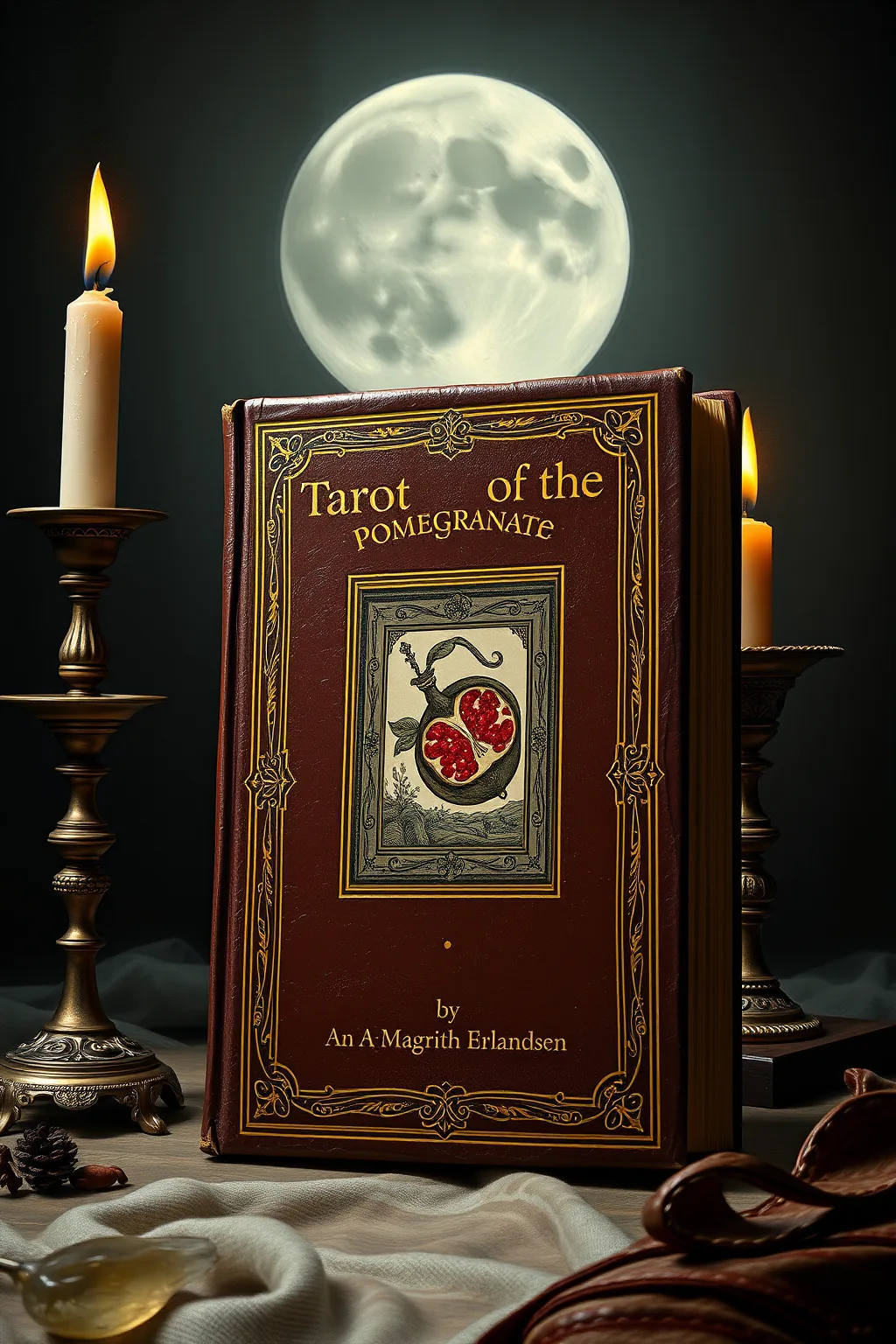
Tarot of the Pomegranate
 61
61

Tarot of the Pomegranate



Silas Hawthorne, Hermetic Studies Editor: An-Magrith Erlandsen's Tarot of the Pomegranate is a masterful exploration of the divinatory arts, resonating with profound esoteric insights. Erlandsen skillfully navigates the intricate symbology of the Tarot, revealing its connections to primal forces and cosmic cycles. The work is characterized by its rich, evocative language and its unwavering commitment to unveiling deeper layers of meaning. This is not a superficial manual, but a profound philosophical treatise disguised as a Tarot guide. It’s an essential read for serious students of Hermeticism, occult philosophy, and anyone seeking a more profound understanding of the Tarot's ancient wisdom. Highly recommended for practitioners and scholars alike.
📝 Description
61
An-Magrith Erlandsen's Tarot of the Pomegranate was published in 1985.
This book examines the Tarot through the lens of esoteric philosophy and ancient myth. Erlandsen connects celestial influences and earthly experiences, using each card as a point of access to deeper understanding. The text aims to guide readers toward self-knowledge by revealing symbolic connections and hidden truths within the cards. It presents a system for interpreting life's complexities and enhancing intuition. The author's writing style is intended to evoke a sense of mystical insight and spiritual inquiry. It seeks to bridge the gap between the material world and a more spiritual awareness. The book encourages a contemplative approach to the Tarot's imagery.
Published in 1985, Tarot of the Pomegranate belongs to the tradition of esoteric Tarot interpretation that gained prominence in the late 20th century. This approach moves beyond simple fortune-telling, seeking instead to align Tarot symbolism with established systems of Western esotericism, including Hermeticism, Kabbalah, and various mythological frameworks. Erlandsen's work situates itself within this lineage, which often emphasizes the Tarot as a tool for psychological and spiritual development rather than solely predictive purposes. The book engages with the idea of Tarot as a symbolic map of consciousness and the cosmos.
💡 Why Read This Book?
Embark on a mystical journey through the Tarot of the Pomegranate to unlock ancient wisdom and profound self-understanding. This book offers a unique esoteric perspective, revealing hidden symbolism and archetypal patterns. Ideal for seekers of spiritual truth, practitioners of divination, and scholars of occult traditions who wish to deepen their connection to the Tarot's transformative power.
⭐ Reader Reviews
Honest opinions from readers who have explored this book.
❓ Frequently Asked Questions
What makes the Tarot of the Pomegranate unique?
Its unique strength lies in Erlandsen's ability to weave together ancient myth, esoteric symbolism, and practical divination, offering a deeply philosophical and mystical interpretation of each card, far beyond standard interpretations.
Who is An-Magrith Erlandsen?
An-Magrith Erlandsen is a respected author and scholar in esoteric studies, known for her insightful and deeply researched works on divination and occult philosophy. Her approach is both scholarly and intuitively profound.
Is this book suitable for beginners?
While rich in esoteric depth, the book's clarity allows dedicated beginners to engage. However, those with some prior exposure to Tarot or mystical concepts will likely find it most rewarding.
What kind of symbolism is explored?
The book delves into a wide spectrum of symbolism, drawing from alchemical, astrological, mythological, and hermetic traditions, connecting them to the archetypal narratives of the Tarot.
Can this book be read for spiritual growth?
Absolutely. The Tarot of the Pomegranate is designed to be a catalyst for spiritual growth, offering profound insights into the human psyche and its connection to the divine through the lens of Tarot symbolism.
🔮 Key Themes & Symbolism
Archetypal Resonance and the Human Psyche
This book posits that the Tarot is not merely a predictive tool but a profound mirror reflecting the archetypal energies that govern the human psyche and the collective unconscious. Erlandsen explores how each card embodies universal patterns of experience, from the nascent spark of the Fool to the culmination of the World, offering insights into personal transformation and spiritual evolution. The pomegranate itself serves as a potent symbol of cyclical rebirth, the underworld, and the hidden fruits of wisdom, underscoring the cyclical nature of life and the journey of the soul.
The Language of Symbols: Alchemy and Mythology
Erlandsen masterfully deciphers the intricate symbolic language embedded within the Tarot, drawing rich parallels to alchemical processes and ancient mythologies. She reveals how the transformative stages of alchemy—nigredo, albedo, rubedo—find echoes in the Tarot's progression, and how myths of descent and ascent mirror the seeker's journey. The pomegranate, a recurring motif, acts as a key to understanding themes of duality, initiation, and the reconciliation of opposing forces, bridging the material and spiritual realms.
Divination as a Path to Gnosis
Beyond simple fortune-telling, the Tarot of the Pomegranate champions divination as a sacred practice for accessing gnosis—direct intuitive knowledge of the divine. Erlandsen guides readers to see Tarot readings not as predestined outcomes, but as dialogues with the higher self and cosmic intelligences. The book encourages a contemplative approach, urging practitioners to cultivate inner stillness and receptivity, thereby unlocking the profound wisdom and transformative potential inherent in the symbolic language of the cards.
💬 Memorable Quotes
Direct passages from the work, attributed to the author.
“To read the Tarot is to converse with the silent architects of destiny.”
— This suggests divination is a profound, intuitive dialogue with universal forces, not a passive reception of fate, emphasizing the active role of the seeker.
“Within the Major Arcana lies the soul's grand pilgrimage, etched in celestial ink.”
— This evokes the epic journey of the soul as depicted in the Major Arcana, portraying it as a sacred, divinely inscribed narrative.
“The minor cards are the daily bread of existence, seasoned with elemental magic.”
— This frames the Minor Arcana as the practical, everyday manifestations of life's energies, imbued with subtle, elemental power.
“Look not for answers in the cards, but for the questions they awaken within you.”
— This emphasizes introspection and self-inquiry, suggesting the true value of Tarot lies in its ability to prompt personal reflection and deeper understanding.
💡 Key Ideas
Editorial paraphrase of the work's core concepts — not direct quotes.
The pomegranate seeds are whispered secrets of the underworld, each a promise of return.
This quote highlights the pomegranate's dual nature—connected to depths and renewal—mirroring the Tarot's ability to reveal hidden truths and guide towards transformation.
🌙 Esoteric Significance
Tradition
The Tarot of the Pomegranate draws heavily from the Hermetic and Neoplatonic traditions, intertwining them with symbolic systems found in ancient mythologies, particularly those with cyclical and chthonic elements. It also exhibits a unique resonance with archetypal psychology, viewing the cards as keys to unlocking the universal patterns of the human psyche and its journey of individuation.
Symbolism
The pomegranate itself is a central symbol, representing fertility, abundance, the underworld, and cyclical rebirth—themes deeply connected to initiation and transformation. Other key symbols explored include the archetypal figures of the Major Arcana, the elemental correspondences of the Minor Arcana, and the intricate allegorical narratives that Erlandsen combines to illuminate their profound meanings.
Modern Relevance
In an age often characterized by rapid change and existential uncertainty, the Tarot of the Pomegranate offers a timeless anchor. Its exploration of archetypal patterns provides a framework for understanding personal challenges and societal shifts. The emphasis on intuitive wisdom and self-discovery empowers individuals to navigate complexity, fostering resilience and a deeper connection to their inner life and the subtle energies of the universe.
👥 Who Should Read This Book
The Tarot of the Pomegranate is a treasure for a diverse audience. **Beginners** seeking a profound and meaningful introduction to Tarot beyond surface-level interpretations will find a rich, guiding text. **Practitioners** looking to deepen their craft and expand their understanding of esoteric symbolism will discover new layers of insight. **Scholars** of occult history, mythology, and comparative religion will appreciate the book's meticulous research and unique synthesis of traditions. **Spiritual seekers** yearning for a tool to facilitate introspection, self-awareness, and a connection to the subtle dimensions of existence will find this book an invaluable companion on their journey.
📜 Historical Context
The Tarot of the Pomegranate emerges from a rich lineage of esoteric thought, deeply influenced by the Hermetic revival of the Renaissance and the subsequent flowering of occultism in the 19th and 20th centuries. Authors like Eliphas Lévi and Arthur Edward Waite laid the groundwork for modern Tarot interpretation, imbuing it with Kabbalistic, astrological, and alchemical symbolism. An-Magrith Erlandsen builds upon this foundation, yet her work is distinct in its unique synthesis of Norse mythology and a deeply personal, intuitive approach to symbolism. The era in which such works gain traction often reflects a societal yearning for deeper meaning, a spiritual counterpoint to burgeoning scientific rationalism. This book speaks to that perennial human quest for understanding our place in the cosmos and the hidden forces that shape our reality, resonating with the timeless appeal of mystery and self-discovery.
📔 Journal Prompts
Meditate on the pomegranate symbol: what does its cyclical nature and underworld connection reveal about your current life phase?
Choose a Major Arcana card and reflect on how its archetypal energy is manifesting in your daily life.
Explore the elemental correspondences of the Minor Arcana. How do the energies of Fire, Water, Air, and Earth feel present in your experiences?
Consider the 'whispered secrets' mentioned in the text. What hidden truths or intuitive insights are the Tarot cards trying to reveal to you now?
If divination is a conversation, what question is your higher self currently asking you through the Tarot?
🗂️ Glossary
Archetype
A universal, inherited pattern of thought or imagery derived from the experience of the species, often found in myths, fairy tales, and dreams. In Tarot, archetypes represent fundamental human experiences and stages of development.
Gnosis
Direct, intuitive knowledge of spiritual truths, often attained through mystical experience or insight, as opposed to rational deduction or faith.
Hermeticism
A religious, philosophical, and esoteric tradition based primarily upon writings attributed to Hermes Trismegistus, emphasizing the interconnectedness of all things and the pursuit of spiritual wisdom.
Esoteric
Intended for or likely to be understood by only a small number of people with a specialized knowledge or interest; relating to secret or mysterious knowledge.
Chthonic
Pertaining to the underworld, the earth, or the deities and spirits associated with it; often associated with primal forces, mystery, and cyclic processes.
This book appears in 3 collections
🔮 Readers Also Liked
Browse all →







From the “Tarot” Collection
View all →






More Free Divination & Tarot Books
View all →