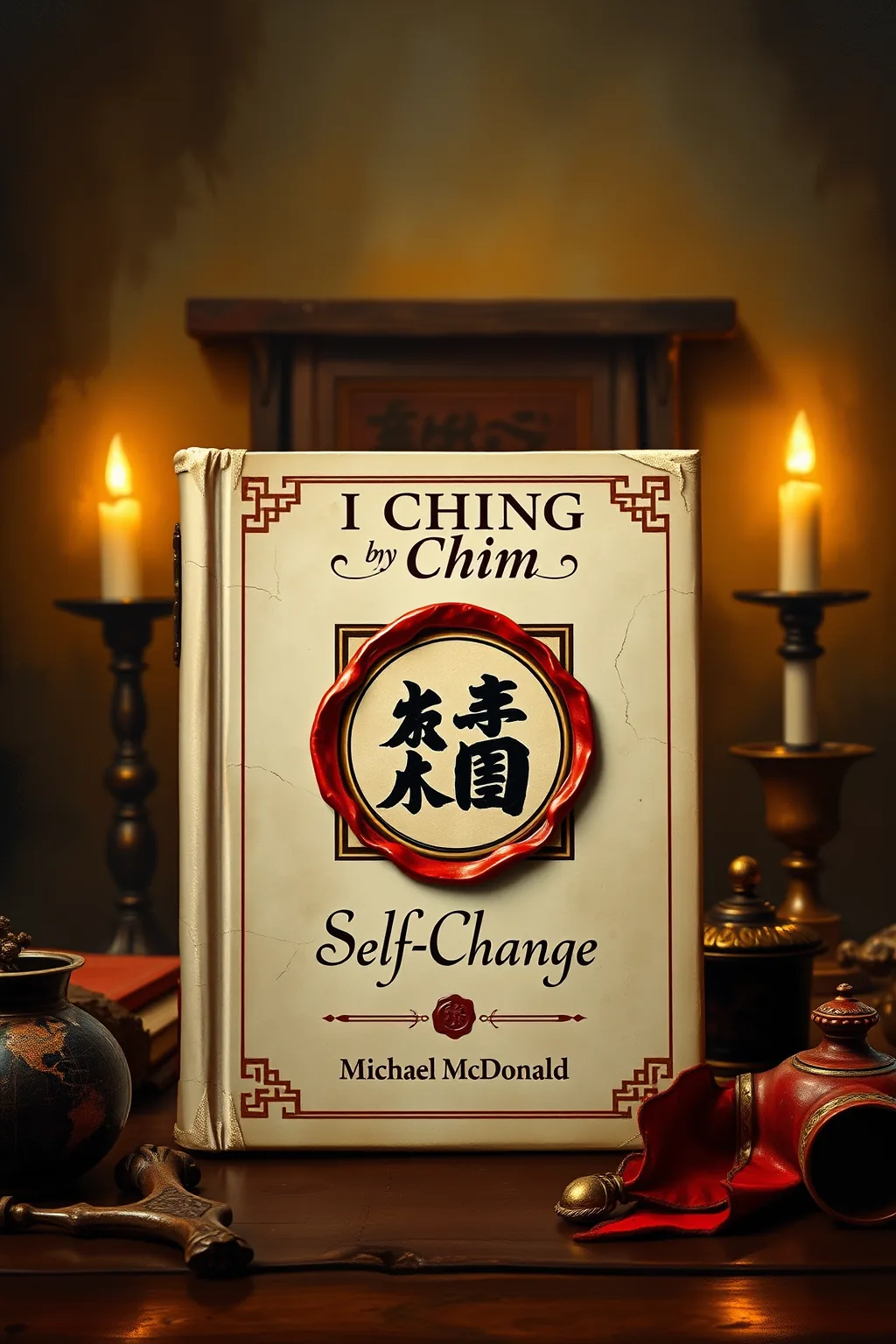
I Ching Self-Change
 61
61

I Ching Self-Change



Alaric Kestrel, Metaphysical Studies Reviewer: Michael McDonald's 'I Ching Self-Change' is a revelation for anyone seeking to move beyond simple fortune-telling into the profound application of the Book of Changes. McDonald's approach is refreshingly practical, yet deeply rooted in esoteric principles. He doesn't just explain the hexagrams; he unlocks their transformative potential as tools for self-awareness and conscious evolution. The book excels in its clarity, making complex symbolism accessible without sacrificing its mystical depth. This is an essential text for serious students of the I Ching and for those on a dedicated path of inner work.
📝 Description
61
Michael McDonald's 'I Ching Self-Change' presents the I Ching not just for divination, but as a tool for personal evolution.
Published by Esoteric Library, 'I Ching Self-Change' by Michael McDonald reframes the ancient Chinese text as a guide for personal transformation. McDonald analyzes the symbolic language within the I Ching's hexagrams. He suggests these symbols offer a framework for understanding and influencing the flow of life. The book encourages a direct engagement with the universe's subtle energies and the cyclical patterns of existence. It aims to shift the reader from a passive recipient of fate to an active participant in shaping their own future. This work connects traditional oracular practices with the demands of contemporary personal development.
This book falls within the Western esoteric tradition's interest in the I Ching, viewing it as more than a fortune telling device. It aligns with interpretations that see the I Ching as a philosophical text and a map of consciousness. McDonald's approach echoes other esoteric writers who sought to integrate Eastern philosophical systems with Western psychological and spiritual concepts for self-improvement. The focus is on practical application and inner work, rather than purely academic study or predictive divination.
💡 Why Read This Book?
Uncover the I Ching not just as a predictive tool, but as a potent catalyst for inner metamorphosis. This book offers practical methods to harness its ancient wisdom for profound self-discovery and deliberate life design. Ideal for seekers of authentic spiritual growth, scholars of Eastern philosophy, and practitioners aiming to integrate esoteric knowledge into daily life for tangible change.
⭐ Reader Reviews
Honest opinions from readers who have explored this book.
❓ Frequently Asked Questions
What is the primary aim of 'I Ching Self-Change'?
The book's primary aim is to guide readers in utilizing the I Ching as a dynamic system for personal growth and transformation, moving beyond simple divination to active self-mastery.
Is prior knowledge of the I Ching required?
While prior familiarity can enhance the experience, Michael McDonald's clear explanations make the text accessible to newcomers, offering a comprehensive introduction to its principles and applications.
How does this book differ from other I Ching guides?
Unlike purely predictive texts, 'I Ching Self-Change' emphasizes the hexagrams as energetic patterns for understanding and influencing one's inner state and external circumstances, focusing on proactive change.
What kind of transformation can one expect?
Readers can expect enhanced self-awareness, improved decision-making, a deeper connection to universal patterns, and the cultivation of resilience and adaptability through conscious engagement with the I Ching's wisdom.
Can the I Ching truly help with 'self-change'?
Absolutely. The I Ching provides a mirror to the soul and a map of potential pathways. By understanding its cyclical wisdom, one can identify patterns, embrace necessary shifts, and consciously steer their personal evolution.
🔮 Key Themes & Symbolism
The Oracle as a Mirror of the Soul
This theme explores the I Ching's profound capacity to reflect the reader's inner landscape, revealing subconscious patterns, hidden strengths, and areas ripe for development. It positions the hexagrams not as external pronouncements, but as internal dialogues, encouraging introspection and a deep communion with one's own psyche. The book examines how symbolic imagery acts as a potent catalyst for self-recognition, enabling individuals to face their shadows and embrace their light, fostering a more integrated and authentic self.
Cyclical Evolution and Cosmic Harmony
McDonald elucidates the I Ching's fundamental principle of cyclical change, mirroring the natural ebb and flow of the cosmos. This theme highlights how understanding these universal rhythms allows for greater attunement with life's unfolding processes. By recognizing the inherent impermanence and constant flux, readers are empowered to navigate transitions with grace and wisdom, transforming resistance into acceptance and chaos into a dance of harmonious progression. It's about aligning personal evolution with the grand, cosmic symphony.
The Hexagrams as Blueprints for Action
Beyond mere interpretation, this theme focuses on the actionable wisdom embedded within each hexagram. McDonald presents the I Ching as a practical guide for conscious decision-making and strategic living. Each symbolic arrangement offers insights into the energetic dynamics of a situation, providing guidance on the most opportune moments and approaches for initiating change. The book encourages readers to actively engage with this wisdom, transforming passive reception into deliberate creation, thus becoming architects of their own destiny through informed action.
💬 Memorable Quotes
Direct passages from the work, attributed to the author.
“The hexagrams are not pronouncements, but conversations.”
— This suggests the I Ching is an interactive dialogue, inviting introspection rather than dictating fate, empowering the reader as an active participant in understanding their path.
“Within every ending lies the seed of a new beginning.”
— Emphasizes the cyclical nature of existence and the inherent potential for renewal and growth found even in apparent conclusions.
“Wisdom is not found, but cultivated.”
— Highlights the active, ongoing process of personal development and the internal cultivation required to achieve true understanding and insight.
“Align your inner world with the outer currents.”
— Encourages attunement with universal energies and finding harmony between one's internal state and the external circumstances of life.
“The oracle whispers, but the heart must listen.”
— Stresses the importance of intuitive receptivity and inner stillness for truly comprehending and acting upon the wisdom offered by the I Ching.
🌙 Esoteric Significance
Tradition
Rooted in the ancient Chinese tradition of the I Ching, also known as the Book of Changes, this work draws from Taoist philosophy and Confucian principles. It is deeply embedded in the esoteric understanding of the universe as a dynamic system governed by interconnected forces and cyclical patterns, a core tenet of many Eastern mystical traditions. The book also aligns with Western Hermetic and alchemical principles that emphasize transformation through understanding universal laws.
Symbolism
The I Ching's sixty-four hexagrams are rich with symbolic meaning, representing fundamental archetypes of human experience and natural phenomena. Lines (broken and unbroken) symbolize Yin and Yang, the primordial dual forces. The trigrams, formed by three lines, represent Heaven, Earth, Water, Fire, Lake, Mountain, Thunder, and Wind. McDonald's interpretation unlocks the deeper symbolic resonance of these elements, revealing their energetic interplay and their profound relevance to personal transformation.
Modern Relevance
In an age marked by rapid change and uncertainty, the I Ching's principles of adaptability, cyclical evolution, and the interconnectedness of all things offer profound guidance. 'I Ching Self-Change' provides a timeless framework for navigating personal challenges, fostering resilience, and cultivating a sense of agency. Its emphasis on conscious choice and inner transformation resonates deeply with contemporary seekers looking for meaning, purpose, and a more harmonious relationship with themselves and the world.
👥 Who Should Read This Book
This clear text is for a diverse audience: **Beginners** seeking an accessible yet profound introduction to the I Ching's transformative power will find clarity and practical guidance. **Scholars** of Eastern philosophy and comparative religion will appreciate its insightful interpretation and grounding in traditional wisdom. **Spiritual Seekers** yearning for tools to deepen self-awareness and align with universal principles will discover a potent oracle for inner work. **Practitioners** of divination, mindfulness, and personal development will find new methods and a richer understanding of how to apply the I Ching for conscious, deliberate change in their lives.
📜 Historical Context
Published during an era of renewed interest in Eastern philosophies and esoteric traditions in the West, 'I Ching Self-Change' emerged as a significant contribution to the growing body of literature on divination and personal development. The late 20th and early 21st centuries saw a surge in individuals seeking spiritual alternatives and ancient wisdom to read through the complexities of modern life. Michael McDonald's work tapped into this zeitgeist, offering a nuanced and practical interpretation of the I Ching that resonated with those disillusioned by purely materialistic worldviews. Its focus on transformation and self-empowerment placed it within a broader movement that sought to integrate ancient spiritual practices with contemporary psychological and philosophical inquiry, making it a key text for the evolving range of esoteric studies.
📔 Journal Prompts
Reflect on a recent challenge: Which hexagram best represents its underlying dynamics, and what subtle shifts can you make based on its wisdom?
Consider a personal goal: How can the principles of cyclical change, as presented in the I Ching, be applied to ensure its sustainable growth and evolution?
Examine your inner dialogue: How do the symbolic conversations of the hexagrams mirror your own internal debates and decision-making processes?
Identify an area for growth: What 'ending' in your life might be holding the 'seed of a new beginning,' and how can the I Ching illuminate this transition?
How can you actively 'cultivate' wisdom today, rather than passively waiting for it, using the insights gained from this book?
🗂️ Glossary
Hexagram
A six-line figure in the I Ching, composed of two trigrams, representing a specific situation or archetypal dynamic in the universe and human experience.
Trigram
A fundamental symbol in the I Ching composed of three lines, each either broken (Yin) or unbroken (Yang). The eight trigrams represent elemental forces and concepts.
Yin
The principle of receptivity, passivity, darkness, and the feminine. Represented by a broken line (--) in the I Ching.
Yang
The principle of activity, assertiveness, light, and the masculine. Represented by an unbroken line (—) in the I Ching.
Tao
The fundamental principle of the universe in Taoism; the Way. It represents the natural order, the flow of existence, and the ultimate reality.
This book appears in 3 collections
🔮 Readers Also Liked
Browse all →








From the “Tarot” Collection
View all →









More Free Divination & Tarot Books
View all →