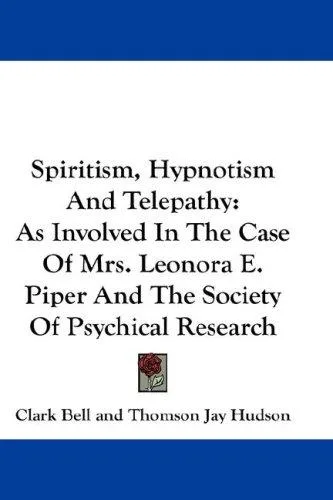
Spiritism, Hypnotism And Telepathy
 75
75

Spiritism, Hypnotism And Telepathy
Clark Bell and Thomson Jay Hudson's Spiritism, Hypnotism And Telepathy offers a window into an era fascinated by the unseen. The strength lies in its earnest attempt to apply a form of rational inquiry to subjects often relegated to the fringes. Hudson, in particular, shows a keen interest in the psychological underpinnings of reported psychic events. However, the limitation is evident in the dated methodology; the evidence presented, while compelling to its contemporaries, lacks the rigor demanded by modern scientific standards. The discussion surrounding the 'percipient' in telepathic experiments, for instance, highlights the subjective biases inherent in the era's investigations. It serves as a valuable historical document of belief and inquiry, rather than a definitive scientific treatise.
📝 Description
75
In 1900, Clark Bell and Thomson Jay Hudson examined spiritism, hypnotism, and telepathy.
Published around the turn of the 20th century, Spiritism, Hypnotism and Telepathy compiles essays and investigations into phenomena that questioned contemporary scientific and spiritual beliefs. Authors Clark Bell and Thomson Jay Hudson analyze the reported abilities of mediums, the mechanics of hypnotic suggestion, and the supposed transmission of thought without sensory input. The book seeks to establish a rational, though unconventional, framework for understanding these subjects.
The volume is suited for scholars of psychical research, historians of late 19th and early 20th-century occultism, and students of parapsychology. It offers primary source material from a time preceding modern scientific skepticism, showing the intellectual environment that fostered movements like Theosophy and Spiritualism. Readers interested in early esoteric ideas about consciousness beyond the physical body will find it valuable.
The late Victorian and Edwardian eras were a time of spiritual inquiry. As industrialization advanced and scientific materialism grew, a counter-movement emerged, seeking evidence for a spiritual reality. This book fits that context, aiming to legitimize the study of telepathy and spirit communication, topics then discussed in intellectual circles. It engages with contemporary debates about mesmerism and the nature of the mind.
This work emerged during a period of intense spiritual inquiry, particularly in the late Victorian and Edwardian eras. As industrialization and scientific materialism became dominant, a concurrent interest in spiritual realities beyond empirical observation grew. Bell and Hudson's book participated in this intellectual milieu, seeking to provide a reasoned basis for studying phenomena like telepathy and spirit communication, which were subjects of discussion in various societies and intellectual circles.
💡 Why Read This Book?
• Understand the early intellectual framework for telepathy and spiritism by examining the authors' arguments, which were developed during the burgeoning psychical research movement of the late 19th century. • Explore the historical context of hypnotism as a tool for investigating consciousness, referencing specific case studies or theories presented by Bell and Hudson. • Gain insight into the foundational concepts of the 'subliminal self' as proposed by Thomson Jay Hudson, a key idea in understanding the era's approach to altered states and psychic phenomena.
⭐ Reader Reviews
Honest opinions from readers who have explored this book.
❓ Frequently Asked Questions
What is Spiritism as discussed in Clark Bell's book?
Spiritism, in the context of this work, refers to the belief and practice involving communication with spirits of the deceased. It was a significant movement in the late 19th century, and this book explores its purported phenomena and underlying principles.
How does Thomson Jay Hudson define Hypnotism in 'Spiritism, Hypnotism And Telepathy'?
Hudson approaches hypnotism as a state of heightened suggestibility and an avenue for exploring the deeper layers of the human mind, often linking it to phenomena like telepathy and subconscious abilities.
What evidence is presented for Telepathy in this book?
The book discusses anecdotal accounts, experiments conducted by psychical researchers of the time, and theoretical arguments attempting to explain thought transference beyond sensory perception, reflecting the investigatory methods of the late 1800s.
Who were the primary authors and when was this work first published?
The primary authors are Clark Bell and Thomson Jay Hudson. The first publication date listed is 2007, though the content reflects late 19th and early 20th-century investigations.
Does the book offer scientific proof for its claims?
The book presents arguments and case studies from its historical period, aiming for a rational explanation within its own framework. However, it does not adhere to modern scientific standards of empirical proof and verification.
What is the 'subliminal self' concept mentioned?
The 'subliminal self' is a concept explored by Thomson Jay Hudson, referring to the subconscious or a deeper level of consciousness believed to hold latent powers and be responsible for phenomena like intuition, dreams, and potentially psychic abilities.
🔮 Key Themes & Symbolism
The Nature of Consciousness
The work grapples with the idea that consciousness extends beyond the physical brain, a central tenet explored in late 19th-century esoteric thought. Authors examine how phenomena like telepathy and mediumship suggest a non-local or broader aspect of the mind. This challenges materialist views prevalent in science, positing that the 'subliminal self' might access information or exert influence outside conventional physical laws, reflecting a significant departure from purely biological explanations of the mind.
Spirit Communication and Mediumship
Spiritism is presented as a system for understanding alleged contact with discarnate entities. The book analyzes reports from mediums and séances, attempting to find patterns or logical explanations for perceived spirit presence and communication. This theme examines the societal and intellectual fascination with the afterlife and the possibility of continued existence, placing these claims within the context of early parapsychological inquiry.
Hypnotism and Suggestibility
Hypnotism is explored not just as a medical or entertainment practice but as a key to unlocking latent mental faculties. The authors investigate how suggestibility in a hypnotic state can reveal deeper psychological layers and potentially facilitate phenomena like telepathy. This section examines the therapeutic and exploratory potential attributed to altered states of consciousness during the period.
Challenges to Materialism
A core objective of the book is to present evidence that counters strict scientific materialism. By examining spiritism, hypnotism, and telepathy, Bell and Hudson argue for a more expansive view of reality that includes non-physical forces and mental capabilities. They address the limitations of empirical science in fully accounting for subjective experience and anomalous phenomena.
💬 Memorable Quotes
Direct passages from the work, attributed to the author.
“The belief in spirit communication is as old as humanity.”
— This statement frames the discussion of Spiritism not as a novel or fringe idea, but as a persistent aspect of human spiritual exploration across cultures and epochs, grounding its significance.
“Hypnotism reveals the power of the mind over the body.”
— This highlights the authors' view of hypnotism as a demonstration of the potent influence of mental states and suggestion on physiological and psychological processes, suggesting a mind-body connection.
“Telepathy suggests a universal medium for thought.”
— This interpretation points to the concept that thought itself might travel through an unseen ether or field, connecting minds directly without reliance on physical senses, a common speculative idea of the era.
“Evidence for the unseen demands careful examination.”
— This emphasizes the authors' approach, advocating for a rational, analytical method even when investigating phenomena that lie outside conventional scientific understanding.
💡 Key Ideas
Editorial paraphrase of the work's core concepts — not direct quotes.
The subliminal self holds untapped potentials.
This paraphrased concept reflects Thomson Jay Hudson's belief in a deeper, subconscious layer of the mind that possesses capabilities beyond ordinary waking consciousness, often linked to psychic phenomena.
🌙 Esoteric Significance
Tradition
This work situates itself within the broader tradition of psychical research and early parapsychology, which often drew from and influenced esoteric movements like Spiritualism and Theosophy. While not strictly Hermetic or Kabbalistic, it engages with the era's fascination with hidden forces and expanded consciousness, aligning with a general esoteric quest to understand realities beyond the material plane. It departs from purely devotional or ritualistic traditions by attempting a more analytical, albeit subjective, approach.
Symbolism
While the text is more analytical than symbolic, the concepts themselves function symbolically. 'Telepathy' symbolizes the interconnectedness of minds, transcending physical separation. 'Hypnotism' represents the exploration of hidden potentials within the psyche, a gateway to the 'subliminal self.' 'Spiritism' symbolizes the persistence of consciousness beyond death, a fundamental tenet in many esoteric traditions seeking proof of an afterlife.
Modern Relevance
Contemporary fields like consciousness studies, parapsychology, and even certain branches of neuroscience that explore altered states and subjective experience owe a debt to these early investigations. Modern practitioners of energy healing, mindfulness, and those exploring quantum consciousness theories may find elements of these foundational inquiries into non-local mind phenomena and the power of suggestion.
👥 Who Should Read This Book
• Students of late 19th and early 20th-century esoteric thought, seeking primary source material on the intellectual currents that gave rise to Spiritualism and Theosophy. • Researchers in the history of psychical research, who will find this work a valuable document detailing early attempts to rationalize and study phenomena like telepathy and hypnotism. • Individuals interested in the philosophical and psychological debates surrounding consciousness, who wish to understand historical perspectives on the mind's potential beyond the physical body.
📜 Historical Context
The late 19th and early 20th centuries witnessed a surge of interest in psychical research, spurred by societal shifts and the perceived limitations of burgeoning scientific materialism. As industrialization advanced, many sought solace and meaning in spiritualism, Theosophy, and other esoteric movements. Spiritism, Hypnotism And Telepathy emerged within this intellectual climate, aiming to provide a coherent framework for understanding phenomena that defied easy explanation. Prominent figures like Helena Blavatsky were popularizing Theosophy, offering a complex spiritual philosophy that engaged with similar questions about consciousness and the unseen world. The work by Bell and Hudson can be seen as an attempt to categorize and rationalize these diverse explorations, engaging with contemporary debates on mesmerism and the nature of the mind, often facing skepticism from the established scientific community.
📔 Journal Prompts
The concept of the 'subliminal self' as presented by Thomson Jay Hudson.
The historical evidence for spirit communication explored in the book.
Hypnotism's role in revealing latent mental faculties.
Telepathy as a challenge to conventional communication models.
The societal reception of phenomena like mediumship in the book's era.
🗂️ Glossary
Spiritism
A doctrine that asserts the possibility of communication with the spirits of the deceased, typically through a medium. It was a significant spiritual movement in the 19th century.
Hypnotism
A state of consciousness characterized by focused attention, reduced peripheral awareness, and an enhanced capacity for response to suggestion. Explored here for its psychological implications.
Telepathy
The purported transmission of information from one person to another without using any of the known sensory channels. Also known as 'mind-to-mind' communication.
Medium
An individual believed to be capable of communicating with spirits of the dead, acting as an intermediary between the physical and spiritual realms.
Subliminal Self
A term popularized by Thomson Jay Hudson, referring to the subconscious mind or a deeper layer of consciousness thought to possess latent abilities and access information beyond normal awareness.
Psychical Research
The study of alleged psychic phenomena and other paranormal claims, often employing scientific methods to investigate such claims. This book is a product of its early era.
Materialism
The philosophical belief that matter is the fundamental substance in nature, and that all phenomena, including mental states and consciousness, are results of material interactions.
🔮 Readers Also Liked
Browse all →









More by Clark Bell, Thomson Jay Hudson
All books →
More Free Occult Philosophy Books
View all →