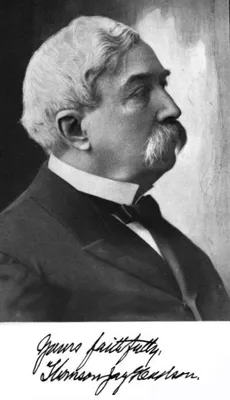
Clark Bell, Thomson Jay Hudson
Thomson Jay Hudson was an American author and psychical researcher who proposed a scientific framework for understanding psychic phenomena through the subconscious mind.
Thomson Jay Hudson was an American author, journalist, and psychical researcher known for his exploration of psychic phenomena through a scientific lens. Born in Ohio in 1834, Hudson had a varied early life that included farm labor, self-directed study, and a brief legal career before transitioning to journalism and later the US Patent Office. He gained international recognition with his 1893 book, "The Law of Psychic Phenomena," in which he posited that many so-called psychic occurrences, such as telepathy and mediumistic trances, could be explained by the workings of the subconscious mind rather than supernatural forces.
Hudson's work centered on the concept of two minds—an objective (conscious) and a subjective (subconscious) mind—and proposed three laws governing psychic phenomena. He suggested that the subjective mind is susceptible to suggestion and incapable of independent reasoning, and that its projections could explain apparitions and spirit photography. While his theories were influential, particularly within the New Thought movement, they relied on the existence of telepathy, which remains unproven. Hudson also authored other significant works, including "A Scientific Demonstration of the Future Life" and "The Law of Mental Medicine," before his death in 1903.
Psychical Research and the Subconscious Mind
Thomson Jay Hudson dedicated much of his later life to the systematic study of psychical phenomena, aiming to provide a scientific and psychological explanation for experiences often attributed to the supernatural. He was particularly interested in the subconscious mind, theorizing that it played a crucial role in phenomena such as telepathy, clairvoyance, and mediumship. Hudson believed that by understanding the mechanisms of the subconscious, one could demystify these experiences. He also explored the influence of hypnotism and suggestion, proposing that these techniques could unlock or demonstrate the latent powers of the subconscious. His work extended to the connection between the mind and body, examining how mental states could affect physical well-being.
The Theory of Two Minds
At the core of Hudson's theoretical framework was the concept of a dual mental organization, which he described as having two distinct minds: the objective (conscious) and the subjective (subconscious). He proposed that these minds possessed separate attributes and could operate independently under specific conditions. Hudson argued that this dualistic view could account for phenomena like apparitions and spirit photography, suggesting these were not manifestations of external spirits but rather projections from the subjective mind, transmitted telepathically between individuals. This theory formed the basis for his "three laws of psychic phenomena," which aimed to establish a rational basis for understanding psychic events.
Influence and Legacy
Hudson's seminal work, "The Law of Psychic Phenomena," published in 1893, brought him considerable fame and significantly influenced subsequent thought in areas like New Thought and Mental Science. His ideas were adopted and expanded upon by figures such as Thomas Troward and Ernest Holmes, who integrated his concepts into their teachings on "Mental Science" and Religious Science, respectively. Hudson's approach, which sought to reconcile psychic experiences with scientific principles, provided a foundation for exploring the potential of the human mind and consciousness beyond conventional understanding, even as his reliance on unproven concepts like telepathy remained a point of contention.
Key Ideas
- The existence of two minds: objective (conscious) and subjective (subconscious).
- The subjective mind is susceptible to suggestion and lacks inductive reasoning.
- Psychic phenomena can be explained by the workings of the subconscious mind and telepathy.
- The mind-body connection and the influence of mental states on physical health.
Books by Clark Bell, Thomson Jay Hudson
2 free public domain books · Read online or download