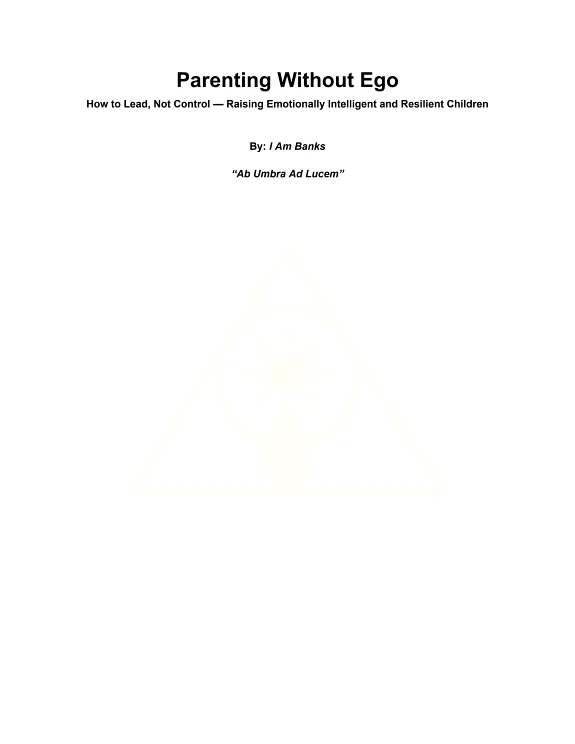
Parenting Without Ego by Author I Am Banks
 78
78

Parenting Without Ego by Author I Am Banks
I Am Banks's Parenting Without Ego arrives with a bold premise: the real work of raising children is the work of raising oneself. The author eschews typical parenting advice, focusing instead on the parent's internal state as the primary locus of change. This is a refreshing, albeit demanding, perspective. Banks's assertion that 'Parenting isn’t about raising children. It’s about raising yourself' is the book’s driving force, pushing readers to confront their own emotional reactivity. The strength lies in its relentless self-inquiry, urging parents to view tantrums and defiance not as personal affronts, but as mirrors reflecting their own unaddressed inner turmoil. However, the book occasionally falters by underemphasizing the practical scaffolding needed to support this intense internal work, particularly for parents in highly stressful environments. A passage discussing the 'conscious pause' effectively illustrates the core concept: the necessity of stepping back from immediate emotional impulse to respond with intentionality. While conceptually sound, the implementation details could be more robust. Ultimately, Banks offers a challenging, inward-looking path for parents committed to profound personal evolution through the crucible of family life.
📝 Description
78
Parenting Without Ego, published in 2025, reframes child-rearing as parental self-mastery, not just child behavior management.
I Am Banks's 2025 book, Parenting Without Ego, suggests that effective child-rearing hinges on a parent's internal capacity to manage their own ego and emotional responses. The work moves away from focusing on external disciplinary tactics and instead redirects attention inward to the parent's psychological state. It is for parents who find their current methods are not working, especially those who struggle with emotional reactions during difficult moments with their children. The book appeals to individuals seeking a more introspective approach to parenthood, valuing personal growth and self-awareness over quick fixes. It looks at the spiritual dimensions of family life.
Banks argues that the 'parental ego' is a main barrier to compassionate parenting. The book describes 'ego ignition' as moments when a parent's insecurities or personal desires take precedence over a child's actual needs. To counter this, the book advocates for cultivating a 'conscious pause,' a practice designed to help parents step back from automatic egoic reactions. This technique aims to foster more mindful and less reactive parenting.
Published in 2025, Parenting Without Ego connects to a long history of introspective spiritual practices. It suggests that the home environment can serve as a training ground for self-cultivation, similar to contemplative disciplines found in monastic orders or older hermetic traditions. While it relates to modern transpersonal psychology and mindfulness, its specific focus on applying these inner work principles to parenting sets it apart. The book views parenting not just as a social role but as a path for spiritual development.
💡 Why Read This Book?
• You will learn to identify and interrupt your own 'ego ignition' moments, transforming reactive outbursts into opportunities for mindful presence, directly inspired by the book's central concept. • Gain practical techniques for cultivating a 'conscious pause,' enabling you to respond to your child's needs with greater clarity and less emotional interference, a skill emphasized throughout the 2025 publication. • Understand how mastering your own emotional landscape, rather than focusing solely on behavioral modification, serves as the most potent tool for fostering a child's secure development, a core tenet of Banks's approach.
⭐ Reader Reviews
Honest opinions from readers who have explored this book.
❓ Frequently Asked Questions
What is the core philosophy behind 'Parenting Without Ego'?
The core philosophy is that effective parenting hinges on the parent's internal self-mastery rather than external methods. It suggests that the primary goal is to raise oneself by managing emotions and egoic impulses, thereby creating a more conducive environment for the child's development.
How does the book define 'ego ignition' in parenting?
'Ego ignition' refers to moments when a parent's personal insecurities, desires, or pride flare up, overriding their child's actual needs. The book uses this term to highlight how parental ego can derail compassionate and effective responses.
What practical technique does 'Parenting Without Ego' suggest for managing emotional responses?
The book promotes the practice of a 'conscious pause.' This involves intentionally halting one's immediate emotional reaction to a child's behavior, creating space to assess the situation objectively and respond with intention rather than impulse.
Is this book focused on specific age groups for children?
While the principles are broadly applicable, the book's focus on the parent's internal state means its concepts can be adapted to various developmental stages. The emphasis is on the parent's journey, making age less of a defining factor than the parent's willingness to engage in self-reflection.
What distinguishes 'Parenting Without Ego' from conventional parenting guides?
Unlike guides that offer behavioral strategies or reward systems, this book redirects the focus entirely inward, on the parent's psychological and emotional growth. It posits self-mastery as the ultimate parenting tool, rather than techniques applied externally to the child.
When was 'Parenting Without Ego' first published?
'Parenting Without Ego' by I Am Banks was first published on July 4, 2025.
🔮 Key Themes & Symbolism
Egoic Interference in Parenting
The work meticulously examines how the parental ego, often an unconscious force, interferes with objective and compassionate child-rearing. Banks details how personal histories, insecurities, and the need for validation can manifest as disproportionate reactions to a child's behavior. This theme challenges the reader to see their child's actions not as direct provocations, but as potential triggers for their own unresolved egoic patterns, urging a shift from external blame to internal accountability.
The Conscious Pause
Central to Banks's methodology is the 'conscious pause'—a deliberate act of interrupting automatic emotional responses. This technique is presented as a vital tool for parents seeking to cultivate self-mastery. By creating a moment of deliberate stillness between stimulus and reaction, parents can disengage from egoic impulses and choose a more aligned, intentional response that prioritizes the child's needs and long-term well-being over immediate emotional gratification.
Parental Self-Mastery as Pedagogy
This theme reframes parenting not as a process of molding a child, but as a rigorous practice of self-refinement for the parent. The book posits that the most profound influence a parent can have is through their own internal state of being. By committing to mastering their emotions and ego, parents indirectly teach children resilience, emotional intelligence, and self-awareness through lived example, making the domestic environment a potent spiritual training ground.
Inner Work for Outer Harmony
Banks argues that lasting harmony within the family unit originates from the parent's inner work. The book connects the external challenges of parenting—tantrums, defiance, sibling rivalry—to the parent's internal landscape. By addressing and transforming inner discord, parents create a ripple effect that fosters greater peace and understanding within the family system, moving beyond superficial behavioral fixes to address root causes within the self.
💬 Memorable Quotes
Direct passages from the work, attributed to the author.
“Parenting isn’t about raising children. It’s about raising yourself.”
— This foundational statement expresses the book's core thesis: that the most effective path to positive child-rearing involves profound parental self-development and introspection.
“Can you master your emotions when they ignite? Can you pause your ego when it flares?”
— These rhetorical questions highlight the central challenge presented by the book, emphasizing the parent's internal struggle with emotional regulation and egoic reactivity as the true test of their parenting capacity.
“It’s not about finding the 'perfect method.' It’s not about which punishment works or which reward system motivates.”
— This directly challenges conventional parenting paradigms, shifting the focus from external techniques and strategies to the parent's internal state and capacity for self-awareness.
“Can you put aside what you feel in the moment to do what your child needs for life?”
— This question probes the parent's ability to prioritize their child's long-term welfare and developmental needs above their own immediate emotional comfort or egoic defense mechanisms.
“The work explores the concept of 'ego ignition' during parental stress.”
— This highlights a key concept, defining specific moments where a parent's egoic defenses are activated by a child's actions, leading to unskillful responses.
🌙 Esoteric Significance
Tradition
While not explicitly aligning with a single historical esoteric lineage, Parenting Without Ego resonates strongly with Hermetic principles of 'As Above, So Below,' suggesting that the inner state of the parent (the 'Above') directly manifests in the family environment (the 'Below'). It also echoes Gnostic ideas of overcoming illusion and recognizing the 'true self' obscured by egoic constructs, framing the parent's journey as one of spiritual liberation through self-awareness within the domestic sphere.
Symbolism
The 'ego' itself functions as a primary symbol, representing the false self or the accumulated personality that obstructs authentic connection and wisdom. The 'conscious pause' can be viewed as a symbolic gateway or threshold, a moment of liminality where transformation becomes possible. The child, in this context, may symbolize the uncorrupted inner potential or the divine spark, whose needs are often obscured by the parent's egoic projections and attachments.
Modern Relevance
Contemporary thinkers in fields ranging from developmental psychology to spiritual coaching are increasingly exploring the impact of parental self-awareness on child well-being. This work finds resonance with proponents of embodied cognition and mindfulness-based stress reduction (MBSR) adapted for families. Modern spiritual teachers who advocate for integrated spirituality, where sacredness is found in everyday life, often draw upon the book's premise that profound personal growth, and by extension, better parenting, is achieved through diligent inner work.
👥 Who Should Read This Book
• Parents experiencing persistent frustration with their children's behavior, seeking a deeper understanding of their own role and reactions, will find a framework for self-inquiry beyond conventional behavioral management. • Individuals interested in personal development and spiritual growth who view parenting as a significant path for self-mastery will appreciate the book's introspective and transformative approach. • Therapists and counselors working with families might find the book's emphasis on parental ego and emotional regulation a valuable adjunct to traditional therapeutic interventions.
📜 Historical Context
Published in 2025, Parenting Without Ego emerges in a contemporary milieu saturated with psychological self-help literature. While its emphasis on introspection echoes trends influenced by figures like Carl Jung and later transpersonal psychologists, Banks’s specific application to the domestic sphere offers a novel angle. The work implicitly engages with perennial philosophical questions about the nature of the self and its role in shaping reality, reminiscent of Stoic practices focused on virtue and emotional control. Unlike the more behaviorist approaches prevalent in parenting guides of the late 20th century, such as those by Dr. Benjamin Spock or the later works of James Dobson, Banks foregrounds the parent's internal world. The book’s reception in 2025 likely positioned it within discussions alongside mindfulness-based parenting programs, yet its direct confrontation with the ego marks a departure from gentler, more purely therapeutic frameworks, aligning it more closely with certain esoteric traditions that view the family as a crucible for spiritual growth.
📔 Journal Prompts
The parental ego's reaction to a child's challenge.
Cultivating the conscious pause during 'ego ignition'.
Identifying personal triggers that bypass rational parenting.
The child's needs versus the parent's immediate desires.
Integrating self-mastery into daily family interactions.
🗂️ Glossary
Ego Ignition
A term coined by the author to describe moments when a parent's egoic defenses, insecurities, or personal desires are triggered by a child's behavior, leading to an emotionally charged and often unskillful reaction.
Conscious Pause
A deliberate technique advocated in the book, where a parent intentionally creates a moment of stillness between a child's action and their own reaction, allowing for a more mindful and intentional response.
Parental Ego
Refers to the aspects of a parent's personality, identity, and self-perception that are driven by egoic needs such as validation, control, or the avoidance of perceived failure, often hindering objective and compassionate parenting.
Self-Mastery
The core concept of the book, emphasizing the parent's ability to understand, manage, and transcend their own emotional states and egoic impulses, viewing this as the foundation of effective parenting.
Inner Work
The process of introspection, self-reflection, and emotional regulation undertaken by the parent, as described in the book, which is presented as essential for transforming parenting dynamics.
Life Needs
Refers to the fundamental developmental and emotional requirements of a child for long-term well-being, which the book argues should be prioritized by parents even when they conflict with the parent's immediate feelings or desires.
Pedagogical Challenge
The conventional view of parenting as primarily a task of teaching and guiding children through established methods, which this book contrasts with its own emphasis on parental self-development.
This book appears in 1 collection
🔮 Readers Also Liked
Browse all →









From the “Ego Death” Collection
View all →







More Free Occult Philosophy Books
View all →