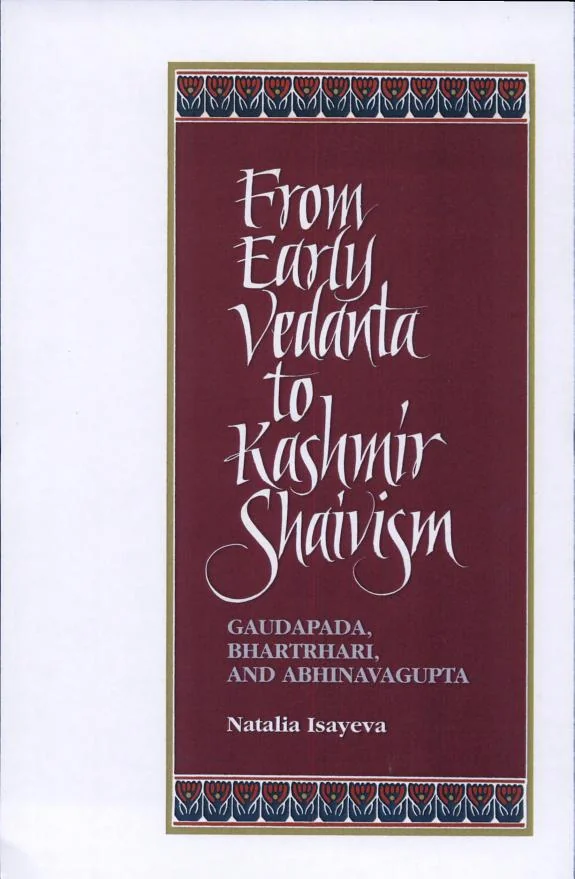
From Early Vedanta to Kashmir Shaivism
 77
77

From Early Vedanta to Kashmir Shaivism
Isaeva's "From Early Vedanta to Kashmir Shaivism" offers a compelling argument for intellectual lineage, focusing on the theological bridge between early Vedanta and the later Shaivite traditions of Kashmir. The strength lies in its detailed exposition of Gaudapada's *mandukya karika* and Bhartrhari's linguistic philosophy, demonstrating how these ideas inform Shankara's Advaita and, subsequently, the monistic Tantra of Abhinavagupta. A notable passage involves the comparative analysis of the concept of *maya* across these thinkers, revealing subtle but significant shifts in its interpretation. However, the text's academic density can be a limitation; its reliance on Sanskrit terminology and intricate philosophical arguments may prove challenging for readers without a solid background in Indian philosophy. The work's primary achievement is its clear articulation of continuity, moving beyond perceived ruptures between Vedantic and Tantric systems. It is a scholarly contribution that clarifies a complex historical and philosophical trajectory.
📝 Description
77
N. V. Isaeva's 1995 book traces the philosophical links from early Vedanta to Kashmir Shaivism.
N. V. Isaeva's "From Early Vedanta to Kashmir Shaivism" examines the philosophical connections between key figures in Indian thought. The work follows the development of ideas about the relationship between the absolute, Brahman, and the phenomenal world, concentrating on the contributions of Gaudapada, Bhartrhari, and Shankara. Isaeva argues for a strong intellectual continuity, showing how their concepts prepared the way for the later growth of Kashmir Shaivism, particularly the philosophy of Abhinavagupta.
This book is suited for scholars and advanced students of Indian philosophy, comparative religion, and esoteric traditions. It is especially useful for those interested in the specific ideas within Advaita Vedanta and the Tantric traditions of Kashmir. Readers who want to understand the historical and philosophical links between different schools of Hindu thought will find considerable worth in this study. It is not an introductory text, but a scholarly examination for individuals with a basic grasp of the subject.
Published in 1995, Isaeva's work engages with the esoteric dimensions of Indian philosophical traditions. It analyzes the intellectual currents from classical Vedanta schools, especially Advaita Vedanta, and their relationship to later Tantric philosophies that developed in Kashmir. The book situates itself within scholarship focused on the evolution of monistic and non-dualistic thought in Hinduism, detailing the shifts and reinterpretations of core doctrines across different centuries and sectarian boundaries.
💡 Why Read This Book?
• Gain a nuanced understanding of the philosophical connections between Gaudapada's *mandukya karika* and the development of Kashmir Shaivism, a critical link often overlooked. • Explore Bhartrhari's concept of *shabdadvaita* (philosophy of language) and its influence on monistic thought, appreciating how language itself is seen as a manifestation of ultimate reality. • Trace the specific doctrinal evolution from Shankara's Advaita Vedanta to the monistic Tantric systems of Kashmir, understanding how core principles were adapted and expanded.
⭐ Reader Reviews
Honest opinions from readers who have explored this book.
❓ Frequently Asked Questions
What is the primary philosophical continuity discussed in the book?
The book's primary focus is the philosophical continuity from early Vedanta, particularly the ideas of Gaudapada and Shankara, to the development of Kashmir Shaivism. It highlights how concepts of the Absolute and creation were interpreted and evolved across these distinct yet related schools of Indian thought.
Who are the key figures analyzed in relation to Kashmir Shaivism?
The key figures analyzed are Gaudapada, Bhartrhari, and Shankara. Isaeva demonstrates how their philosophical contributions, especially concerning the nature of reality and consciousness, laid crucial groundwork for the later monistic Tantric system of Kashmir Shaivism, notably through thinkers like Abhinavagupta.
When was the first edition of 'From Early Vedanta to Kashmir Shaivism' published?
The first edition of N. V. Isaeva's 'From Early Vedanta to Kashmir Shaivism' was published in 1995.
What specific aspect of Indian philosophy does the book clarify regarding God and creation?
The book clarifies the relationship between the Absolute (Brahman) and the phenomenal world (creation) for thinkers like Gaudapada, Bhartrhari, and Shankara. It shows how their understandings of ultimate reality and illusion paved the way for Kashmir Shaivism's explanations.
Is this book suitable for beginners in philosophy?
No, this book is generally not suited for beginners. It requires a foundational understanding of Indian philosophy, particularly Advaita Vedanta and Tantra, due to its scholarly depth and detailed analysis of complex concepts.
What is the main scholarly argument made by N. V. Isaeva?
Isaeva's central scholarly argument is that there is a significant, traceable continuity of thought from early Vedantic philosophers like Gaudapada and Shankara to the development of Kashmir Shaivism, particularly through the influence of Bhartrhari's philosophy.
🔮 Key Themes & Symbolism
Vedanta-Shaivism Continuity
This theme explores the intellectual thread connecting early Vedantic schools, especially Advaita Vedanta, to the monistic Tantric traditions of Kashmir. Isaeva demonstrates how concepts articulated by Gaudapada, Bhartrhari, and Shankara regarding the nature of ultimate reality, consciousness, and the phenomenal world were not isolated but formed a foundation upon which Kashmir Shaivism, particularly the philosophy of Abhinavagupta, was built and elaborated. It challenges notions of sharp breaks, emphasizing a dynamic evolution of ideas within the broader Indic philosophical landscape.
The Absolute and Creation
Central to the book is the analysis of how different Indian philosophical systems conceptualized the relationship between the singular, absolute reality (Brahman) and the multiplicity of the perceived world (creation). Isaeva examines how Gaudapada, Bhartrhari, and Shankara grappled with questions of manifestation, illusion (*maya*), and the ultimate identity of the individual consciousness with the Absolute, showing the progression of these ideas towards the more immanent and experiential understanding found in Kashmir Shaivism.
Bhartrhari's Philosophy of Language
The work gives significant attention to Bhartrhari's *shabdadvaita* (monism of sound/word). Isaeva highlights how Bhartrhari's concept of *vāk* (word/speech) as the fundamental reality, the source of all manifestation, provides a crucial bridge. This perspective on language and consciousness as being ultimately unified with the Absolute is presented as a vital precursor to the Tantric understanding of sound and mantra in Kashmir Shaivism, influencing how creation is seen as a divine utterance.
Advaita Vedanta's Influence
Isaeva meticulously details the foundational role of Advaita Vedanta, particularly the non-dualistic teachings of Shankara, in shaping later esoteric traditions. The book analyzes Shankara's refutation of dualism and his emphasis on the sole reality of Brahman. It shows how this framework, while distinct, was absorbed and reinterpreted within the Tantric milieu of Kashmir, leading to a synthesis that retained non-dualistic principles while incorporating Tantric practices and cosmology.
💬 Memorable Quotes
Direct passages from the work, attributed to the author.
“Clarifies the relationship between God and the creation for Gaudapada, Bhartrhari, and Shankara.”
— This highlights the book's focus on the metaphysical relationship between the ultimate divine principle and the existence of the empirical world, as understood by these influential Indian philosophers and their successors.
“Bhartrhari's philosophy of language as a bridge.”
— This points to the specific philosophical contribution of Bhartrhari, *shabdadvaita*, which Isaeva uses to demonstrate how concepts of sound, word, and consciousness were seen as fundamental to reality, linking Vedanta to Tantra.
“Demonstrates a major continuity of thought.”
— This emphasizes the book's success in tracing a clear and significant intellectual progression, arguing against the idea that different schools of Indian thought developed in isolation from one another.
“The development of Kashmir Shaivism.”
— This indicates that the book not only examines earlier traditions but also shows how their ideas were instrumental in the formation and philosophical underpinnings of the specific esoteric tradition known as Kashmir Shaivism.
💡 Key Ideas
Editorial paraphrase of the work's core concepts — not direct quotes.
The continuity of thought from Gaudapada through Bhartrhari to Abhinavagupta and Kashmir Shaivism.
This paraphrased concept captures Isaeva's core argument: that key ideas about ultimate reality and its manifestation were not lost but evolved and were synthesized across centuries and philosophical schools, forming a coherent lineage.
🌙 Esoteric Significance
Tradition
This work is significant within the study of Indic esoteric traditions, specifically bridging the philosophical foundations of Vedanta with the monistic Tantric lineage of Kashmir Shaivism. It situates Kashmir Shaivism not as a radical departure but as a development and synthesis, incorporating earlier Vedantic insights into its own framework of consciousness and divine immanence. It aligns with traditions that view ultimate reality as singular and consciousness-based, emphasizing the experiential realization of this unity.
Symbolism
While not overtly focused on symbolic interpretation in a ritualistic sense, the book implicitly engages with core concepts that function symbolically. The notion of *Brahman* as the ultimate, undifferentiated reality functions as a symbol for the unmanifest Absolute. The concept of *maya* symbolizes the illusory nature of the phenomenal world and the veil of ignorance obscuring true reality. The emphasis on *Shabdadvaita* (word-monism) can be seen as symbolizing the power of divine utterance or consciousness as the creative principle.
Modern Relevance
Contemporary practitioners and scholars of non-dual traditions, including some modern interpretations of Yoga and Vedanta, can find resonance in Isaeva's work. Thinkers exploring the philosophical underpinnings of consciousness studies or comparative mysticism may draw on its analysis of how different traditions conceptualized awareness and reality. The book remains relevant for those seeking to understand the historical development of ideas that inform contemporary spiritual paths emphasizing unity and the nature of consciousness.
👥 Who Should Read This Book
• Advanced students of Indian philosophy: Those who have a foundational knowledge of Vedanta and Tantra and wish to deepen their understanding of the historical and philosophical links between these schools. • Comparative religion scholars: Researchers interested in tracing the evolution of monistic and non-dualistic thought within a major world religion, specifically Hinduism. • Esoteric practitioners seeking intellectual grounding: Individuals engaged with traditions stemming from India who desire a scholarly exploration of the sophisticated metaphysical concepts underpinning their practices.
📜 Historical Context
Published in 1995, N. V. Isaeva's "From Early Vedanta to Kashmir Shaivism" emerged within a scholarly environment increasingly focused on the intricate relationships between different schools of Indian philosophy. The work directly engages with the intellectual currents of Advaita Vedanta, particularly the influential interpretations by Gaudapada and Shankara, and contrasts/connects them with the later developments in Kashmir Shaivism. The era saw a growing interest in Tantric traditions and their philosophical roots, moving beyond earlier, often dismissive, academic treatments. Isaeva's research addresses a key debate in the study of Indian thought: the degree of influence and continuity between Vedantic and Tantric systems. While scholars like Surendranath Dasgupta had extensively documented these traditions, Isaeva's specific focus on the direct philosophical lineage from Gaudapada and Bhartrhari to Abhinavagupta offered a refined perspective, contributing to the academic discourse on the synthesis of monistic ideas within the Hindu tradition.
📔 Journal Prompts
The concept of *maya* as presented by Gaudapada, Bhartrhari, and Shankara.
Bhartrhari's *shabdadvaita* and its implication for understanding reality.
The transition of non-dual concepts from Vedanta to Kashmir Shaivism.
Abhinavagupta's synthesis of earlier Vedantic ideas.
The nature of the Absolute (Brahman) as described in early Vedanta.
🗂️ Glossary
Advaita Vedanta
A school of Hindu philosophy emphasizing non-duality, asserting that Brahman (the ultimate reality) is the sole reality, and the world of multiplicity is ultimately illusory.
Kashmir Shaivism
A monistic Tantric tradition originating in the Kashmir region, which views Shiva as the supreme being and the underlying reality of all existence, emphasizing consciousness and immanence.
Gaudapada
An influential philosopher believed to have authored the *Mandukya Karika*, a commentary on the Mandukya Upanishad, significant for its early articulation of Advaita Vedanta principles.
Bhartrhari
A philosopher and grammarian known for his work on the philosophy of language (*shabdadvaita*), proposing that linguistic elements and consciousness are ultimately one with the Absolute.
Shankara
The most prominent exponent of Advaita Vedanta, a philosopher and theologian who systematized the non-dualistic teachings of the Upanishads and established monastic centers across India.
Abhinavagupta
A highly influential philosopher and mystic of Kashmir Shaivism who synthesized various Tantric traditions and articulated a sophisticated monistic philosophy.
Maya
A Sanskrit term often translated as 'illusion' or 'magic,' referring to the power that conceals the true nature of reality and creates the appearance of a manifold world.
This book appears in 1 collection
🔮 Readers Also Liked
Browse all →









From the “Vedanta” Collection
View all →






More Free Occult Philosophy Books
View all →