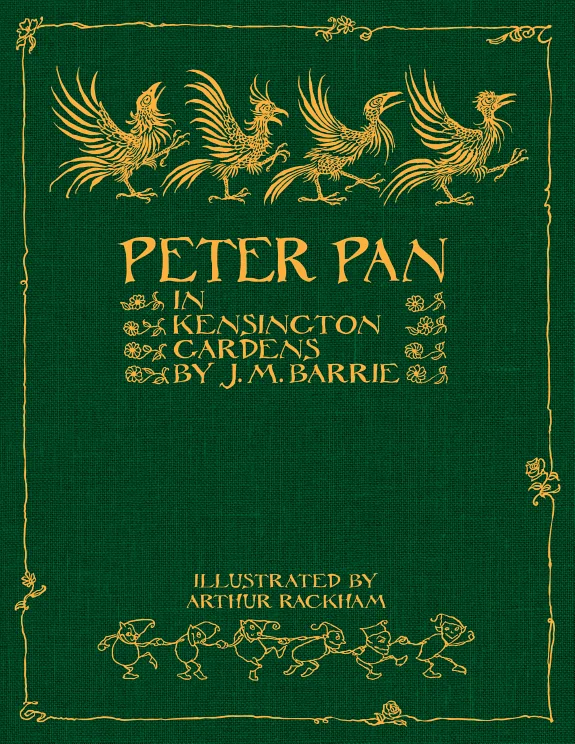
Peter Pan in Kensington Gardens
 71
71

Peter Pan in Kensington Gardens
Barrie’s *Peter Pan in Kensington Gardens* presents a more melancholic and mystical genesis for the boy who famously refused to age. The text, particularly in its exploration of Peter’s initial existence within the Gardens, carries a peculiar gravity. Arthur Rackham's illustrations, a paramount feature of this edition, are not mere adornments; they are visual incantations, perfectly capturing the ephemeral and slightly unnerving magic Barrie evokes. The limitation, however, lies in the book's episodic nature, a remnant of its origin within *The Little White Bird*. The narrative occasionally meanders, relying heavily on atmosphere rather than a driving plot, which might test the patience of those accustomed to more structured storytelling. The passage describing Peter's first encounters with the wild birds, before he gains the ability to fly, exemplifies this blend of wonder and a subtle, underlying loneliness. Ultimately, this is a work of considerable charm and visual splendor, though its fragmented structure keeps it from achieving a perfect narrative cohesion.
📝 Description
71
J. M. Barrie's 1907 book explores the mythical origins of Peter Pan before his adventures in Neverland.
First published in 1907, J. M. Barrie's Peter Pan in Kensington Gardens examines the genesis of the boy who would not grow up. This edition features Rackham's original fifty color illustrations.
The work is not a simple children's tale. Instead, it addresses themes of childhood, imagination, and the transitional spaces between reality and fantasy. It is for readers who enjoy classic literature with a strange, uncanny quality, and those who admire Arthur Rackham's art.
Scholars of children's literature, folklore enthusiasts, and collectors of fine books will find this edition valuable. It connects Barrie's mature ideas with the fantastical elements that later became widely popular.
Published in 1907, the book draws from a period of intense fascination with childhood and the supernatural. It expands on a section of Barrie's 1902 novel, The Little White Bird. The story positions Kensington Gardens as a place where children can slip away from adult life to remain perpetually young. This concept aligns with older folklore traditions that speak of hidden realms or fae lands where time operates differently, allowing individuals to remain ageless. The book taps into a vein of occult thought that views childhood innocence as a state of being close to a primal, magical existence.
💡 Why Read This Book?
• You will gain an understanding of the esoteric concept of the 'eternal child' as a distinct state of being, separate from chronological age, as depicted in Peter's life within Kensington Gardens. • You will learn about the specific artistic collaboration between J. M. Barrie and Arthur Rackham, appreciating how Rackham's 1907 illustrations visually interpret Barrie's mystical narrative of Peter's early existence. • You will explore the folklore surrounding 'lost children' and their potential integration into a hidden, magical society, as alluded to in the book's depiction of the fairies and their realm.
⭐ Reader Reviews
Honest opinions from readers who have explored this book.
❓ Frequently Asked Questions
When was Peter Pan in Kensington Gardens first published?
Peter Pan in Kensington Gardens was first published in 1907. It is an expansion of a chapter from J. M. Barrie's earlier novel, *The Little White Bird*.
Who illustrated the deluxe hardcover edition?
This deluxe hardcover edition features fifty stunning color illustrations by Arthur Rackham, a celebrated artist known for his work in early 20th-century children's literature.
What is the connection between Peter Pan in Kensington Gardens and Peter Pan?
This book explores the mythical origins of Peter Pan, detailing his life as a baby and young boy in Kensington Gardens before he learned to fly and left for Neverland.
Is this book suitable for young children?
While it features Peter Pan, the book delves into more complex themes of infancy, abandonment, and the transition to fairy life, making it more suited for older children and adults.
What makes this book different from the play Peter Pan?
This book provides a mythological backstory for Peter Pan, focusing on his origins and life in Kensington Gardens, whereas the play *Peter Pan* (1904) focuses on his adventures with the Darling children.
What is the significance of Kensington Gardens in the book?
Kensington Gardens is presented as a liminal space, a magical realm where babies can be left and where Peter Pan learns to fly and interact with fairies, existing outside conventional human time.
🔮 Key Themes & Symbolism
The Liminality of Childhood
The work posits childhood, particularly infancy, as a state existing in a distinct, magical realm. Kensington Gardens serves as this threshold space, a place where babies are left by mothers and are susceptible to fairy influence. This concept challenges linear notions of development, suggesting a parallel existence where time and growth operate differently. Peter's inability to remember his mother and his eventual departure from the Gardens highlight the transient nature of these early bonds and the pull of a world beyond human comprehension.
Fairy Governance and Folklore
Barrie imbues the narrative with a rich vein of folklore, presenting a structured fairy society with its own queen and laws. The fairies are not merely whimsical sprites but entities with power over the natural world and the 'lost boys.' Their interaction with Peter, particularly their attempts to teach him to fly, draws upon ancient myths of nature spirits and their role in shaping human destinies. The book explores the idea of a hidden world operating beneath the surface of reality.
The Nature of Memory and Identity
Peter's existence is characterized by a profound lack of memory, especially concerning his origins and his mother. This amnesia is presented not as a deficit but as a condition of his eternal childhood. The book questions what constitutes identity when it is not anchored by past experiences or familial connections. Peter's evolving understanding of himself, from a baby to a boy learning to fly, is a journey of self-discovery within a framework that eschews conventional human narratives of growth and remembrance.
The Allure of Escape
The narrative taps into a deep-seated human desire to escape the constraints of adult life and the passage of time. Kensington Gardens and the world of fairies represent this escape, a place where one can remain perpetually young and free from responsibility. The book explores the bittersweet nature of this eternal freedom, hinting at a potential loneliness that accompanies such an existence. It appeals to the fantasy of a world where childhood's magic is preserved indefinitely.
💬 Memorable Quotes
Direct passages from the work, attributed to the author.
“All children, except one, grow up.”
— This iconic line, though more famously associated with the play, is the foundational concept. It establishes Peter's unique status as a being outside the natural progression of human life, setting the stage for exploring the implications of perpetual childhood.
“The baby who, with the best of intentions, had been left by the sea, was not the only one.”
— This refers to Peter's initial abandonment and hints at a larger pattern of 'lost children.' It connects his story to a broader theme of separation from parental figures and the emergence of an alternative, magical form of upbringing.
“He had his first dream in Kensington Gardens.”
— This marks a crucial developmental moment for Peter, suggesting the beginning of his consciousness and imagination within the magical confines of the Gardens, hinting at the 'dream' state as a precursor to his later adventures.
“The fairies were all coming out to play.”
— This phrase evokes the whimsical yet potent presence of the fairy world, which is integral to Peter's existence and his eventual ability to fly. It signifies the encroachment of the magical into the mundane field of the Gardens.
“He was a fairy, and was to be a fairy forever.”
— This declaration by the Queen of the Fairies solidifies Peter's identity as belonging to their realm. It underscores the idea that his 'boy who wouldn't grow up' status is not merely a choice but a fundamental, almost predetermined, nature.
🌙 Esoteric Significance
Tradition
The work draws implicitly from Celtic and British folklore traditions, particularly concerning fairies and nature spirits, which have often been viewed through an esoteric lens. It aligns with concepts of the Sidhe or 'hidden folk' who exist in parallel realms. While not strictly Hermetic or Kabbalistic, its exploration of a separate, timeless existence for Peter echoes Gnostic ideas of spiritual realms distinct from the material world, and Theosophical notions of elemental beings and spiritual evolution outside conventional human lifespans.
Symbolism
Kensington Gardens functions as a potent symbol of the threshold between the mundane and the magical, a liminal space where the veil between worlds is thin. Babies left there are susceptible to the influence of fairies, representing the unformed consciousness or soul that can be imprinted by spiritual forces. Peter himself symbolizes the eternal child archetype, a being untethered by time and memory, embodying pure potentiality and a connection to primal, untamed nature. The act of flying represents spiritual liberation and transcendence.
Modern Relevance
Contemporary movements in Jungian psychology, particularly those exploring archetypes like the 'eternal child' or 'puer aeternus,' find resonance in Peter Pan's character. Modern pagan and fairy-faith practitioners may also draw inspiration from Barrie's depiction of a structured fairy society and its influence on human affairs. The book's themes of escapism and the preservation of innocence continue to be explored in various forms of fantasy literature and New Age thought, appealing to those seeking alternative perspectives on life stages and spiritual existence.
👥 Who Should Read This Book
• Students of comparative mythology and folklore: To analyze Barrie's unique synthesis of British fairy lore and the archetype of the eternal child. • Aspiring writers and artists: To study how a narrative concept can be expanded and visually interpreted, particularly through the lens of Arthur Rackham's influential illustrations. • Individuals interested in psychological archetypes: To explore the concept of the 'puer aeternus' (eternal boy) and its manifestation in a literary character, examining themes of arrested development and freedom.
📜 Historical Context
Published in 1907, *Peter Pan in Kensington Gardens* emerged from the fertile imaginative field of Edwardian England, a period marked by a fascination with childhood, fairy tales, and psychological exploration. J. M. Barrie, already a successful playwright and novelist, drew upon a section of his 1902 novel, *The Little White Bird*, to create this more focused origin myth for his most famous character. The era was rich with authors exploring similar themes; for instance, E. Nesbit’s *The Railway Children* (1906) also engaged with themes of childhood separation and wonder. While Barrie's work was largely celebrated, the early 20th century also saw intellectual currents like Freudian psychoanalysis beginning to offer new interpretations of childhood. *The Times* of London lauded the book upon its release as "one of the most charming books ever written," indicating strong critical reception for this blend of narrative and Rackham's art.
📔 Journal Prompts
Peter's first dream in Kensington Gardens: What might this dream represent about his nascent consciousness?
The Queen of the Fairies' decree: How does being 'a fairy forever' shape Peter's existence?
The concept of 'lost children': Reflect on the emotional implications of being separated from one's origins.
Kensington Gardens as a threshold: Consider the symbolic meaning of liminal spaces in personal experience.
Peter's memory loss: Explore the relationship between memory, identity, and the experience of time.
🗂️ Glossary
Puer Aeternus
Latin for 'eternal boy.' In psychology, it refers to an archetype representing perpetual youth, freedom from responsibility, and a potential reluctance to mature or engage with the adult world.
Liminal Space
A transitional or in-between state or place, often characterized by ambiguity and the blurring of boundaries. In this book, Kensington Gardens serves as a liminal space between the human world and the fairy realm.
Fairy Lore
The body of myths, legends, and beliefs surrounding fairies and other supernatural beings, particularly prevalent in British and Celtic traditions. Barrie draws heavily on this for the book's magical elements.
Archetype
A recurring symbol, character type, or motif in literature, art, and mythology that represents universal patterns of human nature or experience. Peter Pan is often seen as an archetype of the eternal child.
Neverland
The fictional island where Peter Pan lives with lost boys and other fantastical creatures. While not detailed in this specific book, it represents the ultimate destination of Peter's escape from the human world.
Arthur Rackham
A renowned British illustrator (1867-1939) known for his distinctive style, often featuring whimsical and slightly eerie depictions of fairies, goblins, and other fantastical creatures. His illustrations are integral to this edition.
The Little White Bird
J. M. Barrie's 1902 novel from which the material for Peter Pan in Kensington Gardens was adapted. It provided the initial narrative framework for Peter's babyhood.
This book appears in 1 collection
🔮 Readers Also Liked
Browse all →








From the “Fairies” Collection
View all →





More Free Occult Philosophy Books
View all →