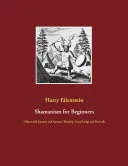
Shamanism for Beginners
 81
81

Shamanism for Beginners
Harry Eilenstein's "Shamanism for Beginners" attempts to demystify a practice as old as humanity itself. Its strength lies in connecting shamanism to widely recognized esoteric concepts like kundalini and astral projection, making the subject accessible. However, the book occasionally feels like a survey rather than a deep dive, particularly when touching upon the complex historical transformations from the Paleolithic era onwards. The discussion of firewalking, for instance, is informative but lacks the visceral detail one might expect. Eilenstein succeeds in framing shamanism as fundamental to many later religious and magical traditions, but the beginner might still require supplementary material for practical application.
This text serves as a solid, if brief, primer on the historical and conceptual landscape of shamanism.
📝 Description
81
Harry Eilenstein's Shamanism for Beginners traces shamanism's origins to the world's oldest religious practices.
This book examines shamanism as one of humanity's earliest spiritual systems. It connects early shamanic beliefs to concepts of the divine feminine, purification ceremonies such as sweat lodges, and the use of altered states of consciousness. The author traces shamanism's development from its Paleolithic beginnings through the Neolithic era, its role in early civilizations, and its presence in the modern world. This historical overview demonstrates the practice's lasting presence and adaptability.
Individuals interested in magic, mythology, and comparative religion will find this work particularly informative. It explains ancient spiritual techniques and their underlying principles. Central topics include astral travel, kundalini energy, firewalking, and the use of sympathetic magic as integral parts of shamanic traditions.
Shamanism for Beginners places itself within a long lineage of spiritual practices that seek direct experience of non-ordinary reality. It connects these practices to what is often termed the 'divine feminine' and highlights rituals designed for purification and altered consciousness. By charting its historical arc from prehistory to the present, the book frames shamanism not as a relic of the past but as a persistent human engagement with spiritual dimensions.
💡 Why Read This Book?
• Gain an understanding of shamanism's historical trajectory from the Paleolithic era to the age of materialism, recognizing its resilience. • Learn about core shamanic practices such as sweat lodges and astral travel, and their connection to the Mother Goddess archetype. • Explore the foundational links between shamanism, firewalking, and general magical principles, offering a new lens on esoteric arts.
⭐ Reader Reviews
Honest opinions from readers who have explored this book.
❓ Frequently Asked Questions
What is the oldest form of religion discussed in "Shamanism for Beginners"?
"Shamanism for Beginners" identifies shamanism as the oldest form of religion, tracing its roots back to the Paleolithic era and exploring its continuous evolution through various historical epochs.
How does the book connect shamanism to the Mother Goddess?
The book posits a close connection between shamanism and the Mother Goddess, exploring this relationship as a fundamental aspect of early spiritual beliefs and practices discussed within its pages.
What are some key practices associated with shamanism in this book?
Key practices explored include sweat lodges, astral travel, the awakening of kundalini, and firewalking, presented as integral elements of shamanic traditions and their development.
What historical periods does "Shamanism for Beginners" cover?
The book covers the historical transformations of shamanism from the Paleolithic and Neolithic epochs, through the era of kingship, and into the modern age of materialism.
Is this book suitable for someone with no prior knowledge of shamanism?
Yes, the title "Shamanism for Beginners" suggests it is designed for those new to the subject, offering foundational knowledge on its history, concepts, and associated practices.
What is the relationship between shamanism and magic according to the book?
The book suggests a strong link between shamanism and magic in general, presenting shamanic practices as foundational to many later magical traditions and techniques.
🔮 Key Themes & Symbolism
Primal Religious Roots
The work emphasizes shamanism as the bedrock of human spirituality, predating organized religions. It examines its deep association with the Mother Goddess archetype, viewing this connection as fundamental to understanding early consciousness and ritual practices. This perspective positions shamanism not merely as a historical curiosity but as a living current flowing through subsequent spiritual expressions.
Altered States and Energy
A significant focus is placed on shamanism's engagement with non-ordinary reality through practices like astral travel. The text also explores the concept of kundalini awakening, presenting it as a potent spiritual energy that shamans historically learned to access and direct for healing and insight. This aspect highlights the internal, energetic dimensions of shamanic work.
Ritual and Elemental Magic
The book details specific rituals such as sweat lodges and firewalking, framing them as powerful purification and transformative ceremonies. These practices are linked to a broader understanding of magic, suggesting that shamanism provided the initial framework for manipulating natural forces and energies for human benefit and spiritual growth.
Historical Continuity
By tracing shamanism's lineage from the Paleolithic through various epochs, including the age of materialism, the book underscores its enduring presence and adaptability. This historical sweep demonstrates how core shamanic principles have persisted and transformed, influencing diverse cultural and religious expressions over millennia.
💬 Memorable Quotes
Direct passages from the work, attributed to the author.
“Shamanism is the oldest form of religion.”
— This statement frames the book's central thesis: that understanding shamanism is key to understanding the very origins of human spiritual and ritualistic behavior across cultures.
“It is closely connected with the Mother Goddess...”
— This highlights a specific, foundational relationship the book explores, linking shamanic practices to ancient matriarchal spiritual concepts and the divine feminine.
“...sweat lodges, astral travel, the awakening of the kundalini...”
— These specific practices are presented as core components of the shamanic toolkit, illustrating the range of techniques used for spiritual exploration and transformation.
“...as well as with firewalking and magic in general.”
— This emphasizes the practical, often elemental, and magical aspects of shamanism, connecting it to broader esoteric traditions and the manipulation of natural forces.
“Therefore, the knowledge of the basic features of shamanism is extremely beneficial for anyone interested in magic, mythology and religion.”
— This serves as a direct call to action and justification for the book, positioning shamanism as essential knowledge for students of esoteric and comparative spiritual studies.
🌙 Esoteric Significance
Tradition
This work can be seen as bridging ancient indigenous practices with modern Western esoteric thought. While shamanism itself predates most formalized traditions, Eilenstein connects its core elements—altered states, energy work, and connection to nature—to concepts familiar within Hermeticism and Theosophy, such as the awakening of subtle energies (kundalini) and non-physical exploration (astral travel).
Symbolism
Key symbols include the sweat lodge, representing purification, rebirth, and communion with the elements, often seen as a womb-like space for spiritual regeneration. Astral travel signifies the shaman's ability to navigate non-physical realms, accessing wisdom or healing beyond the material world. The Mother Goddess archetype symbolizes primal creative and nurturing forces central to many ancient cosmologies.
Modern Relevance
Contemporary practitioners of Neo-shamanism, energy healing modalities, and somatic psychology often draw upon the foundational principles discussed in this book. Thinkers and groups focused on rewilding, earth-based spirituality, and the integration of indigenous wisdom into Western lifestyles find resonance in its exploration of shamanism's historical and conceptual landscape.
👥 Who Should Read This Book
• Aspiring practitioners of alternative spiritualities seeking to understand the roots of ritual and altered states of consciousness. • Students of comparative religion and mythology looking for a concise overview of shamanism's historical development and core tenets. • Individuals interested in esoteric traditions who wish to explore the foundational connections between ancient practices and concepts like astral travel and kundalini.
📜 Historical Context
Published in 2021, Harry Eilenstein's "Shamanism for Beginners" enters a field rich with scholarship, from Mircea Eliade's seminal "Shamanism: Archaic Techniques of Ecstasy" (1951) to contemporary anthropological studies. The book positions itself within the broader esoteric revival, aiming to make ancient practices accessible to a modern audience. Its focus on connecting shamanism to concepts like kundalini and astral travel aligns it with Western esoteric traditions that often reinterpret global spiritual practices through a Hermetic or Theosophical lens. While not directly engaging with academic debates on shamanism's origins or universality, it implicitly addresses a public fascination with indigenous spirituality, a trend that gained momentum in the late 20th century, partly influenced by counter-cultural movements and New Age philosophies.
📔 Journal Prompts
The connection between shamanism and the Mother Goddess archetype.
Experiences with sweat lodge rituals and their transformative potential.
The concept of astral travel and its role in shamanic exploration.
Personal reflections on kundalini energy and its perceived effects.
The historical continuity of shamanic practices from Paleolithic times.
🗂️ Glossary
Shamanism
The oldest known form of religion, characterized by practices involving altered states of consciousness, spirit journeys, and healing, often mediated by a shaman.
Mother Goddess
A primal deity figure representing fertility, creation, and the nurturing aspects of the divine, often associated with early nature-based spiritual systems.
Sweat Lodge
A ritualistic structure, often dome-shaped, used for purification and spiritual ceremonies, involving heated stones and steam.
Astral Travel
The practice of projecting one's consciousness or 'astral body' to explore non-physical realms or distant locations while the physical body remains dormant.
Kundalini
A concept originating in Hindu Tantra, referring to a primal spiritual energy often depicted as coiled at the base of the spine, which can be awakened for spiritual development.
Firewalking
A ritualistic practice involving walking barefoot over hot coals or embers, often undertaken as a test of faith, purification, or spiritual power.
Paleolithic
The prehistoric period extending from about 2.6 million years ago to the end of the last Ice Age, characterized by the development of stone tools and early human culture.