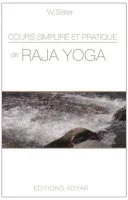
Cours simplifié et pratique de Raja Yoga
 81
81

Cours simplifié et pratique de Raja Yoga
Wallace Slater’s "Cours simplifié et pratique de Raja Yoga" offers a commendably direct pathway into a discipline often shrouded in mystique. The book’s strength lies in its methodical, lesson-based structure, which genuinely simplifies the learning curve for Raja Yoga. Slater’s evident familiarity with the subject, gained through personal experience, shines through, providing practical guidance that feels grounded rather than abstract. One particularly effective section details the initial steps of concentration, breaking down the process into manageable stages. However, the work occasionally feels a touch too didactic, sometimes sacrificing the poetic or philosophical depth that can also be a vital part of yoga's appeal. While excellent for acquiring technique, it might leave those seeking a more philosophical exploration wanting more. It serves as a solid, practical primer for the aspiring yogi.
📝 Description
81
Wallace Slater's 2006 'Cours simplifié et pratique de Raja Yoga' offers a structured introduction to the practice.
Published in 2006, Wallace Slater's "Cours simplifié et pratique de Raja Yoga" presents a step-by-step method for engaging with Raja Yoga. Slater organized the content into distinct lessons, drawing on his background in yoga philosophy. This approach aims to make the core ideas of Raja Yoga accessible to more people, encouraging a gradual understanding of its central principles.
The book is for anyone wanting a clear introduction to Raja Yoga, especially those interested in meditation and spiritual growth. It suits beginners building a base in yoga philosophy and practice, and also those with some experience seeking deeper knowledge. Its practical, lesson-focused structure works well for independent study or alongside formal guidance.
Slater's work breaks down Raja Yoga into understandable lessons. A key part of its method is how each lesson builds on the previous one. This design is meant to simplify the practice, helping students develop self-control, concentration, and awareness of the mind-body link within the yogic path. The focus is on using the techniques, not just discussing them.
Raja Yoga, a path within the broader study of Yoga, became more known in the West during the 20th century. Figures like Swami Vivekananda were instrumental in introducing its concepts globally. Slater's book appeared when many yoga guides were available. It stands out by focusing on a simplified, practical approach, differentiating itself from purely academic or devotional texts.
💡 Why Read This Book?
• Gain a structured, step-by-step method for practicing Raja Yoga, as detailed in the book's lesson format, moving beyond mere theory to tangible practice. • Understand the progressive nature of yogic development, a core principle emphasized throughout the teachings presented by Wallace Slater. • Cultivate focused attention and inner discipline through practical exercises, directly applicable to deepening meditation, as outlined in the book's practical sections.
⭐ Reader Reviews
Honest opinions from readers who have explored this book.
❓ Frequently Asked Questions
What is the primary goal of Raja Yoga as presented in Wallace Slater's book?
The primary goal is to achieve self-mastery and spiritual understanding through disciplined concentration and meditation, as systematically laid out in the book's practical lessons.
Is 'Cours simplifié et pratique de Raja Yoga' suitable for absolute beginners?
Yes, the book is specifically designed for beginners, offering a simplified and progressive approach to Raja Yoga that avoids overwhelming new students.
What does 'Raja Yoga' mean in the context of this book?
In this context, Raja Yoga refers to the 'Royal Path' of yoga, focusing on mental discipline, meditation, and the control of the mind to achieve higher states of consciousness.
When was Wallace Slater's book on Raja Yoga first published?
Wallace Slater's 'Cours simplifié et pratique de Raja Yoga' was first published on November 30, 2006.
How does this book differ from other yoga texts?
It distinguishes itself through its highly practical, lesson-based format, prioritizing a progressive, simplified method for learning Raja Yoga over extensive philosophical discourse.
Does the book cover the ethical principles of yoga?
While the book's primary focus is on the practical and mental aspects of Raja Yoga, the foundational principles often implicitly support ethical conduct through the cultivation of self-awareness and discipline.
🔮 Key Themes & Symbolism
Progressive Practice
The book emphasizes a methodical, lesson-by-lesson progression, ensuring that practitioners build a solid understanding of Raja Yoga's principles gradually. This approach aims to prevent overwhelm and foster consistent development, making the path accessible and manageable for students at all levels. Each stage is designed to prepare the student for the next, creating a seamless learning curve toward mental control and spiritual insight.
Mental Discipline
Central to Slater's exposition of Raja Yoga is the cultivation of mental discipline. The lessons are geared towards training the mind, enhancing concentration, and achieving control over one's thoughts and emotions. This focus on internal regulation is presented not as an ascetic pursuit but as a practical method for improving daily life and facilitating deeper meditation practices.
Foundations of Meditation
The work provides a robust framework for understanding and engaging with meditation. By breaking down the complex aspects of Raja Yoga into simpler components, the book equips readers with the tools needed to approach meditation effectively. It clarifies the process, offering clear instructions that support the development of sustained attention and inner stillness.
Author's Experience
Wallace Slater draws heavily on his personal experience and deep knowledge of yoga philosophy. This experiential foundation lends a practical, grounded quality to the teachings, offering insights that go beyond theoretical knowledge. The lessons are presented as distilled wisdom, reflecting years of practice and study, making the guidance credible and relatable.
💬 Memorable Quotes
Direct passages from the work, attributed to the author.
“The term Yoga is today generally applied to many forms of asceticism, meditation, and spiritual training.”
— This observation, found in the introduction, frames the broad contemporary understanding of 'yoga' while subtly signaling the book's specific focus on Raja Yoga's systematic approach.
“Detailed instructions, given in the form of lessons, are the fruit of the author's experience and his profound knowledge of yoga philosophy.”
— This statement highlights the book's pedagogical structure and the author's credentials, assuring readers that the material is both practical and rooted in deep understanding.
“They allow one to understand and practice Raja Yoga, in a very progressive way.”
— This emphasizes the book's core promise: a gradual and accessible method for learning and applying Raja Yoga principles, making it suitable for those new to the discipline.
“Very useful for approaching and deepening meditation.”
— This succinctly states the primary benefit for the reader, positioning the book as an essential tool for anyone seeking to begin or enhance their meditation practice.
💡 Key Ideas
Editorial paraphrase of the work's core concepts — not direct quotes.
The work explores the progressive method of Raja Yoga practice.
This paraphrased concept underscores the book's methodical, step-by-step approach, differentiating it from more theoretical or unstructured texts on yoga.
🌙 Esoteric Significance
Tradition
This work fits within the broader lineage of Raja Yoga, one of the six orthodox schools (darshanas) of Hindu philosophy. While originating in ancient India, its transmission to the West, notably influenced by Swami Vivekananda's introduction of Patanjali's Yoga Sutras in the late 19th century, has led to various interpretations. Slater's approach aligns with the practical, meditative, and mind-control aspects emphasized in this lineage, presenting it in a structured, accessible format for modern practitioners.
Symbolism
While the book focuses on practical instruction, Raja Yoga itself is steeped in symbolism. The concept of 'Chitta Vritti Nirodha' (cessation of the modifications of the mind) is a foundational idea. Symbols like the 'lotus' in meditation postures represent spiritual unfolding, and the 'path' or 'journey' of yoga signifies the progression toward higher consciousness, moving from the mundane to the divine.
Modern Relevance
Slater's emphasis on a practical, simplified, and progressive approach to Raja Yoga remains highly relevant today. Contemporary mindfulness and meditation movements, while often secularized, draw directly from the techniques of mental control and focused attention that are hallmarks of Raja Yoga. Thinkers and practitioners in fields ranging from positive psychology to contemplative neuroscience often engage with principles that echo Raja Yoga's core tenets of mind training.
👥 Who Should Read This Book
• Aspiring practitioners of Raja Yoga seeking a structured, lesson-based introduction that clarifies the discipline. • Individuals interested in deepening their meditation practice through systematic mental training techniques. • Students of comparative philosophy looking to understand a specific, practical branch of yogic philosophy beyond theoretical discussions.
📜 Historical Context
Wallace Slater's "Cours simplifié et pratique de Raja Yoga," published in 2006, entered a landscape already rich with Western interpretations of Indian spiritual traditions. The early 20th century saw the widespread popularization of yoga, largely through figures like Paramahansa Yogananda and the continued influence of Theosophy, which often presented yogic practices within a broader comparative framework. By 2006, numerous schools and authors offered diverse takes on yoga, from highly physical Hatha Yoga to more philosophical explorations. Slater’s work distinguished itself by adhering to a specific, practical, and simplified pedagogical approach to Raja Yoga – the 'Royal Path' – focusing on mental control and meditation. It emerged at a time when yoga was increasingly commodified, yet Slater’s text aimed for an authentic, structured transmission of core Raja Yoga principles, likely seeking to provide a clear alternative to more generalized or overly commercialized yoga offerings.
📔 Journal Prompts
The progressive nature of Raja Yoga practice as presented in the lessons.
Developing mental discipline through the specific techniques outlined in the book.
Understanding the author's emphasis on practical application over theory.
The role of concentration exercises in deepening meditation, as detailed in the text.
Connecting the foundational concepts of Raja Yoga to personal experiences of focus and distraction.
🗂️ Glossary
Raja Yoga
The 'Royal Path' of yoga, focusing on mental discipline, meditation, and control of the mind to achieve spiritual realization. It is one of the classical paths of yoga, often associated with Patanjali's Yoga Sutras.
Yoga
A broad term originating from Sanskrit, meaning 'union.' It refers to a variety of physical, mental, and spiritual practices or disciplines aimed at achieving union of consciousness with the divine or the universe.
Meditation
A practice where an individual uses a technique – such as mindfulness, or focusing the mind on a particular object, thought, or activity – to train attention and awareness, and achieve a mentally clear and emotionally calm and stable state.
Concentration
The ability to focus one's attention on a particular subject or task for a specified period. In Raja Yoga, it is a key step towards deeper meditative states.
Spiritual training
A systematic process of developing one's spiritual awareness, character, and understanding, often involving practices like meditation, ethical reflection, and study of spiritual texts.
Philosophy of yoga
The underlying theoretical framework and principles that explain the goals, methods, and cosmology of yoga practices, encompassing metaphysics, ethics, and epistemology.
Asceticism
Severe self-discipline and avoidance of all forms of indulgence, typically for religious reasons. While related to some spiritual paths, Raja Yoga focuses more on mental discipline.
![The Byrhtferth's Manuscript (MS 17) † Saint John’s College † Oxford † [1111]](/img/thumb/the-byrhtferth-s-manuscript-ms-17-saint-john-s-college-oxford-1111-the-monk-byrhtferth.webp)