Advaita Vedānta
 83
83

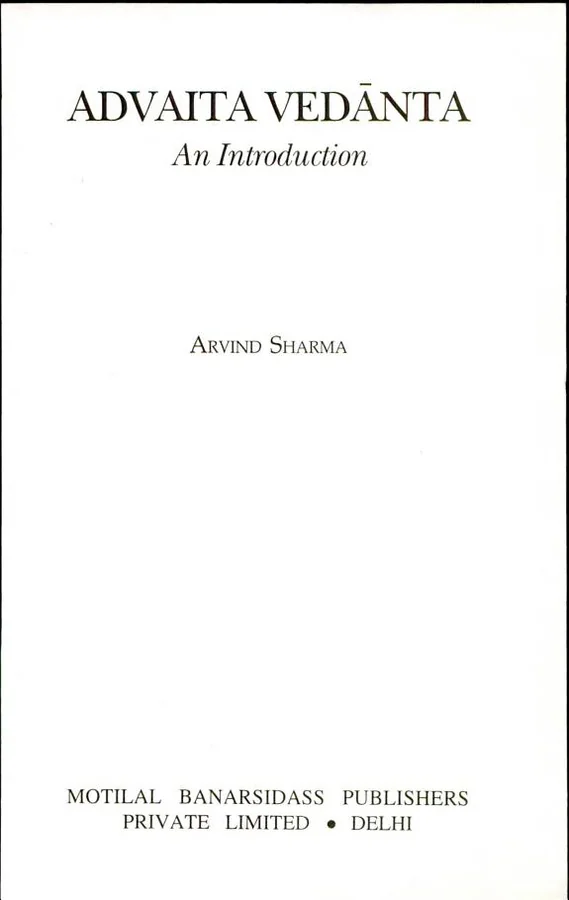
Advaita Vedānta
Arvind Sharma's "Advaita Vedānta" offers a commendable, if somewhat dispassionate, dissection of this complex philosophical tradition. Its strength lies undeniably in the author's deliberate separation of scriptural, rational, and experiential approaches, a pedagogical choice that grants clarity to each distinct mode of inquiry. This structured method is particularly effective in illuminating the logical architecture supporting non-dualism, a feat often obscured by the poetic language of mystical texts. However, this very separation can, at times, feel like an academic exercise, lacking the unifying spark that bridges theory and practice. The discussion on Maya, for instance, is intellectually rigorous but could benefit from a more evocative portrayal of its phenomenological impact. Sharma's work is a valuable resource for systematic understanding, but the visceral apprehension of Advaita's truth remains largely the reader's own pursuit. It is a solid academic primer, not a spiritual awakening.
📝 Description
83
Arvind Sharma's "Advaita Vedānta" presents Indian philosophy through scriptural exegesis, rational argumentation, and experiential realization.
Arvind Sharma's "Advaita Vedānta" dissects this major Indian philosophical system by separating its scriptural analysis, logical reasoning, and direct experience. This approach allows for a clearer understanding of each component. The book aims to give readers a structured grasp of non-dualism's main ideas, showing both its philosophical structure and its implications for inner realization.
This text is useful for anyone wanting a clear introduction to Advaita Vedānta. It suits students of philosophy, religious studies scholars, and those interested in Eastern thought who value careful explanation. Readers who like to see scriptural evidence supported by logical argument will find this method helpful. It also serves practitioners who wish to connect their meditation and contemplation practices with a solid philosophical basis.
Advaita Vedānta, a key school within the Vedānta tradition, was significantly shaped by the 8th-century philosopher Adi Shankara. It proposes that the highest reality is Brahman, and the individual self, Atman, is identical to Brahman. The visible world is understood as Maya, or illusion. This book traces Advaita's development within its historical philosophical setting, showing how its central ideas were articulated and defended over many centuries.
💡 Why Read This Book?
• Gain clarity on the scriptural basis of Advaita Vedānta, understanding how texts like the Upanishads are interpreted to support non-dualism, as presented in Sharma's distinct scriptural analysis section. • Appreciate the logical rigor of Advaita through its rational argumentation, allowing you to construct a philosophical case for non-duality independent of solely scriptural authority, a key benefit of Sharma's methodical approach. • Develop a framework for understanding the experiential realization of Advaita, moving beyond abstract concepts to grasp how the teachings are meant to manifest in direct, lived insight, as explored in the book's experiential component.
⭐ Reader Reviews
Honest opinions from readers who have explored this book.
❓ Frequently Asked Questions
What is the primary philosophical claim of Advaita Vedānta as presented by Arvind Sharma?
Sharma's "Advaita Vedānta" explicates the core claim that Brahman, the ultimate reality, is identical with Atman, the individual self. The phenomenal world is understood as Maya, an illusion that obscures this fundamental non-duality.
How does Arvind Sharma's book differ from other introductions to Advaita Vedānta?
The book's novelty, as noted in its original blurb, lies in presenting Advaita through three independent but complementary methods: scriptural, rational, and experiential, rather than intertwining them.
When was Arvind Sharma's "Advaita Vedānta" first published?
The work was first published on January 1, 2004, offering a modern scholarly perspective on this ancient philosophical school.
What are the key concepts discussed in the book regarding the nature of reality?
The book details Brahman (ultimate reality), Atman (the self), Maya (illusion), and Moksha (liberation), explaining how they relate to the non-dualistic perspective.
Is this book suitable for someone completely new to Indian philosophy?
Yes, its structured approach, breaking down Advaita into scriptural, rational, and experiential components, makes it accessible for beginners seeking a clear understanding of its fundamental tenets.
What is the significance of 'Maya' in Advaita Vedānta according to the book?
The work explores Maya as the principle of cosmic illusion that conceals the true nature of reality (Brahman) and creates the appearance of a diverse, changing world.
🔮 Key Themes & Symbolism
The Unity of Brahman and Atman
Central to Advaita Vedānta is the assertion that Brahman, the ultimate, undifferentiated consciousness that constitutes all existence, is identical to Atman, the innermost self of the individual. The work meticulously unpacks this non-dual identity, demonstrating how scriptural passages and logical reasoning converge on this singular truth. It challenges the conventional perception of a separate self, proposing instead that our true nature is one with the absolute reality, a concept often obscured by ignorance or Maya.
The Nature of Maya
The book critically examines Maya, the concept of cosmic illusion or phenomenal appearance. Maya is not mere nothingness but the power that projects the manifold universe, veiling the singular reality of Brahman. Sharma distinguishes between the scriptural understanding of Maya and its philosophical implications, exploring how this doctrine accounts for the world of multiplicity and suffering experienced by beings who mistake the apparent for the real.
Paths to Liberation (Moksha)
Advaita Vedānta posits liberation (Moksha) as the ultimate goal, achieved through the direct realization of the identity between Atman and Brahman. Sharma's work outlines the three primary avenues through which this realization is sought: the study of scriptures (Shravana), rational reflection and contemplation (Manana), and direct meditative experience (Nididhyasana). Each path is presented as essential for dispelling ignorance and attaining freedom.
The Role of Knowledge
Knowledge (Jnana) is the central to Advaita Vedānta's soteriology. The work emphasizes that liberation is not achieved through ritual action or devotion alone, but through discriminative knowledge that pierces the veil of Maya. This knowledge is not merely intellectual assent but a profound, transformative insight into the non-dual nature of existence, leading to the cessation of suffering and the cycle of rebirth.
💬 Memorable Quotes
Direct passages from the work, attributed to the author.
“The novelty of this book consists of the fact that it introduces the reader to the basic tenets of Advaita Vedanta in three independent but complementary ways: scripturally, rationally and experientially.”
— This statement highlights the book's pedagogical innovation. By dissecting the Advaita system into its scriptural foundations, logical arguments, and experiential dimensions, Sharma aims to provide a more comprehensive and accessible understanding than traditional interwoven approaches.
“All the three elements are usually found intertwined in accounts of Advaita Vedanta.”
— This observation points to a common characteristic of Advaita literature, where scriptural authority, philosophical reasoning, and mystical experience are often presented in a single, cohesive narrative. Sharma's decision to separate them is thus a deliberate departure from convention.
“They are presented distinctly here in the hope that each perspective will enrich one's understanding of Advaita Vedanta as a whole.”
— This expresses the author's pedagogical intent: that by isolating and examining the scriptural, rational, and experiential facets individually, the reader can gain a deeper appreciation for each component and how they collectively form the complete picture of Advaita.
“Advaita Vedānta posits the ultimate reality of Brahman and the identity of the individual soul (Atman) with it.”
— This is a concise statement of Advaita's core metaphysical assertion. It posits a singular, all-pervading consciousness (Brahman) that is not different from the essential self (Atman) within each being.
💡 Key Ideas
Editorial paraphrase of the work's core concepts — not direct quotes.
The phenomenal world is understood as illusory (maya).
This paraphrased concept captures the Advaita doctrine of Maya, which posits that the perceived multiplicity and changeability of the empirical world are not ultimately real, serving instead to obscure the singular, unchanging reality of Brahman.
🌙 Esoteric Significance
Tradition
Advaita Vedānta is a major school within the Hindu philosophical framework of Vedānta, which itself is one of the six orthodox (āstika) schools of Indian philosophy. While not typically categorized within Western esoteric lineages like Hermeticism or Kabbalah, its emphasis on non-dual consciousness, the illusory nature of the perceived world, and the attainment of ultimate knowledge through direct realization shares profound thematic resonances with Gnosticism and certain mystical interpretations within Sufism and Christian mysticism.
Symbolism
A key symbolic concept is Brahman, often described metaphorically as 'Sat-Chit-Ananda' (Existence-Consciousness-Bliss), representing the attributeless, absolute reality. Another crucial motif is Atman, the 'inner self,' whose identity with Brahman is the ultimate realization. The concept of Maya, the cosmic illusion, can be understood symbolically as a veil or a dream, obscuring the underlying unity and leading to perceived separation and suffering. The attainment of Moksha signifies breaking through this veil.
Modern Relevance
Contemporary thinkers and practitioners in fields ranging from transpersonal psychology to consciousness studies often draw upon Advaita Vedānta's concepts of non-duality and the nature of consciousness. Philosophers exploring idealism and metaphysics find its rigorous dialectic compelling. Furthermore, various meditation and mindfulness movements, while sometimes secularized, echo Advaita's emphasis on direct experiential insight into the nature of the self and reality, making its ancient wisdom pertinent to modern quests for inner peace and understanding.
👥 Who Should Read This Book
• Students of comparative religion and philosophy: To understand a foundational school of Indian thought and its metaphysical claims concerning reality and the self. • Contemplative practitioners seeking theoretical grounding: Individuals engaged in meditation or spiritual inquiry who wish to understand the philosophical underpinnings of non-dual realization. • Academic researchers in metaphysics: Scholars interested in exploring concepts of ultimate reality, consciousness, illusion, and liberation within a systematic philosophical tradition.
📜 Historical Context
Arvind Sharma's "Advaita Vedānta," first published in 2004, arrives at a time when Indian philosophical traditions are increasingly subject to rigorous academic scrutiny and comparative study. The Advaita school itself reached its zenith with Adi Shankara in the 8th century CE, establishing a philosophical framework that profoundly influenced subsequent Indian thought. By the early 21st century, Advaita had been extensively commented upon, debated, and adapted. Sharma's work enters this scholarly landscape, offering a contemporary distillation of its principles. It engages with a long lineage of thinkers, including Shankara's commentators and later interpreters like Swami Vivekananda, who sought to present Vedanta to a global audience. The book’s structured approach can be seen as a response to the need for clarity in a field often perceived as esoteric, aiming to make its complex doctrines accessible amidst a global rise in interest in Eastern spirituality and philosophy.
📔 Journal Prompts
The concept of Maya as a cosmic illusion: How does this idea challenge your perception of everyday reality?
Reflecting on Brahman and Atman: Explore the implications of the statement 'Atman is Brahman' for personal identity.
Scriptural interpretation in Advaita: Analyze how specific Upanishadic passages are used to support non-dual claims.
Rational argumentation for non-duality: Construct a logical argument for the oneness of existence based on the book's exposition.
Experiential realization: Consider what constitutes 'direct experience' of non-duality and how it might differ from intellectual understanding.
🗂️ Glossary
Advaita Vedānta
A school of Hindu philosophy asserting that reality is non-dual, meaning Brahman (the ultimate reality) and Atman (the individual self) are identical, and the perceived world is illusory (Maya).
Brahman
The ultimate, unchanging, and absolute reality in Hinduism; the supreme cosmic spirit, conceived as infinite, eternal, and undifferentiated consciousness.
Atman
The individual self or soul, understood in Advaita Vedānta as identical to Brahman, representing the true, eternal essence of a being.
Maya
A Sanskrit term in Advaita Vedānta referring to the cosmic illusion or phenomenal world that veils the true nature of reality (Brahman) and creates the appearance of multiplicity.
Moksha
Liberation or release from the cycle of birth, death, and rebirth (samsara), achieved through the realization of one's true identity with Brahman.
Shravana
The first stage in the path to realization in Advaita Vedānta, involving listening to or studying the scriptures and teachings from a qualified guru.
Manana
The second stage, involving reflection and rational contemplation on the teachings heard during Shravana, to dispel doubts and firm up understanding.
This book appears in 1 collection
🔮 Readers Also Liked
Browse all →








From the “Vedanta” Collection
View all →




More Free Occult Philosophy Books
View all →