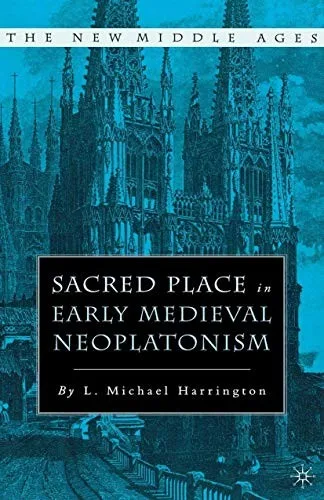
Sacred Place in Early Medieval Neoplatonism
 76
76

Sacred Place in Early Medieval Neoplatonism
Harrington's work offers a vital corrective to the modern framing of sacred space, pushing its origins back into the intellectual currents of early medieval Neoplatonism. The book's strength lies in its rigorous tracing of philosophical lineage, demonstrating how concepts often attributed to 20th-century thinkers have deep roots in Late Antique and early medieval thought. A particularly compelling section discusses how the Neoplatonic understanding of divine emanation naturally leads to a differentiated sense of sanctity across the cosmos. However, the dense philosophical argumentation, while laudable for its precision, can occasionally make the text challenging for readers less familiar with specific Neoplatonic texts or concepts. The exploration of how thinkers like Pseudo-Dionysius the Areopagite might have synthesized Neoplatonic ideas with Christian theology regarding sacred places is a significant contribution. This is an essential, if demanding, read for anyone serious about the history of spiritual geography.
📝 Description
76
L. Harrington's 2017 book traces sacred space concepts back to early medieval Neoplatonism.
This study examines the philosophical and theological ideas about sacred space within Neoplatonism, following its development from Late Antiquity into the early Middle Ages. It argues against the notion that discussions of sacred place are a recent phenomenon, often associated with twentieth-century thinkers like Martin Heidegger and Mircea Eliade. Instead, the book demonstrates that significant precedents for these concepts existed centuries earlier. The work is intended for scholars and advanced students in philosophy, theology, religious studies, and classical antiquity. It will interest those studying the transmission of Platonic and Neoplatonic thought, the history of spiritual geography, and the intellectual links between the ancient and medieval worlds. Readers looking for the conceptual origins of sacred space beyond modern phenomenology will find this research valuable.
The book is situated within the intellectual climate of Late Antiquity and the early medieval period, a time when Neoplatonism greatly affected Christian, Jewish, and pagan philosophical discussions. It recognizes the contributions of figures such as Plotinus and Porphyry, whose ideas about the divine and the cosmos established a basis for later understandings of space and its sacred qualities. The study implicitly addresses the secularizing trends that modern thinkers like Heidegger and Eliade grappled with, asserting that earlier thinkers engaged with similar issues in sophisticated ways.
This book places its inquiry into the Neoplatonic tradition, a philosophical system that profoundly shaped esoteric thought across various cultures. Neoplatonism's hierarchical view of reality and its emanative cosmology provided a framework for understanding the divine immanence within the cosmos. Harrington's work highlights how these ideas were applied to conceptualize sacred places, not merely as physical locations but as points of access to higher realities. This connects to a long-standing esoteric interest in the spiritual significance of geography and the architecture of the cosmos.
💡 Why Read This Book?
• Gain a nuanced understanding of the philosophical origins of sacred space, tracing concepts back to Neoplatonism and its early medieval interpreters, moving beyond 20th-century phenomenology. • Discover how the Neoplatonic cosmological model, particularly the concept of divine emanation, provided an intellectual framework for understanding spatially differentiated sanctity. • Engage with the intellectual legacy of thinkers like Plotinus and Porphyry, understanding their foundational ideas that shaped medieval perceptions of sacred places.
⭐ Reader Reviews
Honest opinions from readers who have explored this book.
❓ Frequently Asked Questions
What is the primary argument of Sacred Place in Early Medieval Neoplatonism?
The book argues that the concept of sacred place, often associated with 20th-century thinkers like Heidegger and Eliade, has significant and unacknowledged precedents in Late Antique and early medieval Neoplatonism.
Which philosophical tradition is central to this book?
The central philosophical tradition is Neoplatonism, tracing its influence from ancient thinkers like Plotinus through its development in the early Middle Ages.
How does this book differ from modern studies of sacred space?
It differs by focusing on the philosophical and cosmological underpinnings of sacred space in an earlier historical period, rather than solely on phenomenological or sociological approaches.
Who are the key figures discussed or referenced in relation to Neoplatonism?
Key figures referenced include Martin Heidegger and Mircea Eliade for context, and implicitly, foundational Neoplatonists like Plotinus and later medieval thinkers who engaged with these ideas.
What is the book's stance on secularization and nature?
The book suggests that early Neoplatonists were already grappling with concepts related to the perceived secularization of space and the manipulation of nature, providing an ancient counterpoint to modern concerns.
What does the book reveal about the early medieval understanding of the cosmos?
It reveals how the Neoplatonic hierarchical and emanative cosmology led to an understanding of the cosmos as inherently ordered and divinely imbued, with varying degrees of sanctity.
🔮 Key Themes & Symbolism
Neoplatonic Cosmology and Space
The book examines how the Neoplatonic worldview, characterized by divine emanation and a hierarchical structure of reality, naturally lent itself to conceptualizing sacred space. Unlike modern views that may see space as neutral, Neoplatonism posited an inherent spiritual geography where different levels of existence, from the divine Intellect down to the material world, possessed distinct qualities of sanctity. This framework allowed for an understanding of places as potentially imbued with divine presence or accessible to higher realities through contemplation and specific practices.
Precursors to Modern Phenomenology
A central thesis is that the concerns driving 20th-century thinkers like Heidegger and Eliade regarding the secularization of space and the human relationship with nature were anticipated by early medieval Neoplatonists. The work suggests that these ancient philosophers developed sophisticated ideas about place and its significance that responded to their own cultural contexts, demonstrating a long intellectual lineage for concepts often considered distinctly modern or postmodern.
Transmission of Ancient Ideas
The study traces the intellectual lineage of sacred space from figures like Plotinus and Porphyry through their reception and adaptation in the early medieval period. It explores how these Neoplatonic ideas, which emphasized the soul's ascent and the divine order of the cosmos, provided a fertile ground for developing theories about locations that held particular spiritual importance or served as conduits to the divine.
The Concept of Sanctity
Harrington's work investigates how sanctity was understood within early medieval Neoplatonic thought. It was not merely a matter of human designation but an inherent quality derived from divine proximity or the nature of the place within the cosmic hierarchy. This understanding allowed for a differentiated perception of the world, where certain sites were intrinsically more sacred than others due to their connection to higher realities.
💬 Memorable Quotes
Direct passages from the work, attributed to the author.
“The modern discovery of sacred place, often linked to Heidegger and Eliade, has deep, unacknowledged roots in Late Antiquity and the early Middle Ages.”
— This statement captures the book's core argument: that contemporary philosophical interest in sacred space is not novel but has a significant historical precedent within Neoplatonic thought.
“Neoplatonic cosmology provided a framework for understanding spatially differentiated sanctity.”
— This highlights how the hierarchical and emanative structure of the Neoplatonic universe inherently suggested that different parts of the cosmos, and thus specific locations, could possess varying degrees of spiritual significance.
“The work traces the appearance and development of sacred place in early medieval Neoplatonism.”
— This describes the book's methodological approach, focusing on the historical evolution and philosophical articulation of the concept of sacred place within a specific intellectual tradition.
“Early medieval thinkers engaged with concepts responding to secularization and nature manipulation.”
— This interpretation suggests that the concerns addressed by modern thinkers like Heidegger regarding humanity's relationship with nature and the perceived loss of sacredness in space were already present in ancient philosophical discourse.
“Sacred place was understood not merely as humanly designated but as inherently imbued with spiritual potency.”
— This points to a key distinction: the Neoplatonic view of sacredness as an objective quality tied to the cosmos, rather than solely a subjective or cultural construct.
🌙 Esoteric Significance
Tradition
This work fits within the broader esoteric tradition by exploring the philosophical underpinnings of sacred space, a concept central to many mystical and magical systems. While Neoplatonism itself is a philosophical school, its emanative cosmology, emphasis on hierarchy, and the soul's ascent have profoundly influenced subsequent esoteric movements like Hermeticism, Kabbalah, and various forms of Western mysticism. Harrington's study reveals how these foundational Neoplatonic ideas provided an intellectual framework for understanding the sacredness inherent in particular locations, a concept vital for ritual practice and spiritual geography.
Symbolism
A key symbol is the Neoplatonic cosmos itself, understood as a divinely ordered hierarchy emanating from the One. Within this structure, different levels (the intelligible realm, the celestial spheres, the material world) possess varying degrees of purity and divine presence. Specific locations on Earth could thus be seen as more sacred by virtue of their proximity to divine influences or their alignment within this cosmic order. The concept of 'place' itself becomes symbolic, representing not just physical location but a state of being or a point of access to higher realities.
Modern Relevance
Contemporary thinkers exploring spiritual geography, phenomenology of religion, and the philosophy of place can draw significant insights from this work. Scholars and practitioners interested in how ancient cosmological models inform contemporary understandings of sacred sites will find Harrington's analysis invaluable. The book's exploration of how early medieval thinkers grappled with concepts of nature, secularization, and inherent sanctity offers a rich resource for those seeking to revive or understand older paradigms of the sacred in a post-secular age.
👥 Who Should Read This Book
• Academic researchers in philosophy, religious studies, and classical/medieval history seeking to understand the intellectual history of sacred space beyond 20th-century phenomenology. • Students of Neoplatonism and its influence on Western thought, providing a bridge from ancient philosophy to early medieval theological and cosmological ideas. • Esoteric practitioners and scholars interested in the philosophical roots of spiritual geography and the conceptualization of sacred sites within mystical traditions.
📜 Historical Context
Published in 2016, L. Harrington's *Sacred Place in Early Medieval Neoplatonism* intervenes in ongoing scholarly discussions about the nature and history of sacred space. The 20th century saw a significant re-engagement with this topic, notably through the works of Martin Heidegger and Mircea Eliade, who sought to understand place in an era of increasing secularization and technological manipulation of nature. Harrington’s work argues that this intellectual lineage extends much further back, finding crucial precedents in the Neoplatonism of Late Antiquity and the early Middle Ages. This period, roughly from the 3rd to the 8th centuries CE, was a vibrant intellectual milieu where Neoplatonic ideas profoundly shaped Christian, pagan, and Jewish philosophical and theological discourse. Thinkers like Plotinus and Porphyry laid the groundwork, and their ideas were later synthesized and adapted by figures such as Pseudo-Dionysius the Areopagite, who engaged with cosmological and hierarchical concepts that directly informed understandings of sacred geography. By tracing these developments, Harrington offers a counter-narrative to the idea that the concept of sacred place is a purely modern invention.
📔 Journal Prompts
The Neoplatonic concept of divine emanation and its relation to sacred places.
How does the idea of a 'cosmic hierarchy' influence the perception of sacred locations?
Reflect on the early medieval engagement with concepts that modern thinkers associate with secularization.
The role of Plotinus's emanative cosmology in shaping ideas of sacred space.
Compare and contrast the Neoplatonic understanding of sanctity with contemporary views.
🗂️ Glossary
Neoplatonism
A school of philosophy that emerged in the 3rd century CE, building on the ideas of Plato. It posits a supreme, transcendent 'One' from which all reality emanates in a hierarchical fashion.
Emanation
In Neoplatonism, the process by which reality flows or issues forth from a divine source (the One) without diminishing the source itself. This creates a hierarchical chain of being.
Intelligible Realm
The higher, non-material reality in Neoplatonism, comprising the Forms or Ideas, which is emanated from the One and is the source of all sensible reality.
Sensible World
The physical, material world perceived by the senses, which is seen in Neoplatonism as a lower level of reality derived from the Intelligible Realm.
Sanctity
The quality of being holy, sacred, or set apart. In the context of this book, it refers to the inherent spiritual potency or divine connection attributed to certain places within a cosmological framework.
Secularization
The process by which religious institutions, beliefs, and practices lose social and cultural significance. The book examines how early thinkers may have implicitly addressed similar concerns about the perceived desacralization of the world.
Spiritual Geography
The study of how spiritual or religious beliefs shape the perception and significance of physical places. It explores the relationship between the sacred and the terrestrial.