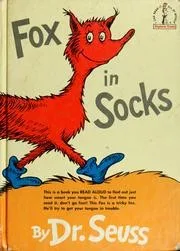
Fox in Socks
 79
79

Fox in Socks
The sheer audacity of "Fox in Socks" lies in its commitment to linguistic gymnastics. Dr. Seuss doesn't just teach reading; he compels the reader to *perform* it, to wrestle with the sounds and rhythms until they yield their meaning. The progression from simple rhymes to the dizzying "Knox on Fox in Socks" sequence is masterful, a genuine challenge for any young speaker. Its primary limitation, however, is its narrow focus; the narrative is secondary to the phonetic play, which might leave some younger children more frustrated than amused. The "Socks on Knox" section, with its rapid-fire, rhyming couplets about a man named Knox and his socks, exemplifies both the book's brilliance and its potential barrier to entry. It's an exceptional tool for phonological awareness, but perhaps less so for pure storytelling.
📝 Description
79
Published in 1986, Fox in Socks challenges young readers with complex phonetic patterns.
This Dr. Seuss book uses rhyming verses and playful narratives to challenge children with difficult wordplay and phonetic sequences. It functions as an early linguistic training tool, encouraging auditory discrimination and articulation. The book presents a series of tongue twisters and rhyming schemes that become progressively harder. It is aimed at children in early elementary grades, especially those developing reading fluency and phonetic awareness. Educators and parents can use it to enhance vocabulary, pronunciation, and a playful engagement with language. The book appeals to readers who appreciate the structural and sonic aspects of language.
Dr. Seuss, born Theodor Seuss Geisel, was already a renowned author when this book was published. Fox in Socks continued his tradition of creating texts that were both entertaining and educationally sound. He pushed the boundaries of early reading materials with his innovative use of rhyme, rhythm, and imaginative illustrations. The book's primary focus is on phonetics and linguistic dexterity. It introduces concepts like alliteration, assonance, and consonance through deliberately crafted, often nonsensical, word combinations. The emphasis is on the physical act of speaking and the auditory experience of language, making it a distinct contribution to early literacy.
While not esoteric in the traditional sense of occult or mystical traditions, Fox in Socks engages with language on a level that can be considered 'esoteric' for early literacy. It treats the mechanics of speech and sound as a subject of play and mastery. The book's focus on the physical and sonic qualities of words, through deliberate manipulation and challenging sequences, invites a deeper, almost ritualistic, engagement with language. This approach to linguistic structure, emphasizing the performer's (the reader's) interaction with the text's soundscape, mirrors some aspects of oral traditions where the performance of text is as crucial as its meaning.
💡 Why Read This Book?
• Learn to articulate complex consonant clusters and vowel sounds, as demonstrated in the "Knox on Fox in Socks" sequence, enhancing your child's speech clarity. • Experience the playful construction of language through specific examples of alliteration and rhyme, such as the "Chicks with bricks" and "ticks with bricks" passages, fostering an appreciation for word sounds. • Engage with a text that actively challenges pronunciation skills, specifically the "Fox's boxed blocks" section, making reading a dynamic, performative act rather than a passive one.
⭐ Reader Reviews
Honest opinions from readers who have explored this book.
❓ Frequently Asked Questions
When was Dr. Seuss's 'Fox in Socks' first published?
'Fox in Socks' by Dr. Seuss was first published in 1986. It was part of his continued effort to create engaging and educational reading materials for young children.
What age group is 'Fox in Socks' best suited for?
This book is ideal for early elementary school children, typically ages 4-8, who are developing their reading skills and phonetic awareness. It challenges young readers with complex wordplay.
What makes the language in 'Fox in Socks' unique?
The book is characterized by its use of tongue twisters, alliteration, and complex rhyming patterns, pushing the boundaries of early reader vocabulary and pronunciation.
Who is the author of 'Fox in Socks'?
The author is Dr. Seuss, whose real name was Theodor Seuss Geisel. He is renowned for his distinctive illustrative style and whimsical, rhythmic storytelling.
Does 'Fox in Socks' have a specific educational purpose?
Yes, its primary purpose is to develop phonological awareness, improve articulation, and build reading fluency through challenging phonetic exercises and playful repetition.
What are some of the memorable characters or scenarios in 'Fox in Socks'?
Key scenarios include a fox in socks, Knox who also has socks, chicks with bricks, and ticking clocks, all presented through increasingly difficult wordplay and rhyme.
🔮 Key Themes & Symbolism
Phonetic Dexterity
The work is a deep dive into the mechanics of spoken language, using rapid-fire rhymes and alliterative phrases to train the reader's mouth and ear. Concepts like "chicks with bricks" and "ticks with bricks" are not mere silliness but exercises in differentiating similar sounds under pressure. The book encourages a performative aspect to reading, where the act of speaking the words correctly becomes part of the engagement. This focus on the physical production of sound distinguishes it from more conventionally narrative texts, turning reading into an auditory and articulatory challenge.
Linguistic Play and Structure
Beyond simple vocabulary, "Fox in Socks" explores the inherent structure and playful potential within language itself. The intricate rhyming schemes and rhythmic patterns, such as those found in the "Knox on Fox in Socks" segment, highlight how words can be manipulated for sonic effect. It demonstrates that language is not just a tool for conveying information but also a form of art and a source of amusement. The book invites readers to appreciate the architecture of sentences and the musicality of words, fostering a deeper, more analytical engagement with text.
Early Literacy Development
This book serves as a sophisticated tool for early literacy, moving beyond basic sight words to engage with phonics and articulation in an advanced manner. The 1986 publication date places it within a lineage of educational materials designed to make learning enjoyable. By presenting complex phonetic challenges, it aims to build confidence in young readers, encouraging them to tackle difficult sounds and word combinations. It acts as a bridge from simple reading to more complex linguistic comprehension and expressive speech.
The Performer Reader
A central, though often overlooked, theme is the transformation of the reader into a performer. The book demands more than passive absorption; it requires active vocalization and a willingness to stumble and try again. The "Socks on Knox" sequence, for instance, is a vocal endurance test. This transforms the reading experience into a dynamic interaction, where the reader's own voice and articulation are central to understanding and enjoying the text. It fosters a sense of accomplishment through mastering these linguistic performances.
💬 Memorable Quotes
Direct passages from the work, attributed to the author.
“Knox on Fox in Socks.”
— This short, repeated phrase captures the book's challenge. It requires precise articulation of multiple 'x' sounds and the transition between words, serving as a core phonetic test.
“Chicks with bricks come. Chicks with blocks go.”
— This demonstrates the book's use of alliteration and near-rhyme to create memorable, yet phonetically distinct, phrases that test a reader's ability to differentiate similar sounds rapidly.
“Who picks the picks with picks? Picks with picks will pick.”
— This exemplifies the intricate wordplay and repetition designed to highlight specific consonant sounds and sentence structures, making the reader conscious of the mechanics of speech.
“I do not like this thing, this thing, this thing.”
— A simple declaration of dislike, but when repeated with escalating phonetic complexity around it, it becomes a refrain that grounds the reader amidst the linguistic chaos.
“Them, Them, Them, Them, Them.”
— This repetition of a simple pronoun, embedded within more complex phonetic structures, serves to emphasize the cadence and rhythm of the language, forcing a focus on the sound over immediate meaning.
🌙 Esoteric Significance
Tradition
While not explicitly belonging to a formal esoteric tradition like Hermeticism or Gnosticism, "Fox in Socks" engages with a universal fascination for the power and manipulation of language, a core concern in many mystical paths. The focus on sound, vibration, and articulation echoes practices found in mantra-based traditions and the Qabalistic emphasis on the creative power of Hebrew letters. It aligns with a broader Neoplatonic appreciation for the underlying order and beauty of forms, here manifest in the structure of words and phonemes.
Symbolism
The primary symbols are abstract: the 'fox' itself, often representing cunning or transformation, is placed in 'socks,' an everyday, grounding item, creating a playful juxtaposition. The recurring 'Knox' character serves as a foil or student figure. The 'bricks' and 'blocks' can be interpreted as basic building elements, representing the fundamental components of language that the reader must assemble and manipulate. The recurring theme of 'picking' or 'ticking' evokes a sense of time and precise action, crucial for mastering the text's challenges.
Modern Relevance
Contemporary educators and linguists still reference Dr. Seuss's work for its innovative approach to early literacy. Thinkers in the field of psycholinguistics might examine its effectiveness in developing phonological awareness. Furthermore, its appeal extends to adults interested in the philosophy of language and the playful manipulation of meaning, finding resonance with postmodern explorations of semiotics and the performative nature of communication. It's a foundational text for understanding how linguistic structures can be both challenging and delightful.
👥 Who Should Read This Book
• Young children aged 4-8 who are beginning to read and need to develop strong phonetic awareness and articulation skills. • Parents and educators seeking fun, engaging methods to improve children's pronunciation, vocabulary, and confidence in speaking. • Individuals interested in the structural and sonic qualities of language, appreciating how wordplay can be used for educational and entertainment purposes.
📜 Historical Context
Published in 1986, "Fox in Socks" emerged from the prolific career of Theodor Seuss Geisel, better known as Dr. Seuss. Geisel had been a dominant force in children's literature since the 1930s, with his breakthrough success coming in the late 1950s with books like "The Cat in the Hat" (1957), which responded to critiques of early readers being too simplistic. By 1986, Seuss was a household name, and "Fox in Socks" continued his established pattern of creating engaging, phonetically challenging texts. While not directly part of a specific esoteric movement, Geisel's work often tapped into a universal fascination with language and rhythm that appeals to a sense of playful wonder often explored in metaphysical thought. His contemporaries included authors like Maurice Sendak, who offered a different, often darker, psychological approach to children's literature, highlighting the diverse field of children's publishing at the time. Reception was generally positive, reinforcing Seuss's status, though some educators noted its advanced difficulty.
📔 Journal Prompts
The "Fox's boxed blocks" sequence and its phonetic demands.
The repetition of "Knox on Fox in Socks" and its effect on articulation.
The contrast between "Chicks with bricks" and "Chicks with blocks."
The role of "ticks" and "picks" in the book's linguistic challenges.
The overall feeling evoked by the fast-paced rhymes and wordplay.
🗂️ Glossary
Alliteration
The occurrence of the same letter or sound at the beginning of adjacent or closely connected words. Examples in the book include 'chicks with bricks' and 'Socks on Knox'.
Phonetics
The study and classification of speech sounds. This book extensively uses phonetic challenges to improve a reader's ability to pronounce specific sounds and combinations.
Tongue Twister
A phrase or sentence that is hard to say correctly, usually because of similar sounds. 'Fox in Socks' is structured around a series of increasingly difficult tongue twisters.
Rhyme Scheme
The ordered pattern of rhymes at the ends of the lines of a poem or verse. This book employs various simple and complex rhyme schemes to enhance memorability and rhythm.
Articulation
The act of producing speech sounds; the clarity with which words are spoken. The book directly challenges and aims to improve a child's articulation.
Knox
A character featured in the book, often associated with socks and providing a phonetic challenge through his name's sound. He appears prominently in the 'Socks on Knox' section.
Fox
The titular character who is often depicted wearing socks and engaging in wordplay. The fox is a recurring motif in Dr. Seuss's works, symbolizing cleverness.
🔮 Readers Also Liked
Browse all →









More by Dr. Seuss
All books →


More Free Occult Philosophy Books
View all →