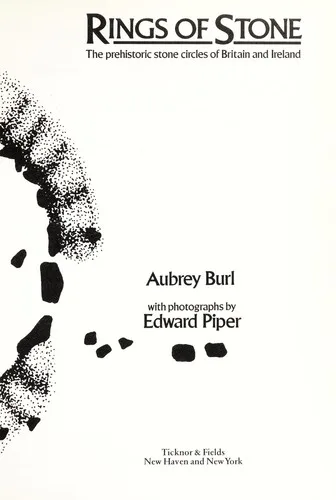
Rings of stone
 72
72

Rings of stone
Aubrey Burl’s *Rings of Stone* attempts to synthesize the archaeological evidence for megalithic circles with speculative interpretations of their purpose. The book's strength lies in its detailed descriptions of specific sites, like Avebury and Callanish, and its clear presentation of astronomical data, such as potential solstitial alignments. However, its weakness emerges when Burl leans too heavily on the more fanciful theories, often without sufficient scholarly grounding. The section discussing the potential for widespread shamanic practices, while intriguing, feels undersupported by the presented evidence. Ultimately, *Rings of Stone* serves as a competent overview for the general reader, but seasoned scholars may find its conclusions less than rigorous.
📝 Description
72
Aubrey Burl's Rings of Stone, published in 1979, examines prehistoric stone circles in Britain.
Aubrey Burl's 1979 book, Rings of Stone, provides a scholarly look at prehistoric stone circles and megalithic structures, especially those found in Britain. It goes beyond basic archaeological facts to consider the possible astronomical alignments, ritual uses, and symbolic meanings people attached to these old sites. The book is for readers interested in archaeoastronomy, the history of ancient religions, and the lasting human interest in stone circles. It helps readers understand the beliefs and goals of prehistoric people by looking at the physical remains they left.
When Burl wrote this book, Stonehenge and similar sites were widely discussed by both academics and the public. His work entered into the existing discussions about the scientific and esoteric ideas surrounding megalithic monuments. It added to a better understanding of how these structures were built and what they were used for. The book discusses ideas like solar and lunar alignments, the use of stone circles as calendars, and the potential for shamanic or druidic practices connected to these places. It also notes the difficulties in interpreting evidence from societies without written records, admitting that much of the research is speculative.
Rings of Stone engages with interpretations of megalithic monuments that extend beyond purely scientific explanations. While grounded in archaeology, the book acknowledges and discusses theories concerning astronomical alignments and ritualistic uses that touch upon beliefs and practices common in esoteric traditions. It reflects a period where the lines between archaeology, folklore, and early pagan or nature-based spiritualities were often blurred in scholarly and popular discourse. The work sits within a broader interest in understanding ancient peoples' relationship with the cosmos and the earth through their monumental constructions.
💡 Why Read This Book?
• Gain an understanding of the astronomical calculations potentially employed in the construction of sites like Stonehenge, as detailed in the book's analysis of solar and lunar cycles. • Explore the archaeological evidence for ritualistic practices at megalithic sites, offering a glimpse into the potential belief systems of prehistoric communities. • Appreciate the scholarly debate surrounding the interpretation of these ancient monuments, including the challenges Burl faced when examining evidence from pre-literate societies.
⭐ Reader Reviews
Honest opinions from readers who have explored this book.
❓ Frequently Asked Questions
What is the primary focus of Aubrey Burl's *Rings of Stone*?
The book primarily examines prehistoric stone circles and megalithic structures, particularly in Britain, exploring their potential astronomical alignments, ritualistic uses, and symbolic meanings.
When was *Rings of Stone* originally published?
Aubrey Burl's *Rings of Stone* was first published in 1979, a period of significant interest in the study of ancient monuments.
Does the book present definitive answers about the purpose of stone circles?
No, the book acknowledges the speculative nature of interpreting evidence from pre-literate societies and discusses various theories without claiming definitive proof for any single purpose.
Which specific sites are discussed in *Rings of Stone*?
The book discusses numerous sites, with notable attention given to well-known examples like Stonehenge and Avebury, as well as others such as Callanish.
Is *Rings of Stone* an archaeological text or an esoteric one?
It bridges both, offering archaeological descriptions and data while also exploring potential esoteric or ritualistic interpretations of the sites' purposes.
What kind of evidence does Burl use to support his interpretations?
Burl utilizes archaeological findings, comparative studies of similar sites, and analysis of astronomical alignments, alongside discussions of prevailing theories from his time.
🔮 Key Themes & Symbolism
Megalithic Astronomy
The work investigates the potential for prehistoric peoples to have possessed sophisticated astronomical knowledge, evidenced by the careful alignment of stone circles with celestial events like solstices and equinoxes. Burl explores how these arrangements may have functioned as calendars or observatories, linking the earthly realm to the cosmic cycles that governed ancient life and agriculture.
Ritual and Belief
Beyond astronomical functions, *Rings of Stone* explores the probable ritualistic and spiritual significance of these ancient monuments. It considers how these imposing structures might have served as sacred spaces for ceremonies, sacrifices, or community gatherings, reflecting the belief systems and spiritual practices of the societies that erected them.
Archaeological Interpretation
A core theme is the challenge of interpreting the remains of pre-literate cultures. Burl examines the available archaeological evidence, acknowledging its limitations and the speculative nature of reconstructing the precise meanings and uses of stone circles, while engaging with contemporary scholarly debates from the late 20th century.
Symbolic Landscapes
The book explores how stone circles were integrated into the broader landscape, suggesting they were not isolated structures but part of a symbolic geography. Their placement and orientation may have held deep cosmological meaning, connecting the specific site to wider natural forces and spiritual concepts held by their builders.
💬 Memorable Quotes
Direct passages from the work, attributed to the author.
“The stones were set up to record the passage of the year.”
— This statement expresses the book's focus on the calendrical and astronomical functions of megalithic sites, suggesting a deliberate intent to measure and mark celestial events.
“We can only guess at the rites performed within these circles.”
— This highlights the inherent difficulty in definitively knowing the exact ceremonies or rituals that took place at ancient stone circles, emphasizing the speculative aspect of their interpretation.
“Megalithic builders possessed an acute awareness of the sun and moon.”
— This interpretation points to the sophisticated understanding of celestial movements that the book attributes to the creators of these ancient structures.
“The precise purpose of many stone circles remains elusive.”
— This acknowledges the ongoing mystery surrounding many megalithic sites, underscoring that while theories exist, conclusive evidence is often lacking.
“These monuments are elements of a forgotten world.”
— This conveys the sense of profound antiquity and the challenge of bridging the vast temporal and cultural gulf between modern observers and the builders of stone circles.
🌙 Esoteric Significance
Tradition
While not strictly an esoteric text in the vein of Hermeticism or Kabbalah, *Rings of Stone* touches upon the perennial interest in ancient earth-wisdom and celestial observation. It aligns with traditions that see prehistoric sites as repositories of forgotten knowledge, connecting human activity to cosmic order. The book appeals to a broad spectrum of esoteric interest by exploring the potential for spiritual and ritualistic practices tied to natural cycles.
Symbolism
The primary symbols are the stone circles themselves, representing community, cosmic order, and sacred space. The alignment with solstices and equinoxes symbolizes the cyclical nature of time, life, death, and rebirth. The stones themselves can be seen as phallic symbols or conduits of earth energy, depending on the interpretive lens applied.
Modern Relevance
Contemporary practitioners of earth-based spirituality, neo-paganism, and archaeoastronomy continue to draw inspiration from works like Burl's. Modern druidic and shamanic circles often reference the potential ritualistic uses of megaliths. The ongoing academic and public fascination with Stonehenge and Avebury ensures that discussions about their astronomical and spiritual significance remain relevant.
👥 Who Should Read This Book
• Students of archaeoastronomy seeking to understand early theories on the celestial alignments of prehistoric sites, as explored in the book's analysis of Stonehenge and Avebury. • Readers interested in the history of religion and ancient belief systems who want to explore potential ritualistic practices associated with megalithic monuments. • Individuals fascinated by the enduring mysteries of ancient Britain and the archaeological challenges of interpreting structures built by pre-literate societies.
📜 Historical Context
Aubrey Burl’s *Rings of Stone*, published in 1979, emerged during a vibrant period of interdisciplinary study concerning prehistoric monuments. The era saw a surge of interest in archaeoastronomy, challenging earlier purely functional or purely ritualistic interpretations. Burl engaged with contemporaries like Alexander Thom, whose work emphasized astronomical precision, while also considering alternative perspectives. The book contributed to a growing body of literature that sought to move beyond simplistic explanations, acknowledging the complexity of these sites. Unlike earlier, more speculative works, Burl’s approach was grounded in a careful review of archaeological data available at the time, though it still grappled with the inherent ambiguities of interpreting pre-literate societies. It addressed the ongoing debate between scientific and more mystical understandings of Stonehenge and similar structures.
📔 Journal Prompts
The astronomical alignments of megalithic sites as described in the text.
Reflect on the potential meaning of the 'stones as recorders of the year' concept.
Consider the evidence presented for ritualistic practices within stone circles.
Analyze the challenges of interpreting the 'forgotten world' elements of megalithic builders.
The symbolic significance of the stone circles as depicted in the book.
🗂️ Glossary
Megalith
A large, often prehistoric stone used in the construction of monuments or structures, either standing alone or as part of a larger arrangement.
Stone Circle
A prehistoric monument consisting of a ring of standing stones, often associated with ritualistic or astronomical purposes.
Solstice
The point at which the sun is farthest north or south in the celestial sphere, marking the longest and shortest days of the year.
Equinox
The time when the sun crosses the celestial equator, making day and night approximately equal in length; occurs twice a year.
Archaeoastronomy
The interdisciplinary study of how past cultures understood celestial phenomena and how they used these understandings in their lives and monumental constructions.
Ritual
A set of actions, performed consistently, often for religious or ceremonial purposes, which carry symbolic meaning.
Pre-literate Society
A society that has not developed a system of writing, making direct interpretation of their beliefs and practices challenging.
🔮 Readers Also Liked
Browse all →








More by Aubrey Burl
All books →





More Free Occult Philosophy Books
View all →