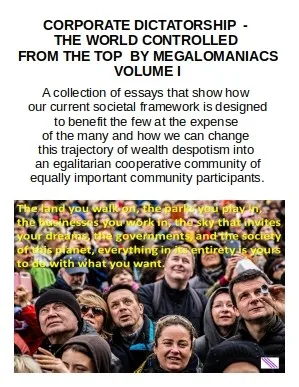
Corporate Dictatorship
 84
84

Corporate Dictatorship
The anonymous author of Corporate Dictatorship bravely tackles the pervasive influence of multinational corporations, a topic often relegated to academic journals. The strength of this work lies in its unflinching portrayal of how corporate interests can warp democratic processes, creating a system where profit dictates public policy. A particularly sharp observation is made regarding the subtle manipulation of consumer behavior, turning citizens into compliant economic units. However, the book's anonymity, while perhaps intended to lend an air of objective critique, can also obscure the author's specific theoretical grounding. Without a clear authorial voice or a defined philosophical lineage, some arguments, while compelling, lack the weight of established scholarship. Nevertheless, Corporate Dictatorship offers a stark, albeit bleak, perspective on contemporary power structures that warrants attention.
📝 Description
84
Published anonymously in the early 21st century, Corporate Dictatorship argues global corporations have seized governmental authority.
This text presents a critique of modern economic and political structures, asserting that global corporations have effectively taken over governmental roles. It contends that corporate power, driven by profit, operates outside democratic control, shaping policy and societal norms. The book is for readers dissatisfied with current political discussions who want to grasp the forces influencing society. It will interest those in critical theory, political philosophy, and alternative economic systems, especially those questioning democracy's effectiveness against corporate influence.
The work appeared during a time of growing globalization and corporate consolidation. It draws on earlier critiques of capitalism, similar to ideas from Karl Marx and more recent thinkers like Noam Chomsky. The book reflects a broader concern about the impact of multinational corporations on public life. Its central idea is 'corporate sovereignty,' where corporate legal and economic power exceeds that of nation-states. It also discusses 'regulatory capture,' where industries shape their regulators, and 'consumer citizenship,' suggesting people become mere consumers rather than active citizens.
While not overtly mystical, Corporate Dictatorship fits within esoteric traditions that question established power structures and hidden influences. Its analysis of systemic control, operating beyond visible democratic processes, resonates with certain occult philosophies that examine the unseen forces shaping reality. The book's focus on how seemingly mundane economic and political systems can function as a form of pervasive, almost invisible, dominion aligns with esoteric explorations of power dynamics and societal conditioning, challenging readers to look beneath the surface of everyday life.
💡 Why Read This Book?
• Understand the mechanisms of 'regulatory capture' as detailed in the book, and how this specific phenomenon allows industries to shape laws affecting them, a concept not always explicitly defined in general political texts. • Grasp the author's concept of 'corporate sovereignty,' a unique framing that argues corporations have effectively become supra-national governing bodies, offering a distinct perspective on global power dynamics. • Examine the critique of 'consumer citizenship' presented, which challenges how modern societies reduce individuals to economic actors rather than active participants in governance, providing a specific lens for self-reflection.
⭐ Reader Reviews
Honest opinions from readers who have explored this book.
❓ Frequently Asked Questions
What is the primary argument of 'Corporate Dictatorship' regarding government power?
The book argues that global corporations have effectively usurped governmental authority, rendering democratic institutions subservient to corporate interests and profit motives. This 'corporate sovereignty' dictates policy and societal direction.
When was 'Corporate Dictatorship' first published?
'Corporate Dictatorship' was first published in 2022, reflecting contemporary concerns about corporate influence in the early 21st century.
Does the book offer solutions to the problems it raises?
While primarily a critique, the book implicitly suggests that a reassertion of citizen agency and a dismantling of corporate control over political processes are necessary. Specific solutions are not extensively detailed.
Who is the author of 'Corporate Dictatorship'?
The author is anonymous. The work was first published in 2022, and the identity of the writer has not been publicly disclosed.
What is 'regulatory capture' as discussed in the book?
Regulatory capture refers to the phenomenon where industries being regulated gain significant influence over the regulatory bodies meant to oversee them, often leading to policies favoring the industry over public interest.
What is 'consumer citizenship' in the context of this book?
Consumer citizenship is a concept critiqued in the book, suggesting that modern society reduces individuals to mere consumers whose primary role is economic participation, overshadowing their civic duties and political agency.
🔮 Key Themes & Symbolism
Corporate Sovereignty
This theme posits that multinational corporations have achieved a status akin to sovereign entities, operating beyond the reach of national laws and democratic accountability. The work details how economic power translates into political leverage, allowing corporations to dictate terms to governments and influence public discourse. It questions the very foundation of nation-state power in an era dominated by global financial entities, suggesting a fundamental shift in authority structures.
The Illusion of Democracy
The book challenges the notion that contemporary political systems are truly democratic, arguing that elections and legislative bodies are largely performative. It suggests that the real power resides with corporate boardrooms and financial institutions, which manipulate public opinion and policy through lobbying, media control, and economic coercion. This theme critiques the superficiality of democratic processes when faced with overwhelming corporate influence.
Consumerism as Control
This theme explores how the culture of consumerism serves as a tool for maintaining corporate dominance. By encouraging constant acquisition and prioritizing economic activity, society is distracted from critical analysis of power structures. The book argues that individuals are conditioned to seek fulfillment through consumption, thereby reinforcing the economic system that perpetuates corporate control and limits their capacity for civic engagement.
Erosion of Public Sphere
Corporate Dictatorship examines the systematic dismantling of the public sphere, including social services, independent media, and communal spaces, often through privatization and deregulation. The work illustrates how this process benefits corporate entities by creating new markets and reducing collective power. It posits that the privatization of public functions diminishes civic life and strengthens corporate oversight over essential societal needs.
💬 Memorable Quotes
Direct passages from the work, attributed to the author.
“The boardroom has replaced the parliament.”
— This concise statement expresses the central thesis: that critical decision-making power has shifted from elected officials to corporate executives, effectively rendering democratic governance secondary to commercial interests.
“We are sold solutions to problems we never had.”
— This highlights the manipulative nature of modern marketing and corporate strategy, suggesting that new consumer needs are manufactured and then met with products, perpetuating a cycle of consumption.
“Profit is the only true sovereign.”
— An interpretation of the book's core argument, this phrase emphasizes the ultimate authority of financial gain above all other considerations, including ethics, social welfare, or environmental concerns.
“Regulation is merely a suggestion corporations choose to heed.”
— This reflects the idea of regulatory capture, suggesting that laws and regulations designed to control corporate behavior are often circumvented or influenced by the very entities they are meant to govern.
💡 Key Ideas
Editorial paraphrase of the work's core concepts — not direct quotes.
Citizenship is reduced to consumption.
This paraphrased concept critiques the modern societal model where individual worth and participation are measured by economic output and purchasing power, rather than civic engagement or political agency.
🌙 Esoteric Significance
Tradition
While not explicitly aligned with a single esoteric tradition, 'Corporate Dictatorship' can be viewed through a lens of modern Gnosticism, where the material world and its corrupting structures are seen as a prison. The book's critique of opaque systems of control and the reduction of human spirit to economic function echoes Gnostic ideas of liberation from a flawed demiurge. It departs from traditional Hermeticism by focusing on socio-economic structures rather than purely spiritual or alchemical transformation.
Symbolism
The 'boardroom' functions as a potent symbol for hidden power and control, akin to the hidden realms in some occult traditions. The 'market' itself, driven by insatiable profit, can be interpreted as a symbol of a lower, materialistic force that enslaves the human spirit. The concept of 'consumer citizenship' symbolizes the reduction of the divine spark within humanity to a mere economic unit, stripped of its true agency.
Modern Relevance
Contemporary thinkers and activists focused on anti-globalization, economic justice, and digital privacy draw heavily on critiques like those found in 'Corporate Dictatorship.' Schools of thought exploring post-capitalist futures and critiques of late-stage capitalism, as well as certain branches of critical theory and political philosophy, find resonance in its analysis of systemic power dynamics and the pervasiveness of corporate influence in daily life.
👥 Who Should Read This Book
• Individuals interested in political philosophy and critical theory seeking to understand the structural underpinnings of modern power, particularly those questioning the efficacy of traditional democratic models. • Activists and organizers involved in social justice, economic reform, or anti-corporate movements looking for theoretical frameworks to articulate their concerns about global financial influence. • Students of sociology and economics who wish to explore alternative perspectives on capitalism, globalization, and the role of corporations beyond mainstream economic discourse.
📜 Historical Context
Published in 2022, 'Corporate Dictatorship' arrived at a moment of heightened global awareness concerning corporate influence, following decades of neoliberal policy shifts. The work engages with a lineage of critical thought, from Frankfurt School theorists like Adorno and Horkheimer, who critiqued the culture industry, to more contemporary analyses of globalization and financialization. It implicitly contrasts with the utopian visions of market efficiency promoted by figures like Milton Friedman. While specific reception events for this anonymous work are not documented, its themes echo broader societal anxieties reflected in movements like Occupy Wall Street. The book can be seen as a direct descendant of critiques of unchecked capitalism, offering a stark vision of the early 21st century where corporate power often overshadows national sovereignty, a concern also voiced by scholars like Naomi Klein.
📔 Journal Prompts
The concept of 'corporate sovereignty' and its implications for personal agency.
Reflect on the transformation of 'citizenship' into 'consumerism'.
Analyze the symbolic meaning of the 'boardroom' in contemporary power structures.
Consider the historical precedents for the critique of corporate influence.
Examine the erosion of the 'public sphere' in your own community.
🗂️ Glossary
Corporate Sovereignty
The idea that large corporations wield power equivalent to or exceeding that of nation-states, influencing policy and operating beyond traditional governmental oversight.
Regulatory Capture
The process by which regulatory agencies, created to act in the public interest, instead advance the commercial or political concerns of special interest groups that dominate the industry or sector they are charged with regulating.
Consumer Citizenship
A critique suggesting that individuals in modern capitalist societies are primarily defined and engage with society through their roles as consumers rather than active, informed citizens.
Public Sphere
The area of social life where individuals can come together to freely discuss and influence public affairs, often contrasted with the private sphere of the home and the corporate sphere of business.
Neoliberalism
A political and economic ideology characterized by free-market capitalism, deregulation, privatization, and reduced government spending, often associated with the late 20th and early 21st centuries.
Globalization
The process of interaction and integration among people, companies, and governments worldwide, often driven by international trade and investment and supported by information technology.
Lobbying
The act of attempting to influence decisions made by officials in a government, most often legislators or members of regulatory agencies.
🔮 Readers Also Liked
Browse all →









More by Unknown
All books →





More Free Occult Philosophy Books
View all →