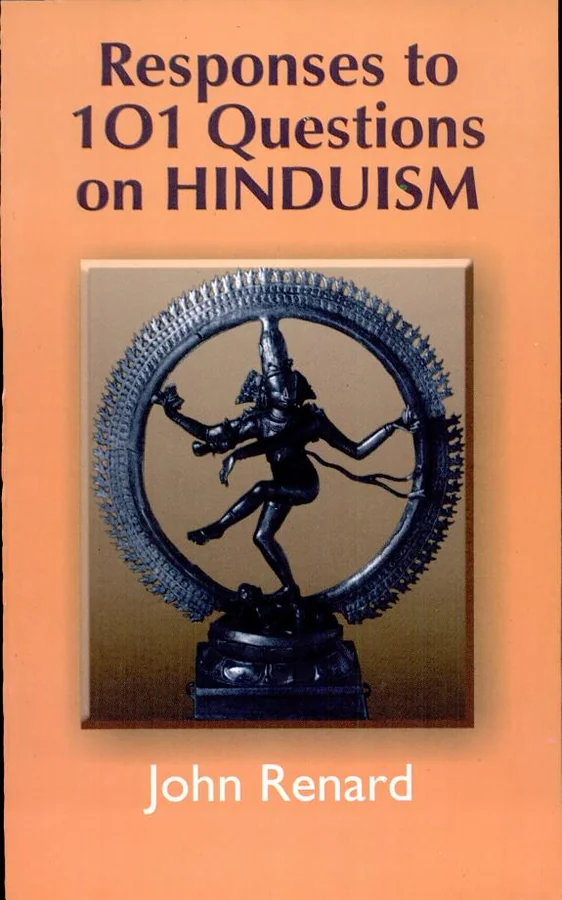
Responses To 101 Questions On Hinduism
 79
79

Responses To 101 Questions On Hinduism
John Renard's *Responses To 101 Questions On Hinduism* presents a commendable effort to demystify a vast religious tradition. Its strength lies in its direct, question-and-answer format, which effectively tackles common points of confusion. For instance, the way it clarifies the concept of reincarnation versus resurrection offers a useful distinction. However, the book's primary limitation is its inherent brevity in addressing each question; some topics feel touched upon rather than thoroughly explored, which is an unavoidable consequence of the format. The discussion around the various forms of yoga, while informative, could benefit from more detailed textual references. Ultimately, Renard provides a solid, accessible primer for those seeking foundational knowledge on Hinduism.
📝 Description
79
John Renard's 1999 book answers 101 common questions about Hindu traditions.
Published in 1999, John Renard's *Responses To 101 Questions On Hinduism* directly addresses common inquiries about Hindu traditions. The book functions as an accessible compendium, covering a broad spectrum of topics from theological concepts to practical observances. It aims to clarify ambiguities and provide informed answers to frequently posed questions, drawing on scholarly understanding of the religion. The structure, organized by question and answer, facilitates a focused approach to learning about diverse facets of Hinduism.
This work is primarily for individuals seeking clear, concise explanations of Hindu beliefs and practices. It is a resource for students of comparative religion, those encountering Hinduism for the first time, or people wishing to deepen their existing knowledge. Those interested in the spiritual and philosophical underpinnings of a major world religion will find value here, especially if they prefer a question-and-answer format to structured academic prose. It suits general readers and those with an interest in esoteric studies.
Published at a time of growing Western interest in Eastern religions, Renard's work arrived as globalization increased access to diverse cultural and religious information. It moves beyond earlier interpretations to present Hinduism from a scholarly perspective, distinct from purely devotional or philosophical treatises. The book reflects a trend towards making complex traditions accessible to a wider audience interested in esoteric studies.
💡 Why Read This Book?
• Gain clarity on the intricate concept of dharma, understanding its role as cosmic law and personal duty as presented in Renard's direct answers, a foundational element often misunderstood. • Grasp the mechanics of karma and reincarnation through Renard's explanations, distinguishing them from Western notions of fate and the afterlife, as detailed in the text's Q&A structure. • Understand the significance of key deities like Vishnu and Shiva, and how they function within the complex Hindu cosmology, as illuminated by specific queries addressed in the book.
⭐ Reader Reviews
Honest opinions from readers who have explored this book.
❓ Frequently Asked Questions
What specific Hindu deities are explained in John Renard's book?
The book addresses major deities central to Hindu worship, including Vishnu, often depicted as the preserver, and Shiva, associated with destruction and transformation. It also likely touches upon the goddess Devi in her various forms, providing context for their roles within the Hindu pantheon.
Does 'Responses To 101 Questions On Hinduism' discuss the Bhagavad Gita?
Given the comprehensive nature of the questions addressed, it is highly probable that the Bhagavad Gita is discussed. This seminal text is fundamental to Hindu philosophy and practice, and Renard's work would likely reference it when explaining concepts like dharma and devotion.
What is the historical period covered by the book's explanations?
While the book was published in 1999, its explanations of Hindu concepts like dharma, karma, and moksha delve into traditions that span millennia, from ancient Vedic periods through to contemporary interpretations and practices.
How does Renard explain the concept of reincarnation?
Renard likely clarifies reincarnation as a cycle of birth, death, and rebirth (samsara), driven by karma. The book probably distinguishes this from linear concepts of an afterlife, emphasizing the soul's journey across multiple lifetimes.
Is the book suitable for someone completely new to Hinduism?
Yes, the Q&A format is specifically designed for accessibility. It breaks down complex theological and philosophical ideas into digestible answers, making it an excellent starting point for beginners seeking foundational knowledge.
What does the book say about Hindu rituals and festivals?
While focused on core beliefs, the book likely touches upon the practical application of these beliefs through rituals and festivals. It aims to provide context for why these observances are significant to adherents.
🔮 Key Themes & Symbolism
Dharma and Cosmic Order
The concept of dharma is central to understanding Hindu ethics and social structure. Renard's work addresses dharma not merely as religious duty but as the inherent nature of reality and the principle that upholds the universe. This includes exploring individual responsibilities within the context of societal roles and cosmic balance, a notion that underpins much of Hindu philosophy and practice. Understanding dharma is crucial for grasping the motivations and actions of characters in Hindu epics and the daily lives of adherents.
Karma and Rebirth
Central to Hindu thought is the law of karma, where actions have consequences that shape future lives. Renard's responses likely elucidate the intricate workings of karma, explaining how it influences the cycle of rebirth (samsara). This isn't a system of predetermined fate but a dynamic process of cause and effect, affecting one's spiritual progression towards liberation (moksha). The book clarifies how this principle informs ethical conduct and the pursuit of spiritual goals.
Deities and Devotion (Bhakti)
Hinduism's rich pantheon, featuring figures like Vishnu, Shiva, and Devi, is explored through Renard's Q&A. The book likely clarifies the roles and symbolism of these deities, presenting them not as separate gods but as manifestations of the ultimate reality (Brahman). It addresses the path of devotion (Bhakti Yoga) as a primary means of connecting with the divine, offering insights into worship, prayer, and the personal relationship adherents cultivate with their chosen deities.
Paths to Liberation (Moksha)
The ultimate spiritual goal in Hinduism is moksha, liberation from the cycle of samsara. Renard's work likely outlines the various paths recognized for achieving this state, including the paths of knowledge (Jnana Yoga), action (Karma Yoga), devotion (Bhakti Yoga), and meditation (Raja Yoga). The book aims to explain these diverse approaches, showing how they are interwoven and contribute to spiritual realization and freedom from suffering.
💬 Memorable Quotes
Direct passages from the work, attributed to the author.
“The concept of reincarnation is not about a soul transmigrating into a new body, but rather a continuation of a karmic stream.”
— This interpretation clarifies a common Western misconception about Hindu beliefs. It emphasizes that 'reincarnation' is not a direct transfer of a fixed entity but the unfolding of consequences and tendencies from past actions into a new existence.
“Dharma is the inherent order that sustains the universe and guides individual conduct.”
— This highlights dharma as a dual concept: a universal principle of cosmic balance and a personal ethical framework. It suggests that living according to one's dharma contributes to both personal well-being and the stability of the world.
“Devotion to a chosen deity can be a powerful means of spiritual progress.”
— This points to Bhakti Yoga, the path of devotion, as a significant and accessible spiritual discipline within Hinduism. It underscores the personal and emotional connection that can be cultivated with the divine as a way to achieve spiritual goals.
“Karma is not fate; it is the principle of cause and effect governing actions and their consequences.”
— This interpretation distinguishes karma from predestination. It stresses that individuals have agency and that their present actions are the determinants of their future, offering a more empowering perspective on spiritual development.
“The ultimate reality, Brahman, is often understood through its various manifestations.”
— This explains the relationship between the impersonal, absolute divine (Brahman) and the personal deities worshipped in Hinduism. It suggests that the diverse forms of gods and goddesses are ways to conceptualize and relate to the singular, ultimate source.
🌙 Esoteric Significance
Tradition
While Hinduism itself is a broad religious tradition, Renard's work engages with its philosophical and spiritual dimensions that often overlap with esoteric studies. It addresses concepts like karma, dharma, and moksha, which are fundamental to yogic and Vedantic traditions that have significant esoteric interpretations in the West. The book provides a grounding in the source material for those exploring these concepts through a Hermetic or Theosophical lens, offering a bridge between mainstream understanding and more specialized esoteric inquiries.
Symbolism
Key symbols such as the Om (Aum) mantra, representing the primordial sound and ultimate reality, and the lotus flower, symbolizing purity, enlightenment, and spiritual awakening, are likely discussed. The book would explain their significance within Hindu cosmology and practice. Furthermore, the symbolism of deities like Vishnu's conch shell (purity, beginning) and Shiva's trident (creation, preservation, destruction) are integral to understanding Hindu iconography and its spiritual meaning.
Modern Relevance
Contemporary Western esoteric practitioners and spiritual seekers often draw on Hindu philosophy for frameworks of consciousness, karma, and spiritual evolution. Movements and thinkers influenced by Yoga, Vedanta, and Buddhist philosophy, which share roots and concepts with Hinduism, find Renard's accessible explanations valuable. The book's clarity on concepts like dharma and karma remains relevant for those integrating Eastern spiritual ideas into modern mindfulness, wellness, and personal development practices.
👥 Who Should Read This Book
• Beginners to Hinduism: Individuals encountering Hindu concepts for the first time will benefit from the direct, clear answers to fundamental questions about beliefs and practices. • Comparative religion students: Scholars and students seeking a concise overview of key Hindu doctrines and their interrelations will find this an efficient resource. • Spiritual seekers exploring Eastern traditions: Those interested in yoga, meditation, or Eastern philosophies will gain foundational knowledge of the cultural and religious context from which these practices arise.
📜 Historical Context
Published in 1999, John Renard's *Responses To 101 Questions On Hinduism* emerged during a period of increasing academic and popular interest in Eastern religions within the West. This era saw a shift away from earlier, often essentialist or exoticizing, portrayals of Hinduism towards more nuanced scholarly analyses. The work arrived as comparative religion studies were gaining traction, influenced by scholars like Wendy Doniger, who was actively publishing significant works on Hindu mythology and gender. Renard's approach, a direct Q&A format, democratized access to information previously found in dense academic texts or specialized treatises. It responded to a growing demand for accessible explanations of traditions that were becoming more visible through globalization and increased interfaith dialogue, offering a counterpoint to purely devotional or mystical interpretations.
📔 Journal Prompts
The complex nature of dharma as cosmic law and personal duty.
Karma's role in shaping existence and the cycle of rebirth.
The symbolic meanings behind prominent Hindu deities.
The concept of Brahman as the ultimate reality.
The various paths (yogas) toward spiritual liberation (moksha).
🗂️ Glossary
Dharma
In Hinduism, dharma refers to one's duty, righteousness, cosmic law, and the inherent nature of reality. It guides ethical conduct and social order, encompassing religious, moral, and societal obligations.
Karma
The principle of cause and effect, where actions (karma) in this life and past lives determine future consequences and influence the cycle of rebirth (samsara).
Samsara
The continuous cycle of birth, death, and rebirth in Hindu philosophy. It is driven by karma and ignorance, and the ultimate goal is to escape this cycle through spiritual liberation.
Moksha
Liberation from the cycle of samsara. It is the ultimate spiritual goal in Hinduism, representing freedom from suffering and the attainment of eternal bliss or union with the divine.
Brahman
The ultimate, unchanging reality or absolute consciousness in Hinduism. It is the source and sustainer of all existence, often described as infinite, eternal, and beyond human comprehension.
Bhakti Yoga
The spiritual path of devotion and love towards a personal deity. It is considered one of the primary means to achieve spiritual realization and connect with the divine.
Upanishads
A collection of ancient Sanskrit texts that form the core of Vedanta philosophy. They explore profound philosophical concepts like Brahman, Atman (the self), and the nature of reality.
This book appears in 1 collection
🔮 Readers Also Liked
Browse all →









From the “Hinduism” Collection
View all →







More Free Occult Philosophy Books
View all →