We Never Left the Garden
 82
82

We Never Left the Garden
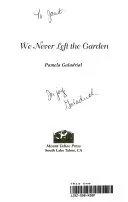
Pamela Galadrial’s "We Never Left the Garden" offers a refreshing, albeit demanding, perspective on perennial philosophy. Rather than rehashing well-trodden paths, Galadrial constructs a unique hermetic garden of thought, inviting readers to contemplate existence from a less common vantage point. The strength of the book lies in its evocative prose and its consistent refusal to simplify complex ideas into easily digestible platitudes. One particularly striking passage discusses the "shadow garden," a concept that brilliantly reinterprets the Jungian shadow not as a place of mere negativity, but as a fertile, often overlooked, aspect of the psyche. However, the book’s opacity can be a significant hurdle; its non-linear structure and dense symbolism require considerable reader effort, occasionally bordering on the arcane without sufficient grounding. While its intellectual rigor is commendable, the lack of explicit guidance for the uninitiated might alienate some. "We Never Left the Garden" is a challenging, rewarding text for the dedicated seeker, but not for the casual browser.
📝 Description
82
Pamela Galadrial's "We Never Left the Garden" was published in 1995, challenging conventional reality.
Pamela Galadrial's "We Never Left the Garden" is a collection of essays and meditations published in 1995. The book examines consciousness, myth, and the perceived separation between the ordinary and the mystical. It moves past simple storytelling to consider philosophical questions about existence and how archetypal states echo in the human mind. This work does not function as a guide but rather as a space for readers to contemplate existence and perception.
This text suits individuals involved in esoteric studies, particularly those interested in comparative mythology, depth psychology, and non-dual philosophies. Readers who prefer an evocative, poetic approach over linear arguments will find "We Never Left the Garden" appealing. It is for those who seek personal reflection and a re-evaluation of their inner world, rather than direct answers. The book speaks to readers familiar with Jungian archetypes or Gnostic themes, showing their expression in a distinct literary style.
Published in the mid-1990s, "We Never Left the Garden" emerged during a time of renewed interest in Jungian psychology and mystical thought, following the New Age movements. The intellectual environment fostered a deeper look at consciousness and myth, influenced by thinkers like Joseph Campbell and the emerging field of consciousness studies. Galadrial's writing engages with authors who bridge psychology and spirituality, yet it maintains a personal voice distinct from more academic contemporaries.
💡 Why Read This Book?
• Gain a novel perspective on the psyche's relationship with primordial states, as explored through Galadrial's "garden" metaphor, offering an alternative to conventional psychological models. • Understand the manifestation of archetypal patterns in everyday experience, moving beyond Jungian theory to Galadrial's unique interpretive framework presented in "We Never Left the Garden." • Cultivate a more integrated sense of self by examining the constructed nature of reality, a key theme illuminated by the book's exploration of memory and perception.
⭐ Reader Reviews
Honest opinions from readers who have explored this book.
❓ Frequently Asked Questions
What is the primary metaphor in 'We Never Left the Garden'?
The central metaphor is the "garden," representing a primordial state of consciousness or being that remains accessible despite the perceived separation of modern life. It signifies an inner landscape and a source of perennial wisdom.
When was 'We Never Left the Garden' first published?
Pamela Galadrial's 'We Never Left the Garden' was first published in 1995, placing it within a period of significant interest in consciousness studies and esoteric philosophy.
Does the book offer practical exercises or guidance?
While not a prescriptive manual, the book's contemplative style and philosophical inquiries encourage personal reflection and a re-evaluation of one's inner landscape. Its value lies in stimulating thought rather than providing direct instruction.
What kind of esoteric tradition does 'We Never Left the Garden' align with?
The book draws implicitly on Gnostic and Hermetic concepts, as well as Jungian psychology, exploring themes of consciousness, archetypes, and the nature of reality from a non-dualistic perspective.
Who is Pamela Galadrial?
Pamela Galadrial is the author of 'We Never Left the Garden,' a work of esoteric philosophy first published in 1995. Details about her life and other works are not widely publicized, adding to the enigmatic nature of her writings.
Is 'We Never Left the Garden' suitable for beginners in esoteric studies?
It is best suited for those with some background in comparative mythology, psychology, or esoteric traditions. The book's dense symbolism and abstract nature may present a challenge for absolute beginners.
🔮 Key Themes & Symbolism
The Primordial Garden
This theme posits an ever-present state of being, a 'garden' that exists prior to and beyond the ego's constructions of time and self. It's not a lost paradise but a foundational reality. Galadrial suggests this garden is accessed not through external journeys, but through an internal recognition of its persistent presence within consciousness. It represents a state of unity or non-duality, where the perceived separation between the individual and the cosmos is dissolved, offering a profound reorientation of perspective.
Archetypal Echoes
Galadrial explores how universal patterns, akin to Jungian archetypes, manifest within the individual psyche and collective consciousness. These are not abstract concepts but living forces that shape perception and experience. The book examines how these ancient patterns echo through personal narratives and cultural myths, providing a framework for understanding the deeper currents of human behavior and spiritual longing. Recognizing these echoes is key to understanding the 'garden' state.
Constructed Reality
A significant focus is placed on how our perceived reality is a construction, influenced by memory, language, and societal conditioning. The book challenges the solidity of the external world, suggesting it is a projection or interpretation of deeper, more fluid states of consciousness. By deconstructing these perceived boundaries, readers are invited to glimpse the underlying unity that the 'garden' symbolizes, revealing the illusory nature of mundane limitations.
The 'Shadow Garden'
This concept reinterprets the notion of the 'shadow' not as a place of mere repression or negativity, but as a vital, often neglected, aspect of the inner landscape. Galadrial suggests that this 'shadow garden' is a source of profound, untapped energy and wisdom. Engaging with it, rather than avoiding it, is crucial for a more complete understanding of the self and for accessing the deeper realities of the primordial garden.
💬 Memorable Quotes
Direct passages from the work, attributed to the author.
“The walls we perceive are merely suggestions whispered by memory.”
— This statement challenges the perceived solidity of boundaries in our lives, whether physical, psychological, or spiritual. It suggests that our limitations are often self-imposed or based on past experiences rather than inherent truths.
“To seek the garden outside is to miss the soil beneath your feet.”
— This emphasizes the internal nature of spiritual realization. The 'garden,' representing a state of deeper consciousness or truth, is not found through external searching but through an inward turning and recognition of what is already present.
“Archetypes are not relics; they are the living architecture of the soul.”
— This highlights the dynamic and essential role of archetypal patterns in shaping human experience. They are presented not as historical curiosities but as fundamental, active components of our psychological and spiritual makeup.
“The serpent in the garden is not an adversary, but a guide to deeper knowing.”
— This offers a reinterpretation of a classic symbol, suggesting that temptation or challenge can be a catalyst for useful insights and spiritual growth, rather than solely a source of downfall.
“Time is a shadow cast by the light of the eternal present.”
— This concept frames time as a secondary phenomenon, an illusion or derivative of a timeless, ever-present reality. It encourages a focus on the 'now' as the point of access to deeper truths.
🌙 Esoteric Significance
Tradition
The work draws implicitly from Gnostic and Hermetic traditions, particularly in its exploration of hidden knowledge and the nature of consciousness as a divine spark obscured by illusion. It shares with Hermeticism the idea of correspondence between the inner and outer worlds and with Gnosticism a focus on gnosis (knowledge) as liberation. However, Galadrial integrates these with a distinctly Jungian psychological framework, reinterpreting archetypal symbols through a lens of depth psychology rather than solely through classical esoteric systems.
Symbolism
The central symbol is the "garden," representing an primordial state of being or consciousness, a locus of unbroken connection. The "serpent" appears not as a purely negative force but as a symbol of transformative knowledge, akin to the Caduceus, representing the integration of opposing forces and the journey towards deeper understanding. The "walls" symbolize the perceived limitations and constructs of the ego-mind, which obscure access to the garden's reality.
Modern Relevance
Contemporary thinkers in transpersonal psychology and those exploring non-dualistic spiritualities often find resonance in Galadrial's work. Her exploration of archetypes as living forces within consciousness continues to inform discussions on myth and psychology. Practices focused on mindfulness and inner landscape exploration can benefit from her insights into constructed reality and the accessibility of deeper states of being, making "We Never Left the Garden" relevant to modern seekers of integrated consciousness.
👥 Who Should Read This Book
• Students of Jungian psychology and comparative mythology seeking to understand archetypal patterns beyond academic texts, benefiting from Galadrial's unique interpretive lens. • Individuals engaged in contemplative or non-dual spiritual practices who wish to explore the concept of an ever-present inner reality, finding practical application in her "garden" metaphor. • Readers of esoteric philosophy interested in texts that challenge conventional notions of self and reality, appreciating a work that prioritizes evocative exploration over didactic instruction.
📜 Historical Context
Pamela Galadrial's "We Never Left the Garden," published in 1995, emerged during a period of significant intellectual ferment concerning consciousness and spirituality. The mid-90s saw a continued engagement with Jungian psychology, particularly its archetypal theories, following the groundwork laid by figures like Marie-Louise von Franz. Simultaneously, the rise of the internet began to democratize access to esoteric texts and ideas, though Galadrial’s work retained a more traditional, book-bound feel. It can be seen as part of a broader, albeit less visible, current of Western esotericism that sought to synthesize psychological depth with mystical traditions, moving beyond the more overtly New Age phenomena of previous decades. While not directly engaging with academic philosophy, it resonated with the growing interest in perennial philosophy championed by scholars like Huston Smith, offering a more poetic and experiential approach to similar themes of consciousness and ultimate reality.
📔 Journal Prompts
The persistent traces of archetypes: how do they shape your daily perceptions?
Reflecting on the "walls" of perceived limitation: what suggestions does memory whisper to you?
The "soil beneath your feet": identifying the internal sources of wisdom you overlook.
Interpreting the "serpent" in your own life: what challenges offer deeper knowing?
Mapping your personal "garden": what elements represent its primordial state?
🗂️ Glossary
The Garden
A central metaphor in the book representing a primordial state of consciousness, an unbroken connection to being, or an inner range of profound truth that exists independently of the ego's constructs.
Archetypes
Universal patterns of the collective unconscious that influence human behavior and perception. Galadrial views them not as static concepts but as dynamic, living forces shaping our inner and outer worlds.
Constructed Reality
The idea that our perceived world is not an objective given but an interpretation shaped by memory, language, conditioning, and psychological filters. The book explores how to see beyond these constructions.
Shadow Garden
A reinterpretation of the psychological 'shadow,' presented not as a place of negativity but as a vital, often ignored, source of wisdom and energy within the psyche.
Memory Whispers
Refers to the subtle influence of past experiences and ingrained patterns on present perception, suggesting that our limitations are often 'whispered' by memory rather than being objective truths.
Eternal Present
A concept suggesting a timeless dimension of reality that exists beyond the linear progression of time. Accessing this state is key to understanding the 'garden'.
Soil Beneath Your Feet
A metaphor for the immediate, inherent reality or wisdom that is always present, often overlooked in the search for external spiritual answers. It emphasizes inner grounding.
This book appears in 1 collection
🔮 Readers Also Liked
Browse all →


![[ Alexander W. Dray] The Infernal Path Dark Harvest ( Occult Publishers 2012)](/img/thumb/alexander-w-dray-the-infernal-path-dark-harvest-occult-publishers-2012-alexander-w-dray.webp)






From the “Aura Cleansing” Collection
View all →








More Free Occult Philosophy Books
View all →