Poltergeist
 80
80

Poltergeist
Richardson’s *Poltergeist* offers a competent, if familiar, entry into the urban fantasy subgenre, centering on PI Harper Blaine’s post-mortem investigations. The premise of a "Greywalker"—one who straddles the veil between life and death—is intriguing, and the specific plot concerning a university's attempt to create an artificial poltergeist provides a solid hook. The narrative effectively contrasts scientific skepticism with genuine spectral disturbances. However, the pacing occasionally falters, particularly in the middle sections where the procedural elements overshadow the escalating paranormal threat. A standout aspect is the portrayal of Harper’s reluctant acceptance of her abilities, which feels grounded amidst the supernatural chaos. While the resolution of the artificial poltergeist experiment feels somewhat convenient, the novel succeeds in building a world ripe for further exploration. It’s a solid, if not revolutionary, addition to the supernatural detective canon.
📝 Description
80
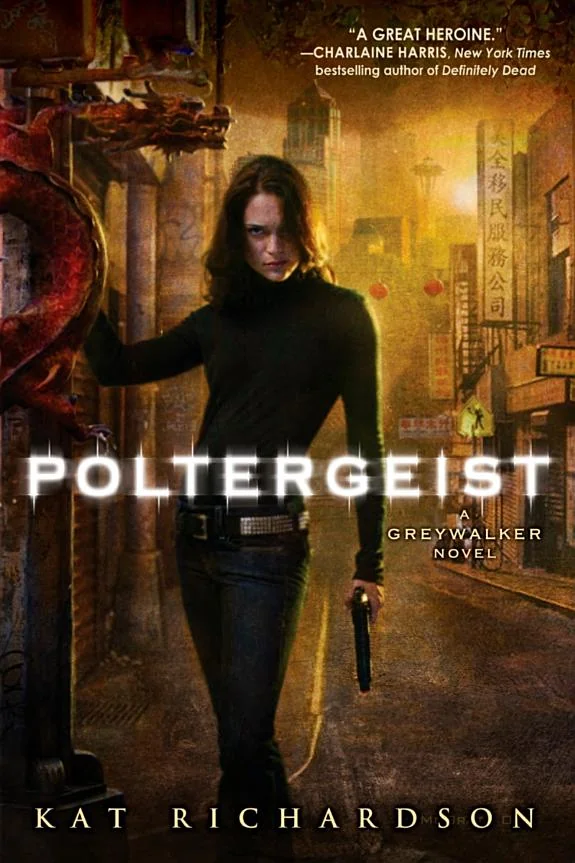
Kat Richardson's 2007 novel, Poltergeist, features a private investigator who can see ghosts.
Harper Blaine, a private investigator, gains the ability to perceive and interact with spirits after a near-death experience. This unique status as a 'Greywalker' positions her on the edge of the living and spectral worlds, leading her into unusual cases. The story focuses on a university research team trying to create a poltergeist artificially. Their scientific approach to understanding the supernatural quickly becomes entangled with real spectral activity.
As Harper investigates this case, she encounters both potential deception within the research group and the actual manifestations of a poltergeist. The novel examines the conflict between scientific methods and the irrational aspects of the supernatural. It questions the ethics of manipulating such forces and probes the true nature of the entities involved. The book establishes the foundation for Richardson's Greywalker series, detailing Harper's abilities and the world she operates in. It sets up further stories about hauntings, spectral beings, and the relationship between the physical and metaphysical.
The novel engages with concepts of mediumship and spiritualism, particularly the idea of interacting with discarnate entities. Harper's ability to perceive the spectral realm aligns with traditions that explore consciousness beyond the physical body, a common theme in occultism and parapsychology. The attempt to scientifically quantify and even generate supernatural phenomena touches upon historical and modern attempts within occult circles to understand and control spiritual forces through various means, from ritual to alleged scientific experimentation.
💡 Why Read This Book?
• Gain insight into the specific challenges of investigating phenomena that defy conventional scientific explanation, as seen through Harper Blaine’s unique "Greywalker" abilities after her 2007 near-death experience. • Understand the esoteric concept of attempting to artificially manifest or control spectral entities, a core element of the university research plotline. • Experience a narrative that directly confronts the dichotomy between empirical scientific methods and the tangible reality of the paranormal, as explored through the book's central mystery.
⭐ Reader Reviews
Honest opinions from readers who have explored this book.
❓ Frequently Asked Questions
What is a "Greywalker" in Kat Richardson's Poltergeist?
A Greywalker, as defined in Kat Richardson's 2007 novel *Poltergeist*, is a person who has died and returned, granting them the ability to perceive and interact with the paranormal realm, existing on the boundary between the living and the dead.
What is the central conflict in Kat Richardson's Poltergeist?
The central conflict involves PI Harper Blaine investigating a university research group attempting to create an artificial poltergeist, while simultaneously dealing with genuine spectral activity that complicates their experiments.
When was Kat Richardson's Poltergeist first published?
Kat Richardson's novel *Poltergeist* was first published on August 7, 2007.
Does Poltergeist by Kat Richardson involve scientific attempts to study ghosts?
Yes, the book features a university research group actively trying to create an artificial poltergeist, which serves as a significant plot point and a source of conflict and investigation for the protagonist.
What are the key themes explored in the Poltergeist novel?
Key themes include the nature of reality, the intersection of science and the supernatural, the ethics of paranormal research, and the personal journey of a protagonist coming to terms with extraordinary abilities.
Is Kat Richardson's Poltergeist part of a series?
Yes, *Poltergeist* is part of Kat Richardson's Greywalker series, featuring the protagonist Harper Blaine.
🔮 Key Themes & Symbolism
The Greywalker's Liminal State
Harper Blaine’s unique condition as a Greywalker, a result of her near-death experience, forms the crux of the narrative. This liminal state allows her to perceive and interact with the spectral plane, blurring the lines between the living and the dead. The novel explores the psychological and practical implications of this existence, where the mundane world constantly intersects with the paranormal. It’s not just about seeing ghosts, but about navigating a reality where the veil is thinner, making her uniquely suited for cases involving the unexplained.
Artificial Manifestation vs. Genuine Haunting
A core theme is the attempt by a university research group to scientifically engineer a poltergeist. This scientific hubris contrasts sharply with the genuine, often chaotic, spectral activity that begins to manifest. The book probes the ethics and potential dangers of trying to control or replicate supernatural phenomena through empirical means, questioning whether such forces can truly be manufactured or simply provoked. It highlights the inherent unpredictability and power of entities that exist beyond conventional understanding.
Science Meets the Supernatural
The novel positions itself at the intersection of rational investigation and the inherently irrational nature of the paranormal. Harper, a PI, employs investigative techniques, but her abilities transcend typical detective work. The university researchers represent the scientific approach, attempting to clarify the supernatural through experimentation. *Poltergeist* examines the limitations of purely materialist perspectives when confronted with undeniable spectral evidence, suggesting a need for broader frameworks of understanding reality.
The Investigator's Burden
Harper Blaine’s role as a private investigator is amplified by her Greywalker status. She is drawn into cases that would baffle ordinary law enforcement, often involving entities and phenomena that defy rational explanation. The book explores the personal toll this takes on her, forcing her to confront her own mortality and the constant danger inherent in her work. Her journey is one of reluctant acceptance and growing competence in a world few can comprehend.
💬 Memorable Quotes
Direct passages from the work, attributed to the author.
“Harper Blaine was your average small-time PI until she died-for two minutes.”
— This concise statement establishes the inciting incident that fundamentally alters the protagonist's reality, transitioning her from a conventional investigator to one operating within the paranormal domain.
“Now she's a Greywalker-walking the thin line between the living world and the paranormal realm.”
— This defines Harper's new, extraordinary status, emphasizing her unique position as a bridge between two distinct planes of existence, a concept central to the series' mythology.
“Her new abilities are landing her all sorts of 'strange' cases.”
— This highlights the direct consequence of Harper's near-death experience: her altered perception draws her into investigations that are far outside the scope of normal private detective work.
“A university research group that is attempting to create an artificial poltergeist.”
— This introduces the novel's primary plot driver, a scientifically ambitious and potentially dangerous endeavor that serves as the catalyst for both external conflict and Harper's deeper involvement.
“The head researcher suspects someone is fak”
— This hints at internal conflict and potential deception within the research group, suggesting that human machinations may be as dangerous, or even more so, than the supernatural phenomena they seek to study.
🌙 Esoteric Significance
Tradition
While not explicitly tied to a single historical esoteric lineage, *Poltergeist* draws heavily from Western occult traditions concerning spirits, hauntings, and the nature of the afterlife, particularly as popularized in 19th and 20th-century spiritualism and modern paranormal investigation. It functions within the broader spectrum of contemporary esoteric fiction that often incorporates elements of mediumship, astral projection, and the interaction between physical and non-physical realms without strict adherence to a singular doctrine.
Symbolism
The concept of the "Greywalker" itself functions as a potent symbol of liminality—the threshold between life and death, the known and the unknown. The "artificial poltergeist" symbolizes humanity's often-fraught attempt to control or rationalize forces that may be beyond comprehension or manipulation, reflecting a modern hubris. The university setting, a bastion of empirical knowledge, becomes a stage where the unexplained intrudes, symbolizing the limits of rationalism when confronted by the numinous.
Modern Relevance
Contemporary thinkers and practitioners interested in mediumship, ghost hunting, and the intersection of consciousness studies with paranormal phenomena can find resonance in *Poltergeist*. The novel's exploration of a protagonist who navigates spectral dimensions aligns with modern interests in altered states of consciousness and the potential for interaction with non-corporeal entities. It speaks to a continued cultural fascination with the boundaries of reality and the possibility of interacting with unseen forces, often explored in contemporary esoteric circles and paranormal investigation communities.
👥 Who Should Read This Book
• Fans of urban fantasy who appreciate a strong mystery element woven into supernatural narratives, particularly those intrigued by protagonists with unique abilities. • Readers interested in exploring the concept of "thin places" or dimensional boundaries within fictional contexts, examining how characters cope with altered perceptions of reality. • Individuals curious about the fictional portrayal of scientific attempts to study or replicate paranormal phenomena, and the ethical questions that arise from such endeavors.
📜 Historical Context
Published in 2007, Kat Richardson's *Poltergeist* emerged during a period of significant popular interest in urban fantasy and paranormal investigation narratives. This era saw authors like Jim Butcher (The Dresden Files, beginning 2000) and Charlaine Harris (The Southern Vampire Mysteries, beginning 2001) achieving mainstream success, often blending detective tropes with supernatural elements. Richardson’s work fit within this burgeoning market, offering a female protagonist navigating a world of ghosts and spectral energies. The novel’s premise, exploring scientific attempts to replicate paranormal events, touches upon ongoing debates in parapsychology and the occult, a field historically influenced by societies like the Society for Psychical Research (founded 1882) which sought empirical evidence for the supernatural. While not directly engaging with specific academic critiques of the time, the book implicitly challenges purely materialistic worldviews prevalent in certain intellectual circles, offering a narrative where the metaphysical is empirically verifiable through Harper’s unique perspective.
📔 Journal Prompts
Harper Blaine's "Greywalker" state and its implications for perceiving reality.
The ethical considerations of attempting to artificially create a poltergeist.
Reflecting on the boundary between scientific explanation and paranormal phenomena.
The personal burden of navigating between the living and spectral realms.
Investigative methods employed when dealing with non-corporeal entities.
🗂️ Glossary
Greywalker
A term coined by Kat Richardson, referring to an individual who has experienced a near-death event and can now perceive and interact with the paranormal realm, existing on the threshold between the living and the dead.
Poltergeist
A type of ghost or supernatural entity whose physical interactions with the world are often characterized by movement of objects, noises, and physical disturbances, typically attributed to a specific person or location.
Liminal
Relating to a transitional or initial stage of a process, or occupying a position at, or on both sides of, a boundary or threshold. In this context, it refers to Harper's existence between the living and spectral worlds.
Artificial Poltergeist
A fictional concept within the novel where researchers attempt to scientifically create or manifest the phenomena associated with a poltergeist through experimental means.
Paranormal Realm
A dimension or plane of existence separate from the physical world, inhabited by spirits, ghosts, and other entities, accessible to those with specific sensitivities or abilities like a Greywalker.
Near-Death Experience (NDE)
A profound personal experience associated with death or dying, often involving altered states of consciousness, perceptions of light, and encounters with spiritual entities. In the novel, it is the catalyst for Harper's Greywalker abilities.
Empirical Methods
A method of gaining knowledge based on observable and measurable evidence, relying on experimentation and observation rather than theory or belief alone. This is the approach the university researchers attempt to apply to the paranormal.
This book appears in 1 collection
🔮 Readers Also Liked
Browse all →








From the “Poltergeist” Collection
View all →








More Free Occult Philosophy Books
View all →