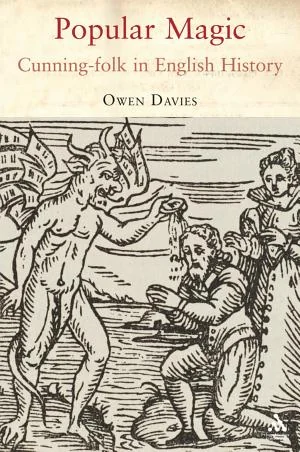
Popular Magic: Cunning-folk in English History
 74
74

Popular Magic: Cunning-folk in English History
Owen Davies's *Popular Magic* offers a compelling corrective to the historical narrative of magic, shifting focus from sensational witch trials and esoteric grimoires to the pragmatic services of cunning-folk. The book's strength lies in its exhaustive research, drawing on court records, personal testimonies, and folklore collections to paint a vivid picture of these local practitioners. Davies effectively argues that cunning-folk were more representative of magical engagement for most people than any other group. A minor limitation might be the sheer density of case studies, which, while informative, can occasionally feel repetitive without a more pronounced thematic thread tying them together. However, the section detailing how cunning-folk adapted their practices in response to growing scientific understanding and changing social structures, particularly in the 19th century, is exceptionally insightful. This is a foundational text for understanding the lived experience of magic in English history.
📝 Description
74
Owen Davies's 2007 book details the history of English cunning-folk, local magical practitioners serving ordinary people.
Popular Magic: Cunning-folk in English History, published in 2007, examines the history of local magical practitioners in England. These cunning-folk differed from elite occultists by offering practical solutions to everyday problems for common people. Their services, which included healing, finding lost objects, assisting with love matters, and ensuring good harvests, were a significant part of community life over many centuries. Owen Davies reconstructs their world, addressing both academic neglect and public misunderstandings.
The book places cunning-folk within the larger scope of English history, from the medieval period to the early 20th century. It contrasts their accessible, community-focused magic with the more intellectual and sometimes feared practices of ceremonial magicians, astrologers, and witches. Davies highlights the social and economic conditions that made such practitioners necessary, particularly before widespread literacy, formal education, and the development of modern science and social welfare systems. Their persistence into the modern era, often operating discreetly, is a primary focus.
This book situates 'popular magic' as distinct from learned or ceremonial occultism. It focuses on magic as a functional, everyday practice embedded in community life, often passed down through tradition. Davies contrasts this with the intellectual pursuits of figures like ceremonial magicians and astrologers, illuminating a less studied aspect of esoteric history that directly impacted the lives of ordinary people.
💡 Why Read This Book?
• Learn about the specific services offered by cunning-folk, such as finding lost property or diagnosing ailments using methods described in Chapter 3, providing concrete examples of practical magic that are distinct from theoretical occultism. • Understand the social and economic necessity for cunning-folk in communities before the widespread availability of modern medicine and insurance, as explored in the book's analysis of the 18th century. • Discover how cunning-folk navigated suspicion and persecution, often integrating their practices with Christian beliefs, a nuanced perspective detailed in the discussions on folk religion.
⭐ Reader Reviews
Honest opinions from readers who have explored this book.
❓ Frequently Asked Questions
Who were the 'cunning-folk' described in Owen Davies's book?
Cunning-folk were local practitioners of magic in English history who offered practical services to their communities. Unlike elite magicians or accused witches, they focused on everyday problems like healing, finding lost items, and resolving disputes, acting as essential community figures.
What is the difference between cunning-folk and witches in historical context?
Davies distinguishes cunning-folk by their role as service providers, often seen as helpful, whereas accused witches were typically portrayed as malevolent figures who harmed others through dark magic, a contrast frequently explored in the book's analysis of legal records.
What time period does 'Popular Magic' cover?
The book covers a broad span of English history, examining cunning-folk from the medieval period through to the early 20th century. Davies provides specific examples from centuries like the 17th and 18th to illustrate evolving practices.
What kind of problems did cunning-folk help with?
Cunning-folk addressed a wide range of everyday issues. These included healing the sick, locating stolen or lost property, offering charms for love or protection, and assisting with agricultural matters like ensuring good harvests, as documented in various case studies.
How did cunning-folk interact with established religion?
Davies shows that cunning-folk often integrated their practices with Christianity, using prayers, blessings, and sacred objects alongside folk remedies. This often allowed them to operate with a degree of acceptance, though they could still face suspicion.
Is this book about ceremonial magic or occultism?
No, *Popular Magic* specifically focuses on 'popular magic' as practiced by local healers and charmers, distinguishing them from the more scholarly or arcane traditions of ceremonial magic, astrology, or necromancy discussed in the introduction.
🔮 Key Themes & Symbolism
The Cunning-Folk as Service Providers
Davies emphasizes that cunning-folk were defined by the services they offered to their communities, distinguishing them sharply from figures associated with malevolent witchcraft or esoteric scholarship. These services were practical, addressing immediate needs like healing, finding lost objects, or securing good fortune. The book details numerous instances, drawn from court records and oral histories, where individuals sought out cunning-folk for remedies and solutions to mundane yet pressing problems, illustrating magic's role as a functional social utility before modern institutions.
Magic as Social Necessity
A central argument is that the prevalence of cunning-folk stemmed from a societal need for their skills in an era lacking modern scientific understanding, formal healthcare, or social safety nets. In worlds rife with uncertainty – from illness and crop failure to theft and personal misfortune – these practitioners offered tangible hope and intervention. Davies explores how their practices filled a crucial gap, acting as an informal social security system and a means of managing the unpredictable aspects of life across centuries.
Interaction with Official Structures
The work meticulously examines how cunning-folk navigated their relationship with established religious and legal authorities. While often operating outside official channels, their practices were frequently blended with Christian prayers and rituals, enabling a degree of coexistence. Davies analyzes instances where cunning-folk were prosecuted, but also highlights cases where their community standing protected them, revealing a complex dynamic between folk practice and the dominant social order throughout English history.
Distinguishing Popular from Elite Magic
Davies makes a clear demarcation between the magic practiced by cunning-folk and the more theoretical or ceremonial magic pursued by scholars, astrologers, and alchemists. Popular magic was accessible, empirical, and community-oriented, relying on charms, herbs, and practical knowledge. This distinction is vital for understanding the true field of magical belief and practice among the general populace, moving beyond sensationalized accounts of witchcraft or the esoteric pursuits of a learned few.
💬 Memorable Quotes
Direct passages from the work, attributed to the author.
“The cunning-man or woman was a figure of considerable importance in the community, providing a valued service to local people.”
— This statement expresses the book's core thesis: that local magic practitioners were integral to community life, offering essential services that were widely sought after and valued by ordinary people, contrary to their historical neglect.
“These practitioners were far more representative of magical practice than the arcane delvings of astrologers and necromancers.”
— Davies uses this to position cunning-folk as the true face of historical magic for the majority, contrasting their everyday problem-solving with the esoteric or academic pursuits of elite occultists, arguing for a broader understanding of magical engagement.
“Mostly unsensational in their approach, cunning-folk helped people with everyday problems.”
— This highlights the pragmatic and low-key nature of cunning-folk's work, emphasizing their role in addressing common human concerns rather than engaging in dramatic or feared magical acts, which is central to their historical representation.
“In a world of uncertainty, before insurance and modern science, cunning-folk played an important role that has previously been ignored.”
— This interpretation underscores the social function of cunning-folk as providers of security and solutions in pre-modern societies. It frames their importance within specific historical conditions and calls attention to their overlooked contribution to social history.
“The cunning-folk's legacy lies in their practical engagement with the challenges of life.”
— This suggests that the true significance of cunning-folk is not in abstract theory but in their tangible actions and the real-world assistance they provided to individuals and communities facing adversity, a key takeaway from Davies's research.
🌙 Esoteric Significance
Tradition
This work doesn't strictly align with a single esoteric lineage like Hermeticism or Kabbalah. Instead, it grounds esoteric practice in the lived reality of folk tradition and communal necessity. It represents a departure from the intellectualized, text-based Western Esoteric Tradition by focusing on empirically derived, orally transmitted magical knowledge and its practical application within social structures, suggesting a parallel, often unrecognized, stream of magical engagement.
Symbolism
While not overtly symbolic in the manner of high ceremonial magic, the cunning-folk's practices often involved potent folk symbols. These could include the use of specific herbs like rosemary for protection or purification, the significance of found objects (like 'hag stones' with natural holes) for warding off evil, or the power attributed to written charms and sigils. These elements, though seemingly simple, carried deep cultural resonance and were believed to channel specific energies for healing, luck, or defense.
Modern Relevance
Contemporary movements in folk witchcraft, traditional witchcraft, and certain forms of modern paganism draw heavily on the historical models presented in Davies's book. Thinkers and practitioners interested in reclaiming pre-Christian or non-institutionalized spiritual practices find in the cunning-folk a model for community-based, nature-attuned magic. The emphasis on practical, everyday magic and healing appeals to modern desires for accessible, earth-based spirituality and alternative wellness approaches.
👥 Who Should Read This Book
• Students of social history and folklore seeking to understand the everyday lives and beliefs of past communities, particularly in England, will gain a nuanced perspective on popular magical practices. • Practitioners of modern folk magic, traditional witchcraft, or nature-based spirituality can learn from the historical examples of cunning-folk, understanding the roots and practical applications of these traditions. • Researchers of religious studies and anthropology interested in the intersection of magic, religion, and social structure will find extensive case studies and analysis of how magical belief functioned within communities.
📜 Historical Context
Owen Davies's *Popular Magic* emerged in the early 21st century, a period marked by growing academic interest in social history, folklore, and the lived experiences of ordinary people. It directly challenged the long-standing scholarly focus on witch trials and elite occultism, which had largely marginalized the study of everyday magical practices. Davies situated his work within the tradition of social historians examining popular belief, but specifically carved out the role of the cunning-folk, a figure often conflated with witches or dismissed as mere superstition. His research, drawing extensively from archives and folk collections, provided a robust empirical counterpoint to earlier, more speculative accounts. While contemporaries like Richard Kieckhefer had explored European witchcraft, Davies focused on the specific English context and the more common, often less overtly threatening, figure of the cunning-man or woman, demonstrating their continued presence well into the 19th century, a period when scientific rationalism was supposedly ascendant.
📔 Journal Prompts
The role of cunning-folk as service providers.
Community reliance on magic before modern science.
The integration of cunning-folk practices with Christianity.
Distinguishing popular magic from elite occultism.
The evolution of cunning-folk practices through the 19th century.
🗂️ Glossary
Cunning-folk
Local practitioners of magic in English history, distinct from witches or elite magicians, who offered practical services like healing, finding lost items, and fortune-telling to their communities.
Popular Magic
Magic understood and practiced by the general populace, often through inherited traditions, practical knowledge, and empirical methods, as opposed to theoretical or ceremonial occultism.
Witchcraft
In historical context, often associated with malevolent magic, pacts with the devil, and harm to others, leading to accusations and prosecutions, distinct from the service-oriented role of cunning-folk.
Charms
Objects or words believed to possess magical power, used by cunning-folk for protection, healing, luck, or other beneficial purposes.
Folk Remedies
Traditional healing practices, often using herbs and natural substances, frequently employed by cunning-folk alongside or as part of their magical services.
Divination
The practice of seeking knowledge of the future or the unknown by supernatural means, a service sometimes offered by cunning-folk to clients.
Sorcerer
A broad term historically used for individuals practicing magic, often with negative connotations, but sometimes encompassing figures like cunning-folk depending on context and social perception.
This book appears in 1 collection
🔮 Readers Also Liked
Browse all →








From the “Witchcraft” Collection
View all →







More Free Occult Philosophy Books
View all →