Plotinus
 71
71

Plotinus
Gerson’s examination of Plotinus offers a commendable clarity, particularly in its explication of the difficult doctrine of emanation. The author successfully demystifies the flow from the One through Intellect and Soul, a cornerstone of Neoplatonism. However, the text occasionally feels overly academic, sometimes sacrificing the experiential dimension that Plotinus himself emphasized. For instance, the discussion of the soul’s ascent, while philosophically sound, could benefit from more direct engagement with the mystical union Plotinus described. The strength lies in its systematic philosophical reconstruction. A limitation is the sometimes-dry presentation of deeply spiritual concepts. Overall, Gerson provides a solid, if not entirely vibrant, introduction to Plotinus’s system.
📝 Description
71
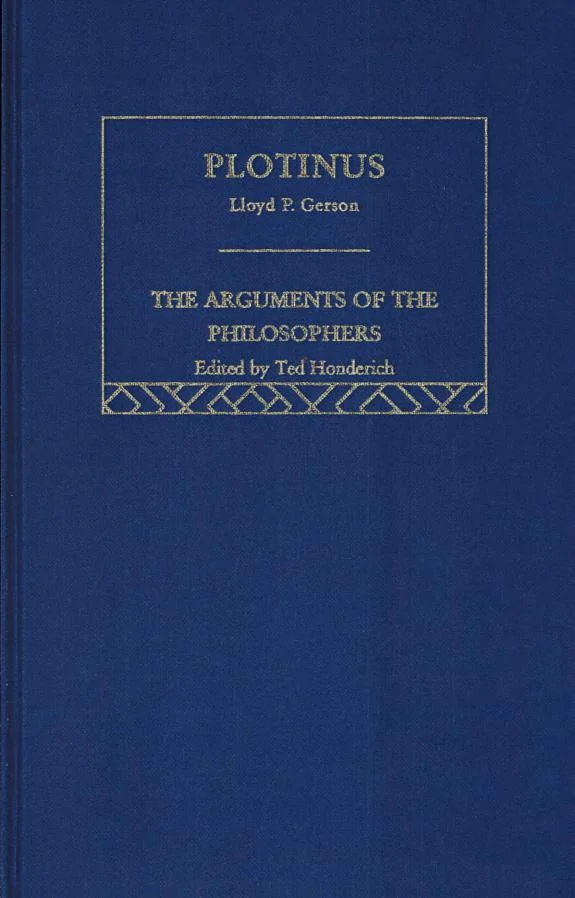
Lloyd P. Gerson's 1999 study presents Plotinus's metaphysical system for modern readers.
This volume by Lloyd P. Gerson examines the philosophy of Plotinus, the key figure in Neoplatonism. First published in 1999, the book offers an introduction to Plotinus's complex thought for those new to his ideas. Gerson carefully explains Plotinus's main doctrines, making clear concepts that have had a lasting impact on Western philosophy.
The book is intended for readers interested in ancient philosophy, comparative religion, and esoteric thought. It aims to provide a clear yet detailed account of Plotinus's philosophy, going beyond surface-level interpretations. Students of ancient thought, as well as practitioners of traditions like Hermeticism and Gnosticism, will find this work a useful guide.
Gerson places Plotinus in his historical setting, the 3rd century CE Roman Empire, a time of intellectual activity. Plotinus drew on Plato, Stoicism, and Aristotle to build his system, which later influenced Christian, Jewish, and Islamic mysticism. Gerson details Plotinus's connections to earlier schools and the intellectual environment of his era.
Plotinus's philosophy represents a crucial development in late antique thought, bridging classical Greek philosophy with later mystical traditions. His system, centered on the ineffable One from which all reality emanates, became a cornerstone for various esoteric paths. Concepts like the soul's journey back to its divine source resonated deeply within Hermeticism, Gnosticism, and later Sufism and Kabbalah. Gerson's work helps situate these influential ideas within their original philosophical context, showing how Plotinus's metaphysics provided a framework for understanding spiritual experience and the structure of the cosmos.
💡 Why Read This Book?
• Understand the concept of 'emanation' as described by Plotinus, a foundational idea in many esoteric traditions, by examining its philosophical underpinnings as laid out in Gerson's analysis. • Grasp the Neoplatonic triad of the One, Intellect (Nous), and Soul, clarifying their interrelationship and significance in Plotinus's metaphysics, a key subject in the book's early chapters. • Appreciate the historical milieu of 3rd century CE Rome and its influence on Plotinus's thought, providing concrete context to his philosophical innovations that Gerson details.
⭐ Reader Reviews
Honest opinions from readers who have explored this book.
❓ Frequently Asked Questions
What is Plotinus's concept of 'the One'?
Plotinus's 'One' is an ineffable, transcendent source of all reality, beyond existence and thought. It is the ultimate principle from which all else emanates, a concept central to Neoplatonism and explored extensively in Gerson's work.
How does Plotinus describe the soul's journey?
Plotinus posits that the soul, originating from the divine Intellect, can descend into the material world but ultimately seeks to ascend back to its source. This journey involves purification and contemplation, as detailed by Gerson.
What is Neoplatonism and how does Plotinus fit in?
Neoplatonism is a philosophical system that developed from Plato's teachings, with Plotinus (c. 204/5 – 270 CE) considered its founder. It synthesizes Platonic thought with other traditions, forming a comprehensive metaphysical and ethical framework.
When was Plotinus alive and active?
Plotinus was active in the 3rd century CE. He taught in Rome from around 245 CE until his death, influencing many students and shaping the direction of late antique philosophy.
Who was Porphyry in relation to Plotinus?
Porphyry was Plotinus's most famous student and editor. He compiled and organized Plotinus's writings into the Enneads, the primary source text for Plotinus's philosophy, a crucial detail in understanding Plotinus's legacy.
What is the concept of 'Intellect' (Nous) in Plotinus's philosophy?
In Plotinus's system, Intellect (Nous) is the second hypostasis emanating from the One. It contains the Platonic Forms and is the realm of pure thought and being, a key concept explained in the book.
🔮 Key Themes & Symbolism
The Triad of the One, Intellect, and Soul
This work meticulously dissects Plotinus's foundational metaphysical structure: the ineffable One, the divine Intellect (Nous) containing all Forms, and the Soul, which bridges the spiritual and material realms. Gerson clarifies how these hypostases are not separate entities but successive emanations from the ultimate source. Understanding this triad is crucial for grasping Plotinus's cosmology and his explanation for the existence and diversity of the universe, moving from absolute unity to multiplicity.
Emanation and the Nature of Reality
A central theme is Plotinus's doctrine of emanation, where reality unfolds from the One without diminishing it. Gerson explains this process, illustrating how all existence flows necessarily from the divine principle, creating a hierarchical cosmos. This concept challenges notions of a creator god separate from creation, offering instead a model of continuous divine outflow that underpins much of later Neoplatonic and esoteric thought, particularly concerning the relationship between the spiritual and material.
The Soul's Descent and Ascent
The book examines Plotinus's understanding of the human soul, its divine origin in Intellect, its temporary descent into the material world, and its potential for spiritual ascent. Gerson explores the ethical and psychological implications of this journey, detailing how through philosophy and virtue, the soul can purify itself and return to its source. This theme is vital for understanding Plotinus's practical philosophy and its enduring appeal in mystical traditions.
The Ineffable One
Central to Plotinus's philosophy is the concept of the One, a principle so utterly transcendent that it defies all predication and description. Gerson navigates the philosophical challenges of discussing the ultimate reality, emphasizing that the One is beyond being, intellect, and even thought. This absolute simplicity is the source of all complexity and the ultimate goal of spiritual seeking, a concept that profoundly influenced mystical theology across various religions.
💬 Memorable Quotes
Direct passages from the work, attributed to the author.
“The One is not anything; it is not mind, nor truth, nor life, nor anything else that we can name.”
— This highlights Plotinus's radical apophaticism concerning the ultimate principle. It asserts that the One transcends all categories of being and thought, challenging conventional philosophical and theological approaches to divinity.
“Every soul is an offshoot of the divine.”
— This interpretation underscores the inherent divinity of the human soul, positing its origin not in the material world but in the higher spiritual realms, specifically Intellect (Nous).
“The soul's return is a journey upward.”
— This conveys the core of Plotinus's ethical and spiritual teaching: the soul's purpose is to move away from the material and towards its divine source through philosophical practice and purification.
“Beauty comes from the intelligible realm.”
— This links aesthetic experience to the higher metaphysical realities, suggesting that true beauty is not merely sensory but a reflection of the Forms and the divine order.
“We must not be surprised if the soul, when it leaves the body, is like the soul that has never been in the body.”
— This suggests that the purification process allows the soul to shed its material attachments, revealing its true, incorporeal nature that was always present, albeit obscured.
🌙 Esoteric Significance
Tradition
Plotinus is the foundational figure of Neoplatonism, a philosophical tradition that became a central to Western esotericism. His system provided a metaphysical scaffolding for later Hermetic, Gnostic, and Kabbalistic thought, as well as influencing Christian mysticism. While distinct from the magical practices sometimes associated with Hermeticism, Plotinus's emphasis on ascent to the divine and the hierarchical structure of reality offered a profound philosophical basis for contemplative and spiritual disciplines.
Symbolism
Key symbols in Plotinus include the One, representing absolute unity and the source of all; Intellect (Nous), often symbolized by the area of Forms and pure thought; and the Soul, which can be depicted as a divine spark or a weaver, connecting the higher realms to the material. The concept of 'emanation' itself functions symbolically, illustrating a divine outflow rather than a mechanistic creation, a motif found in various creation myths and esoteric cosmologies.
Modern Relevance
Contemporary thinkers and practitioners in fields ranging from comparative philosophy to depth psychology still draw upon Plotinus. His ideas on consciousness, the nature of the self, and the pursuit of higher realities inform modern spiritual movements and contemplative practices. Philosophers like Pierre Hadot have explored his influence on the concept of philosophy as a way of life, while artists and writers continue to engage with his cosmology and mystical insights.
👥 Who Should Read This Book
• Advanced students of Western Esotericism seeking to understand the philosophical roots of traditions like Hermeticism and Gnosticism, gaining insight into the metaphysical underpinnings of their practices. • Philosophy undergraduates and graduates specializing in ancient or medieval thought, who require a detailed academic exposition of Plotinus's complex system beyond introductory texts. • Contemplative practitioners and spiritual seekers interested in the philosophical articulation of mystical ascent and the nature of ultimate reality, looking for a rigorous framework to deepen their understanding.
📜 Historical Context
Plotinus (c. 204/5 – 270 CE) developed his philosophy during a period of intense spiritual and intellectual searching in the Roman Empire. His work, compiled posthumously by his student Porphyry in the *Enneads*, synthesized Platonic ideas with Stoic and Aristotelian elements, creating Neoplatonism. This system emerged amidst a landscape populated by Gnosticism and various mystery cults, offering a sophisticated philosophical framework that sought to explain the origin of evil and the path to salvation. Plotinus's teachings directly influenced figures like Porphyry, who in turn impacted later Christian thinkers such as Augustine of Hippo and Marius Victorinus. The intellectual currents of the time, marked by a decline in traditional Roman religion and a rise in personal salvific paths, provided fertile ground for Plotinus's complex metaphysical and ethical system, which offered a coherent vision of reality and the soul's place within it.
📔 Journal Prompts
The nature of the One as beyond predication.
The soul's perceived descent into the material world.
The relationship between beauty and the intelligible realm.
The process of purification for the soul's ascent.
The concept of Intellect (Nous) as the container of Forms.
🗂️ Glossary
The One
Plotinus's term for the ultimate, transcendent, and ineffable source of all reality, which is beyond existence and thought. It is the absolute simplicity from which all multiplicity emanates.
Intellect (Nous)
The second hypostasis in Plotinus's system, emanating from the One. It is the area of pure thought and contains all the Platonic Forms, serving as the intelligible model for the Soul.
Soul
The third hypostasis, emanating from Intellect. It bridges the spiritual and material worlds, animating individual beings and possessing the capacity for both descent into matter and ascent back to Intellect.
Emanation
The process by which reality flows or proceeds from the One without diminishing it. It describes a hierarchical unfolding of existence from a single source, a key concept in Neoplatonism.
Hypostasis
A fundamental reality or principle, often used in Neoplatonism to denote the distinct levels of being (the One, Intellect, Soul) that constitute the structure of reality.
Forms
The eternal, unchanging archetypes or essences of things, residing within the area of Intellect (Nous). Plotinus reinterprets Plato's Forms as immanent within divine Intellect.
Apophatic Theology
A theological approach that describes God or the ultimate reality by negation – stating what it is not, rather than what it is, due to its transcendent nature. Plotinus heavily utilizes this approach for the One.
This book appears in 1 collection
🔮 Readers Also Liked
Browse all →








From the “Neoplatonism” Collection
View all →








More Free Occult Philosophy Books
View all →