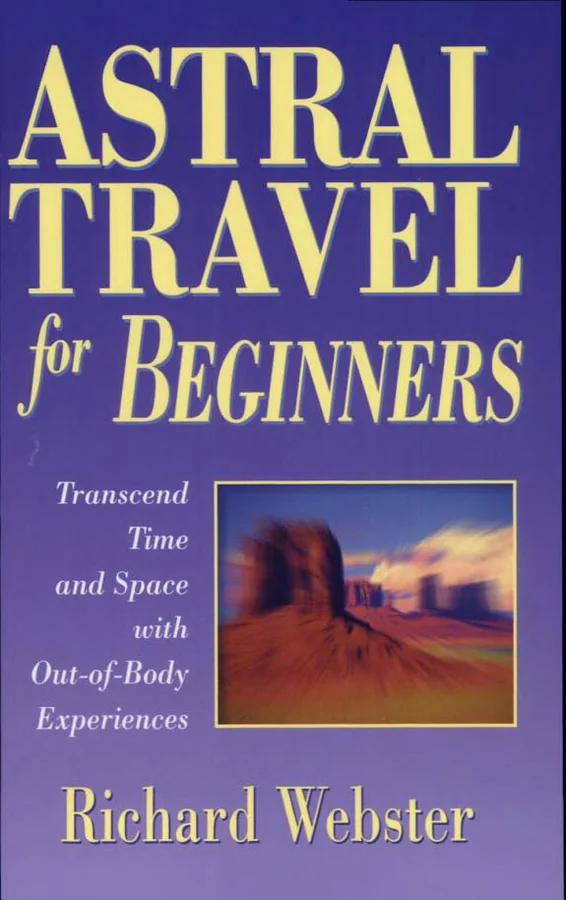
Astral Travel for Beginners
 74
74

Astral Travel for Beginners
Richard Webster’s Astral Travel for Beginners offers a refreshingly direct path for those curious about leaving the body. Its strength lies in the methodical, almost pedagogical, progression of exercises, which genuinely feel graded. Unlike many texts that promise instant results, Webster builds the reader's confidence and capability incrementally. A notable passage details the importance of ‘anchoring’ oneself mentally before attempting projection, a practical tip often overlooked. However, the book’s primary limitation is its occasional lack of depth regarding the philosophical implications or the broader spiritual context of OBEs. It focuses heavily on the ‘how-to,’ sometimes at the expense of the ‘why.’ For the uninitiated seeking a functional guide, it’s a solid, if somewhat utilitarian, introduction to the practice.
📝 Description
74
Richard Webster's 1998 guide, Astral Travel for Beginners, details a structured method for out-of-body experiences.
This book serves as a practical manual for individuals new to astral projection. Webster structures the content as a series of exercises designed to build skills for initiating and controlling out-of-body experiences (OBEs). He aims to make the subject accessible by breaking down the process into manageable steps. The core approach emphasizes gradual progression, starting with relaxation techniques and moving toward methods for astral projection.
Astral Travel for Beginners is written for those interested in exploring consciousness beyond the physical body. It offers a systematic introduction to astral projection, appealing to readers curious about OBEs, lucid dreaming, and altered states of awareness. Those who prefer a clear, instructional format and commit to regular practice will find it useful. Readers who found other books on the topic too theoretical may appreciate Webster's step-by-step method.
Published in 1998, Astral Travel for Beginners arrived during a period of increased public interest in New Age spirituality. It follows earlier works by authors like Robert Monroe and Sylvan Muldoon who codified OBE techniques. Webster's book continues this tradition by offering a simplified manual for a wider audience. It reflects a trend in esoteric literature to make complex spiritual phenomena more approachable, contrasting with denser academic studies.
💡 Why Read This Book?
• Gain practical, graded exercises for initiating out-of-body experiences, building confidence from simple relaxation to actual projection, as detailed in the book's step-by-step structure. • Learn specific techniques for mental focus and visualization, crucial for guiding your astral form and controlling the experience, as outlined by Webster. • Understand the foundational concepts of the astral body and safe transition practices, ensuring a controlled and comprehensible introduction to astral projection.
⭐ Reader Reviews
Honest opinions from readers who have explored this book.
❓ Frequently Asked Questions
Is Astral Travel for Beginners suitable for someone with no prior experience in meditation?
Yes, the book is designed for absolute beginners. It begins with fundamental relaxation and visualization techniques that serve as a precursor to meditation, making the concepts accessible even without prior practice.
How does Richard Webster's approach differ from other astral projection books?
Webster's method is characterized by its carefully graded exercises, moving step-by-step from simple techniques to actual out-of-body experiences, offering a structured learning curve.
What is the 'astral body' as described in the book?
The book likely describes the astral body as a subtle, non-physical form or vehicle that can separate from the physical body and travel independently during an out-of-body experience.
Does the book offer guidance on safety during astral travel?
Yes, a key aspect of beginner guides like this is ensuring the practitioner learns how to maintain awareness and safely return to the physical body after an out-of-body experience.
When was Astral Travel for Beginners first published?
The book was first published in 1998, reflecting the interest in esoteric and New Age topics during that era.
Can these exercises help with lucid dreaming?
While focused on astral travel, the techniques involving heightened awareness, visualization, and dream-like states often have a positive crossover effect, potentially enhancing lucid dreaming abilities.
🔮 Key Themes & Symbolism
Graded Exercise Methodology
Webster's primary contribution in Astral Travel for Beginners is its structured, progressive approach to out-of-body experiences. The book avoids overwhelming novices by presenting exercises in a deliberate sequence, starting with foundational practices like deep relaxation and focused visualization. Each subsequent exercise builds upon the skills developed previously, creating a scaffolding for the practitioner. This method aims to clarify astral projection, transforming it from an elusive phenomenon into a learnable skill, accessible through diligent practice and adherence to the outlined steps.
The Astral Body
Central to the practice of astral travel is the concept of the astral body, often referred to as the subtle body or etheric double. This work likely explains the astral body as a non-physical counterpart to our physical form, capable of independent movement and perception. Understanding its nature and how to consciously inhabit and direct it is crucial for successful out-of-body experiences. Webster guides readers in recognizing and eventually separating from their physical form, utilizing this energetic vehicle for exploration.
Consciousness and Awareness
A recurring theme is the cultivation and management of consciousness during the transition into and out of the astral state. The book emphasizes maintaining awareness, even as the physical body falls asleep or enters a relaxed state. This heightened consciousness is key to having a controlled and conscious out-of-body experience, rather than an accidental or confusing one. Techniques for anchoring one's focus and intention are vital components of this theme, ensuring the practitioner remains the active director of their astral journeys.
Practical Application of Esotericism
This book represents a practical application of esoteric principles for personal exploration. It moves beyond theoretical discussions common in some occult traditions, focusing instead on actionable techniques that readers can implement immediately. The goal is not just intellectual understanding but direct experiential knowledge of phenomena often considered paranormal or spiritual. By providing a clear manual, Webster makes the esoteric practice of astral projection tangible and achievable for a wider audience.
💬 Memorable Quotes
Direct passages from the work, attributed to the author.
“Exercises are carefully graded to take readers step-by-step through an actual out-of-body experience.”
— This expresses the book's core pedagogical strategy. It signals that the author has intentionally designed a learning path, moving from basic skills to complex maneuvers, ensuring a manageable progression for newcomers to astral projection.
“The importance of deep relaxation before attempting astral projection.”
— This highlights a foundational prerequisite for out-of-body work.Webster stresses that a calm, relaxed physical and mental state is essential for the subtle body to separate effectively, preventing interference from physical tension or mental chatter.
“Developing focused intention for guiding the astral body.”
— This points to the active role of the practitioner's will. It suggests that once separated, the astral form is directed by the focused intention and mental visualization of the traveler, rather than being passively carried.
“Safely returning to the physical body after an OBE.”
— This addresses a common concern for beginners. The quote implies that the book includes guidance on ensuring a smooth and conscious re-integration with the physical form, promoting a sense of control and security.
“Understanding the nature of the astral body.”
— This indicates the book provides conceptual framework. Readers are expected to grasp what the astral body is and how it functions as the vehicle for experiences beyond the physical realm.
🌙 Esoteric Significance
Tradition
This work falls within the broad umbrella of Western Esotericism, specifically drawing from traditions focused on consciousness exploration and subtle body practices. While not explicitly tied to a single lineage like Kabbalah or Gnosticism, it reflects the practical, experiential emphasis found in Hermeticism and modern occultism, particularly the focus on developing inner faculties for non-physical perception. It departs from more ritualistic or philosophical approaches by offering a direct, 'how-to' manual for achieving specific states of consciousness.
Symbolism
The primary 'symbol' in this context is the concept of the 'astral body' itself – a representation of the non-physical self capable of independent travel. Another implicit symbol is the act of 'separation' from the physical form, symbolizing liberation from material limitations. The exercises likely employ visualization, using imagined landscapes or guiding lights as symbolic anchors to maintain focus and direction during the astral journey.
Modern Relevance
Webster's approach continues to be relevant for contemporary practitioners of lucid dreaming and consciousness exploration. Its accessible methodology is often cited by individuals seeking practical entry points into OBEs. Modern online communities and forums discussing astral projection frequently reference beginner-friendly guides like this one, indicating its enduring appeal for those exploring consciousness outside established spiritual or scientific paradigms.
👥 Who Should Read This Book
• Novice explorers of consciousness interested in verifiable techniques for out-of-body experiences, seeking a structured guide rather than theoretical discourse. • Individuals curious about the nature of the subtle body and its potential for non-physical travel, wanting practical exercises to test these concepts. • Aspiring practitioners of meditation or relaxation techniques who wish to expand their practice into direct experiential exploration of altered states.
📜 Historical Context
Richard Webster's Astral Travel for Beginners, published in 1998, arrived during a fertile period for accessible New Age and esoteric literature. Following the groundbreaking work of figures like Robert Monroe, whose early books explored OBEs from the 1970s onwards, there was a demand for practical, user-friendly guides. Webster's contribution fits within this wave, aiming to clarify astral projection for a general audience. This era saw a proliferation of self-help and spiritual development books, often drawing from diverse traditions like Theosophy and Western Hermeticism, but simplifying them for mass consumption. Unlike more academic or historically dense works on consciousness or occultism, Webster's manual prioritized direct experience and technique. While not engaging directly with academic debates, its popularity reflected a societal interest in altered states of consciousness and personal spiritual growth, often outside traditional religious frameworks.
📔 Journal Prompts
The concept of the astral body and its perceived texture during projection.
A visualization exercise from the book and its effectiveness in inducing relaxation.
The sensation of 'separation' from the physical body as described by Webster.
Intention setting: how clarity of purpose influences the direction of an astral journey.
Reflecting on the difference between a vivid dream and a controlled out-of-body experience.
🗂️ Glossary
Astral Body
A non-physical, subtle body or vehicle believed to separate from the physical body during out-of-body experiences, enabling travel and perception on other planes.
Out-of-Body Experience (OBE)
A phenomenon where an individual perceives themselves as being outside of their physical body, often accompanied by a sense of floating or traveling.
Relaxation Techniques
Methods used to achieve a state of deep physical and mental calm, considered a prerequisite for initiating an astral projection by reducing tension and quieting the mind.
Visualization
The mental process of creating vivid images or scenes in the mind's eye, used as a tool to focus intention and guide the astral body during projection.
Separation
The critical stage in astral travel where the astral body detaches from the physical body, allowing for independent movement and exploration.
Anchoring
A technique used to maintain focus and mental presence during the transition to or during an astral journey, preventing disorientation or loss of awareness.
Subtle Body
An alternative term for the astral body, referring to the energetic or non-physical component of a person that is believed to interact with different planes of existence.
This book appears in 1 collection
🔮 Readers Also Liked
Browse all →









From the “Astral Projection” Collection
View all →








More Free Occult Philosophy Books
View all →