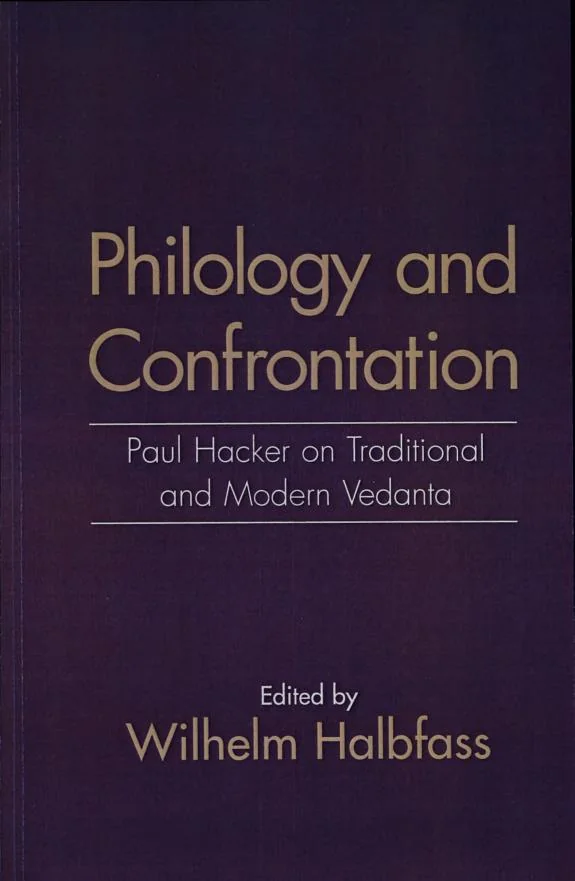
Philology and Confrontation
 71
71

Philology and Confrontation
Paul Hacker’s *Philology and Confrontation* is not an easy read, nor does it pretend to be. It is a dense, scholarly dissection of Indian religious thought, rooted in a commitment to philological precision that feels increasingly rare. Hacker’s strength lies in his unyielding focus on textual analysis, particularly evident when he examines the concept of *Mokṣa*. He meticulously traces the semantic shifts and philosophical implications of the term, challenging facile interpretations. However, this same rigor can sometimes feel like a limitation; the confrontational aspect of the title refers to Hacker's often sharp critiques, which, while intellectually stimulating, can leave little room for the nuanced appreciation of lived religious experience that less textually-bound scholars might explore. A passage where Hacker dissects the various meanings attributed to *Saṃsāra* demonstrates his analytical power at its peak. Ultimately, this is a vital, albeit demanding, work for those committed to the critical study of religious history.
📝 Description
71
Paul Hacker's 1995 posthumous publication, Philology and Confrontation, critically examines Indian religious thought.
Published in 1995, Philology and Confrontation is Paul Hacker's scholarly assessment of how linguistic analysis informs the study of religious and philosophical systems. Hacker, a prominent Indologist, uses rigorous philological methods to break down the conceptual frameworks within various esoteric and religious traditions. He investigates how language affects comprehension and how exact textual interpretation can question established beliefs and practices. This volume is for academics, advanced students, and dedicated practitioners in religious studies, philosophy, and comparative theology who value careful scholarship. Readers interested in the historical growth of Indian thought and its dissemination will find considerable merit in Hacker's approach. His work contrasts with broader or syncretic views of Eastern religions by stressing the importance of precise textual criticism.
Hacker's work emerges from a post-war German academic milieu that re-evaluated Indology. He opposed generalized approaches to Eastern religions, advocating for strict textual criticism. His stance challenged contemporary academic and spiritual understandings of Indian traditions. This approach aligns with a scholarly tradition prioritizing historical accuracy and linguistic precision in studying religious texts.
💡 Why Read This Book?
• Gain a rigorous understanding of how precise linguistic analysis, as applied to terms like *Mokṣa*, can fundamentally alter perceptions of Indian religious philosophy, a depth rarely achieved through broader surveys. • Appreciate the critical methodology of Indology as practiced by Paul Hacker, learning to question inherited interpretations and focus on the historical and textual evidence, particularly concerning the concept of *Saṃsāra*. • Engage with a scholarly tradition that prioritizes linguistic accuracy over spiritual speculation, offering a unique perspective on the intellectual history of religious studies in the 20th century, as exemplified by Hacker's critical stance.
⭐ Reader Reviews
Honest opinions from readers who have explored this book.
❓ Frequently Asked Questions
When was Philology and Confrontation first published?
Philology and Confrontation was first published in 1995, making it a posthumous release of Paul Hacker's significant scholarly work on Indology.
What is the primary focus of Paul Hacker's work in this book?
The book's primary focus is the rigorous application of philological methods to the study of Indian religious and philosophical traditions, emphasizing precise textual interpretation and critical analysis.
What does 'confrontation' refer to in the title?
The 'confrontation' in the title refers to Paul Hacker's critical approach, which often challenges established interpretations and assumptions within the study of Indian religions and philosophies.
Is this book suitable for beginners in religious studies?
Due to its dense scholarly nature and reliance on philological expertise, the book is more suitable for advanced students and academics rather than absolute beginners.
What are some key concepts explored in Philology and Confrontation?
Key concepts include the detailed examination of *Mokṣa* and *Saṃsāra*, alongside a critical reflection on the methodologies employed in Indology.
What is Paul Hacker's background?
Paul Hacker was a prominent German Indologist, known for his meticulous scholarly research and critical engagement with Indian philosophical and religious texts.
🔮 Key Themes & Symbolism
Philological Rigor
This theme centers on Paul Hacker's unwavering commitment to philology as the primary tool for understanding religious texts. He argues that precise attention to linguistic evolution and original meanings is crucial, often contrasting this with more speculative or historically ungrounded interpretations. The work demonstrates how a deep knowledge of Sanskrit and related languages can unlock nuances missed by broader scholarly approaches, thereby challenging prevalent understandings of core doctrines by returning them to their linguistic roots. This approach aims to confront established narratives with textual evidence.
The Concept of Mokṣa
Hacker undertakes a detailed philological investigation into the concept of *Mokṣa* (liberation) within various Indian philosophical schools. He scrutinizes how the term and its associated ideas have been understood and transmitted over centuries, highlighting significant shifts and potential misinterpretations. The book seeks to delineate the historical and textual boundaries of *Mokṣa* as understood within specific traditions, questioning universalizing claims and emphasizing the importance of context and linguistic precision in grasping its meaning.
Critique of Religious Scholarship
The 'confrontation' aspect of the title is strongly linked to Hacker's critique of existing scholarship on Indian religions. He challenges what he perceives as a lack of critical rigor, a tendency towards romanticization, or the imposition of Western philosophical frameworks onto Eastern traditions. The book advocates for a more historically grounded and linguistically precise approach, urging scholars to confront their own assumptions and biases when interpreting complex religious systems. This critical stance is applied to understandings of concepts like *Saṃsāra*.
Saṃsāra and Rebirth
Examining the doctrine of *Saṃsāra* (the cycle of rebirth and suffering), Hacker applies his philological expertise to understand its origins and evolution within different Indian philosophical contexts. He investigates the textual basis and conceptual development of this central doctrine, seeking to clarify its meaning and implications as presented in primary sources. The work aims to provide a precise, textually supported understanding of *Saṃsāra*, distinguishing it from later or external interpretations that may obscure its original philosophical weight.
💬 Memorable Quotes
Direct passages from the work, attributed to the author.
“The precise meaning of 'liberation' shifts significantly depending on the textual tradition being examined.”
— This statement expresses Hacker's core argument that concepts like *Mokṣa* are not monolithic. Understanding their true import requires a deep dive into the specific linguistic and philosophical contexts of each tradition, rather than assuming a universal definition.
“The understanding of *Saṃsāra* has been influenced by later philosophical developments and external comparisons.”
— This interpretation suggests that Hacker believed the original, textually grounded understanding of the cycle of rebirth might have been obscured by subsequent interpretations or by comparing it too readily with concepts from other traditions.
“The confrontation lies in testing received doctrines against their earliest linguistic formulations.”
— This interpretation points to the core methodology of the book: challenging current or widely accepted understandings of religious doctrines by rigorously examining their original linguistic expressions and historical development.
💡 Key Ideas
Editorial paraphrase of the work's core concepts — not direct quotes.
Philology is the indispensable tool for confronting the historical reality of religious thought.
This paraphrased concept highlights Hacker's belief that accurate linguistic analysis is not merely an academic exercise but a necessary confrontation with the actual historical development and meaning of religious ideas, moving beyond mere speculation.
Scholarly interpretations must be grounded in textual evidence, not on speculative resemblances.
This paraphrased concept reflects Hacker's critical stance towards scholarship that he felt relied too heavily on conjecture or perceived similarities between traditions, rather than rigorous textual analysis.
🌙 Esoteric Significance
Tradition
While not strictly 'esoteric' in the Western sense, Hacker's work engages deeply with the philosophical and religious traditions of India, which contain profound inner dimensions. His meticulous philological approach serves to clarify the foundational doctrines of traditions like Hinduism and Buddhism, which have inspired numerous esoteric movements globally. His work fits within the lineage of critical scholarship that seeks to understand the historical and textual underpinnings of these traditions, providing a necessary corrective to purely mystical or allegorical interpretations.
Symbolism
Key concepts like *Mokṣa* (liberation) and *Saṃsāra* (cycle of rebirth) function as profound symbolic frameworks within the Indian traditions Hacker analyzes. *Mokṣa* symbolizes ultimate freedom from the constraints of conditioned existence, while *Saṃsāra* represents the cosmic cycle of existence, death, and rebirth. Hacker's philological analysis aims to strip away later accretions to reveal the core philosophical and existential meaning embedded within these potent symbols.
Modern Relevance
Contemporary scholars of comparative religion and philosophy continue to draw upon Hacker's emphasis on textual precision. Thinkers in fields like the history of religions, South Asian studies, and critical philosophy of religion benefit from his methodological rigor. His work remains relevant for those seeking to understand the historical development of Indian thought and to avoid anachronistic or overly generalized interpretations, providing a foundation for nuanced engagement with traditions that influence modern spiritual and philosophical discourse.
👥 Who Should Read This Book
• Advanced students and academics specializing in Indology, comparative religion, and the history of philosophy who require a deep, textually grounded understanding of Indian thought. • Researchers focused on the precise historical and linguistic development of key concepts such as *Mokṣa* and *Saṃsāra*, seeking to challenge prevailing interpretations with rigorous scholarship. • Practitioners of meditation and yoga traditions originating from India who wish to understand the philosophical underpinnings of liberation and the cycle of existence from a critical, scholarly perspective.
📜 Historical Context
Published in 1995, *Philology and Confrontation* emerged decades after Paul Hacker's most active research period, reflecting a rigorous German Indological tradition. The post-war era saw continued scholarly debates on the nature of Indian religions, with figures like Helmuth von Glasenapp advocating for precise historical and linguistic study. Hacker’s work represented a strong counterpoint to more syncretic or phenomenological approaches that were gaining traction. His critical stance, particularly concerning the interpretation of concepts like *Mokṣa*, often placed him at odds with prevailing academic and spiritual views. The book's emphasis on philological exactitude aligns with a scholarly current that valued historical accuracy above all, a methodology that sometimes faced criticism for its perceived austerity or its direct challenge to established interpretations of texts dating back to the early centuries CE.
📔 Journal Prompts
The confrontation between philological findings and received doctrine regarding *Mokṣa*.
How does Hacker's critique of scholarship influence your own reading of religious texts?
The evolution of the concept of *Saṃsāra* as revealed by linguistic analysis.
Applying Hacker's emphasis on textual precision to a concept in your own field of study.
The role of precise definition in understanding spiritual liberation.
🗂️ Glossary
Philology
The study of language in historical sources; it is a combination of literary criticism, history, and linguistics. In this context, it refers to the rigorous analysis of ancient texts and their language to understand their meaning and historical development.
Mokṣa
A Sanskrit term meaning 'liberation,' 'release,' or 'emancipation.' It is a central concept in Indian religions, referring to the ultimate goal of spiritual practice: freedom from the cycle of birth and death (*Saṃsāra*).
Saṃsāra
A Sanskrit term referring to the cyclical nature of existence, the process of death and rebirth through which souls pass in Indian religions. It is often associated with suffering and ignorance.
Indology
The academic field devoted to the study of the history, languages, literature, and philosophies of India. Paul Hacker was a prominent figure in this field.
Doctrine
A belief or set of beliefs held and taught by a Church, political party, or other group. In this context, it refers to established teachings within religious and philosophical traditions.
Textual Criticism
The study and comparison of different versions of a text to determine the most authentic original wording. It is a key component of philology.
Hermeneutics
The theory and methodology of interpretation, especially the interpretation of biblical texts, wisdom literature, and philosophical texts. Hacker's work engages critically with hermeneutical approaches.
This book appears in 1 collection
🔮 Readers Also Liked
Browse all →









From the “Vedanta” Collection
View all →





More Free Occult Philosophy Books
View all →