The Demon-haunted World
 76
76

The Demon-haunted World
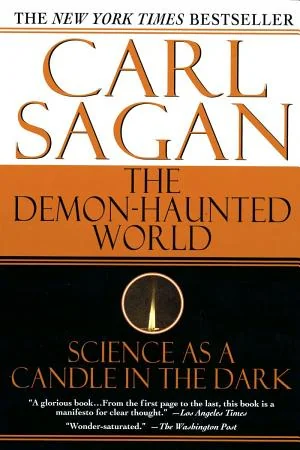
Sagan's "The Demon-haunted World" remains a potent, if sometimes disheartening, examination of humanity's struggle with reason. The chapter detailing the "Baloney Detection Kit" is particularly lucid, offering practical mental exercises for dissecting dubious assertions, whether they concern crop circles or the claims of psychics. It’s a vital manual for anyone wishing to inoculate themselves against irrationality. However, the book's extensive cataloging of pseudoscientific phenomena, while comprehensive, can occasionally feel like a relentless enumeration rather than a deeply analytical exploration of the psychological underpinnings of belief. Despite this, Sagan's earnest plea for scientific literacy and critical thinking is undeniable. It's a crucial reminder that a candle, however small, can illuminate the dark.
📝 Description
76
Carl Sagan published 'The Demon-haunted World' in 1997 to defend science against rising pseudoscience.
Carl Sagan's 1997 book, 'The Demon-haunted World: Science as a Candle in the Dark,' stands as a forceful argument for critical thinking and the scientific method. Sagan wrote it as a response to what he saw as a growing prevalence of superstition and irrationality. The book explains the steps of scientific inquiry, showing how skepticism and evidence help us understand the world. Sagan argued that people lacking scientific understanding are easily misled. This book is for anyone worried about declining critical thought in society, including students, educators, and the general public encountering unsubstantiated claims online or in the media. It offers clear reasoning for those feeling overwhelmed by conspiracy theories or beliefs without evidence, providing tools to separate fact from fiction.
The late 1990s saw increasing public interest in topics like UFOs and alternative medicine. As the internet began to spread information widely, fringe theories also found a larger audience. Sagan's work directly addressed this cultural moment, sharing concerns similar to those of Martin Gardner, who also questioned paranormal claims. The book appeared as a counterpoint to the acceptance of unfounded beliefs in popular culture, urging a return to evidence-based verification.
While categorized as esoteric, Sagan's work functions as a critique of what he termed 'demon-haunted' thinking – beliefs that lack empirical grounding and often arise from fear, ignorance, or manipulation. It addresses the appeal of supernatural explanations and irrational belief systems that flourish when scientific literacy is low. The book positions itself against the uncritical acceptance of paranormal phenomena, conspiracy theories, and New Age claims, advocating instead for a rational, evidence-based worldview as a necessary defense against societal gullibility.
💡 Why Read This Book?
• You will learn to identify logical fallacies and cognitive biases using Sagan's "Baloney Detection Kit," a framework directly applicable to evaluating claims about UFOs and alien encounters. • You will gain historical perspective on societal susceptibility to mass hysteria and pseudoscience, understanding how events like the witch trials of the 17th century parallel modern-day credulity. • You will appreciate the robust, self-correcting nature of the scientific method as a tool for genuine discovery, contrasting it with dogmatic belief systems, a central theme explored throughout the book.
⭐ Reader Reviews
Honest opinions from readers who have explored this book.
❓ Frequently Asked Questions
What is Carl Sagan's "Baloney Detection Kit"?
Sagan's "Baloney Detection Kit" is a set of intellectual tools for evaluating claims. It emphasizes independent verification, encouraging debate on evidence, considering the number of independent experts, and applying Occam's Razor. This framework helps discern valid arguments from pseudoscience.
Why does Carl Sagan call science a "candle in the dark"?
He uses this metaphor to represent science as a beacon of knowledge and reason illuminating the darkness of ignorance, superstition, and irrationality. It signifies science's role in dispelling fear and misunderstanding, guiding humanity toward a clearer understanding of the universe.
What historical events does Sagan reference to illustrate scientific ignorance?
Sagan references numerous historical events, including the witch trials of the 17th century, the belief in astrology, and the mass hysteria surrounding supposed alien abductions. These examples highlight how a lack of critical thinking and reliance on superstition can lead to widespread societal delusion.
How does "The Demon-haunted World" address the prevalence of pseudoscience?
The book systematically debunks various pseudoscientific claims, from psychic abilities to UFO conspiracies, by applying rigorous scientific scrutiny. Sagan argues that pseudoscience thrives on emotional appeal and anecdotal evidence, lacking the empirical foundation of legitimate scientific inquiry.
What is the main argument regarding scientific literacy in the book?
Sagan's primary argument is that widespread scientific illiteracy makes societies vulnerable to misinformation, charlatanism, and irrational beliefs. He posits that a populace equipped with critical thinking skills is essential for a functioning democracy and for making sound collective decisions.
When was "The Demon-haunted World" first published?
"The Demon-haunted World: Science as a Candle in the Dark" was first published in 1997, near the end of Carl Sagan's prolific career, making it one of his final major works.
🔮 Key Themes & Symbolism
The Scientific Method
Fundamentally, the book champions the scientific method not as a static body of knowledge, but as a dynamic process for acquiring reliable understanding. Sagan details its principles: empirical evidence, testable hypotheses, peer review, and self-correction. He contrasts this rigorous, evidence-based approach with the dogma and unsubstantiated claims of pseudoscience and superstition, illustrating how scientific inquiry has consistently advanced human understanding while unfounded beliefs have led to stagnation or delusion. The method is presented as the most effective tool against the 'demons' of ignorance.
Pseudoscience and Superstition
Sagan meticulously dissects various forms of pseudoscience, from astrology and alien abductions to faith healing and parapsychology, revealing their common reliance on anecdotal evidence, confirmation bias, and logical fallacies. He illustrates how widespread belief in these areas often stems from a lack of scientific education and a desire for simple answers to complex questions. The book argues that unchecked, the proliferation of pseudoscience poses a significant threat to rational decision-making and societal progress, making critical evaluation indispensable.
Critical Thinking and Skepticism
The work is a powerful advocate for skepticism – not as cynicism, but as a healthy, questioning attitude grounded in evidence. Sagan introduces his "Baloney Detection Kit," a pragmatic set of tools designed to help readers critically evaluate extraordinary claims. This emphasis on critical thinking serves as a defense mechanism against manipulation, hysteria, and the acceptance of unsubstantiated beliefs. It's presented as an essential skill for informed citizenship and personal intellectual integrity in an information-saturated world.
Science vs. Hysteria
Sagan draws parallels between historical instances of mass hysteria, such as the witch trials of the 17th century, and contemporary phenomena like UFO cults and unfounded medical panics. He argues that the underlying psychological mechanisms driving these delusions are often similar: fear, misinformation, and a failure to apply critical reasoning. The book positions science as the antidote to such irrational outbreaks, offering a framework for understanding the world based on verifiable facts rather than fear or fantasy.
💬 Memorable Quotes
Direct passages from the work, attributed to the author.
“The "Baloney Detection Kit"...”
— This refers to Sagan's practical guide to critical thinking. It's a set of tools designed to help readers dissect claims, identify logical fallacies, and demand evidence, thereby protecting themselves from misinformation and pseudoscience.
“We are all prone to believing things we want to be true.”
— This observation highlights the psychological tendency towards confirmation bias. Sagan suggests that our desires can cloud our judgment, making us more receptive to information that aligns with our pre-existing beliefs, even if that information is flawed.
“Extraordinary claims require extraordinary evidence.”
— A central to scientific skepticism. This principle asserts that the more unusual or improbable a claim is, the higher the burden of proof required to accept it as true. It acts as a crucial filter against baseless assertions.
“Science is a way of thinking much more than it is a body of knowledge.”
— This emphasizes the process and methodology of science over mere accumulated facts. It suggests that the true value of science lies in its approach to inquiry, questioning, and evidence-gathering, rather than just the conclusions it reaches.
“The difference between a scientist and a charlatan is that the scientist is willing to be wrong.”
— This interpretation highlights the self-correcting nature of science. Scientists are expected to revise their theories based on new evidence, whereas charlatans often cling to their claims regardless of contradictory data, prioritizing dogma over discovery.
🌙 Esoteric Significance
Tradition
While not strictly an esoteric text, "The Demon-haunted World" engages with the very boundaries of esoteric thought by scrutinizing claims often found within it. It operates from a rationalist, empirical tradition, positioning itself as an antagonist to belief systems that lack verifiable evidence. It doesn't fit neatly into Hermetic, Gnostic, or Kabbalistic lineages but instead provides a critical lens through which adherents of those traditions might examine their own foundational claims and modern interpretations, particularly those bordering on the pseudoscientific.
Symbolism
The central symbol is the "candle in the dark," representing science as a source of illumination against the pervasive darkness of ignorance, superstition, and fear. The "demons" themselves symbolize irrational beliefs, unfounded fears, and pseudoscientific claims that haunt the human psyche and society. Sagan uses these potent, archetypal images to convey the struggle between reason and unreason, knowledge and delusion, highlighting the fragility of our understanding in the face of deeply ingrained human tendencies toward magical thinking.
Modern Relevance
In an age of "fake news," rampant misinformation on social media, and increased polarization, Sagan's "Baloney Detection Kit" and his emphasis on critical thinking are more relevant than ever. Contemporary skeptics, science communicators, and educators frequently reference his work. Thinkers concerned with media literacy, cognitive biases, and the impact of pseudoscience on public health and policy draw directly from his arguments, continuing his legacy of promoting rational inquiry in an often bewildering world.
👥 Who Should Read This Book
• Students of critical thinking and logic: Will gain practical tools and historical examples for dissecting arguments and identifying fallacies, directly applicable to evaluating any claim. • Individuals concerned about misinformation: Will find a robust framework for discerning credible information from pseudoscience and conspiracy theories prevalent online and in media. • Educators and parents: Will discover effective strategies and clear explanations for fostering scientific literacy and skepticism in younger generations.
📜 Historical Context
Published in 1997, "The Demon-haunted World" emerged during a period of burgeoning internet access, which, while democratizing information, also amplified the reach of pseudoscientific claims and conspiracy theories. This era saw a heightened public interest in UFOs, paranormal phenomena, and alternative spiritualities, often presented without rigorous evidence. Sagan's work served as a powerful counter-narrative to this trend, echoing the critical spirit of earlier skeptics like Martin Gardner. The book arrived as a much-needed intellectual anchor amidst a cultural landscape increasingly receptive to unsubstantiated beliefs, advocating for the enduring relevance of empirical reasoning and critical thought. It implicitly engaged with the growing anti-science sentiment by forcefully defending the scientific method.
📔 Journal Prompts
The "Baloney Detection Kit" as a personal shield.
Historical parallels between 17th-century witch trials and modern hysteria.
Evaluating the "candle in the dark" metaphor for scientific understanding.
The psychological appeal of pseudoscience.
Personal biases identified through Sagan's critical lens.
🗂️ Glossary
Pseudoscience
A collection of beliefs or practices mistakenly regarded as being based on the scientific method. It often mimics the language of science but lacks empirical evidence, testability, and peer review.
Confirmation Bias
The tendency to search for, interpret, favor, and recall information in a way that confirms one's pre-existing beliefs or hypotheses, while giving disproportionately less consideration to alternative possibilities.
Skepticism
An attitude of doubt or a disposition to incredulity either in general or toward a particular object or doctrine. In science, it means questioning claims until sufficient evidence is presented.
Empirical Evidence
Information acquired through observation and experimentation. It is the central to the scientific method, providing a basis for testing hypotheses and formulating theories.
Occam's Razor
A problem-solving principle that states that among competing hypotheses, the one with the fewest assumptions should be selected. Simpler explanations are generally preferred over more complex ones.
Mass Hysteria
A phenomenon characterized by the appearance of the same or similar hysterical symptoms among two or more people. It often involves the rapid spread of irrational beliefs or fears within a group or community.
Scientific Literacy
The knowledge and understanding of scientific concepts and the scientific process required for personal decision-making, participation in civic and cultural affairs, and economic productivity.
This book appears in 1 collection
🔮 Readers Also Liked
Browse all →









From the “Witchcraft” Collection
View all →








More Free Occult Philosophy Books
View all →



![A high-school algebra wallet-sized proof, of the Bieberbach conjecture After L. Weinstein]](/img/thumb/a-high-school-algebra-wallet-sized-proof-of-the-bieberbach-conjecture-after-l-weinstein-shalosh-b-ekhad.webp)