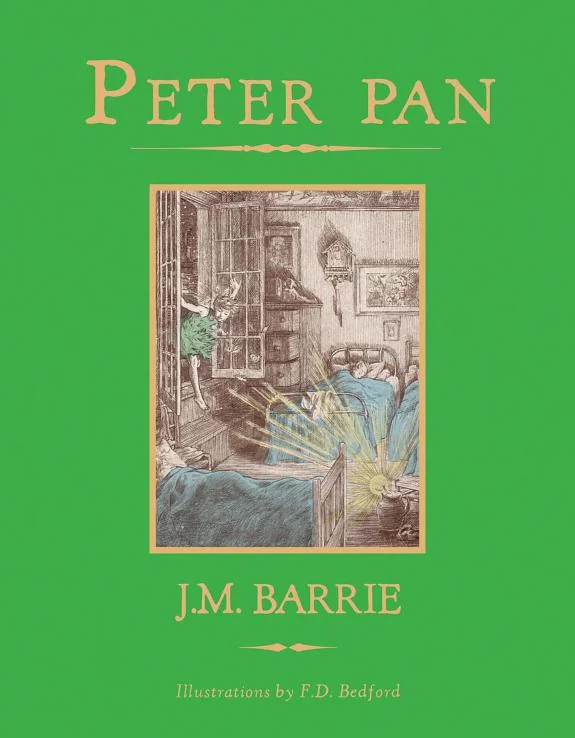
Peter Pan
 83
83

Peter Pan
Barrie's Peter Pan is less a children's fantasy and more a poignant, unsettling meditation on the nature of memory and the fear of becoming ordinary. The character of Peter, while seemingly joyous, carries an undercurrent of profound detachment, a chilling refusal to engage with the emotional weight of growing up. This is most evident in his casual disregard for the mother figures he momentarily adopts. The narrative’s strength lies in its dual nature, offering surface-level adventure while simultaneously probing the psychological underpinnings of eternal childhood. A notable limitation is the occasionally uneven pacing, particularly in the novelization, which can detract from the dreamlike quality of Never-Never Land. The passage detailing Wendy's eventual return, and the bittersweet acknowledgment of the fading magic, highlights the story's underlying melancholy. Ultimately, Peter Pan remains a complex fable, more about the loss of innocence than its preservation.
📝 Description
83
J.M. Barrie's Peter Pan first appeared on stage in 1904, exploring the allure of perpetual childhood.
Peter Pan chronicles the Darling children's journey to Never-Never Land, a place ruled by the boy who refuses to grow up. Here, they encounter Peter and his Lost Boys, perpetually at odds with the pirate Captain Hook. The story examines childhood, imagination, and the resistance to adult life.
This narrative appeals to those interested in the psychology of eternal youth and the symbolic world of childhood. It is especially relevant for readers who study how literature uses archetypal figures and the process of moving from innocence to experience. Students of children's literature and comparative mythology will find much to analyze in Barrie's creation.
Peter Pan was conceived during a time of significant interest in psychoanalysis and the child's nature. Barrie's work tapped into a cultural fascination with childhood innocence, set against a backdrop of industrial change. While contemporary with writers like H.G. Wells and Arthur Conan Doyle, Barrie's focus remained firmly on fantasy and the enduring strength of imagination.
While not explicitly occult, Peter Pan taps into esoteric ideas concerning arrested development and the unconscious mind. Never-Never Land can be seen as a symbolic representation of a liminal space, a psychic realm where the rules of the mundane world do not apply. Peter himself embodies a desire for eternal stasis, a common theme in spiritual traditions that seek to transcend the limitations of the physical body and the passage of time. Captain Hook, in this light, represents the inescapable forces of decay and death that the eternal spirit seeks to evade.
💡 Why Read This Book?
• Understand the symbolic weight of Never-Never Land, a liminal space representing the refusal of linear time and adult consequence, offering a unique lens on developmental psychology. • Explore the archetype of the eternal child through Peter Pan, examining the allure and inherent danger of stasis, providing insights into escapism and arrested development. • Grasp the narrative’s critique of the adult world through Captain Hook’s fear of mortality, revealing how Barrie uses this antagonist to underscore the value and fragility of lived experience.
⭐ Reader Reviews
Honest opinions from readers who have explored this book.
❓ Frequently Asked Questions
When was J.M. Barrie's Peter Pan first published as a novel?
While the play debuted in 1904, J.M. Barrie's novelization of Peter Pan was first published on February 27, 2015, bringing his iconic characters to a new generation.
What is the primary allegorical meaning of Never-Never Land in Peter Pan?
Never-Never Land functions as a symbol for a psychic space where the characters, particularly Peter Pan, evade the realities of time and maturation, representing eternal childhood and imagination.
How does Captain Hook represent the adult world's fears?
Captain Hook embodies the fear of mortality and the loss of control associated with aging. His pursuit of Peter Pan is a struggle against the very concept of perpetual youth and freedom from consequence.
What is the significance of Wendy Darling's role in Peter Pan?
Wendy serves as a maternal figure who attempts to impose order and nurture within Never-Never Land, representing the domestic sphere and the inevitable pull towards adulthood that Peter rejects.
Does Peter Pan contain elements of occult philosophy?
While not overtly occult, Peter Pan explores themes of eternal life, detachment from conventional reality, and archetypal figures often found in esoteric thought, particularly concerning the anima and the rejection of the shadow.
Who are the Lost Boys in Peter Pan?
The Lost Boys are children who have fallen out of their prams and been brought to Never-Never Land by Peter Pan. They represent a community existing outside normal societal structures, perpetually in childhood.
🔮 Key Themes & Symbolism
The Eternal Child
Peter Pan embodies the archetype of the eternal child, a figure who actively resists maturation and the responsibilities of adulthood. This resistance is not merely playful but represents a profound detachment from the linear progression of time and the emotional complexities that accompany aging. The work probes the allure of remaining perpetually young, contrasting it with the eventual necessity of confronting reality and the sorrow of lost innocence. The esoteric angle lies in the concept of arrested development as a chosen state, a refusal to integrate the experiences that lead to maturity.
Never-Never Land as Liminal Space
Never-Never Land is more than a mere setting; it is a psychogeographical representation of a state of being outside conventional time and space. It symbolizes a field of pure imagination, unbound by the laws of the physical world, where desires manifest instantly and consequences are fleeting. Esoterically, this land can be interpreted as a projection of the collective unconscious, a place where archetypal energies play out freely, untainted by the ego's demands. It is a sanctuary from the 'grown-up' world, yet inherently unstable.
The Shadow of Mortality
Captain Hook serves as the antagonist, representing the inevitable encroachment of mortality and the fear of oblivion that accompanies the passage of time. His nemesis, Peter Pan, actively evades death, embodying a denial of finality. The conflict between them highlights the tension between the desire for eternal existence and the reality of a finite lifespan. This dynamic mirrors spiritual traditions grappling with mortality, the afterlife, and the nature of the soul's journey through existence.
Maternal Archetypes and Abandonment
The female characters, particularly Wendy, often fulfill a surrogate maternal role, offering comfort and domesticity to Peter and the Lost Boys. However, this is invariably temporary, reflecting Peter's inability to form lasting emotional bonds and his subconscious fear of attachment. This theme touches upon the primal need for nurturing and the lasting impact of perceived abandonment, resonating with psychological and spiritual explorations of the Great Mother archetype and its limitations.
💬 Memorable Quotes
Direct passages from the work, attributed to the author.
“Second star to the right and straight on till morning.”
— This directive is more than a navigational instruction; it represents a symbolic journey towards a realm beyond the mundane, a destination fueled by imagination and a yearning for a fantastical existence.
“All children, except one, grow up.”
— This foundational statement immediately establishes Peter Pan's unique status and introduces the central theme of perpetual childhood, setting the stage for explorations of innocence, memory, and the societal expectation of maturation.
“Do you think I am a fairy? ... I am Peter Pan.”
— This assertion highlights Peter's self-definition, separate from conventional categories. It speaks to his identity as an archetype, an embodiment of an idea rather than a conventional individual bound by societal norms.
“The kiss which has no meaning can be translated into 'Good-bye'.”
— This poignant interpretation of a kiss signifies emotional detachment and the transient nature of relationships within Never-Never Land. It underscores Peter's inability to form deep, lasting connections, treating affection as a fleeting gesture.
“It is sad to think that the fun of one’s childhood must end.”
— This sentiment, often voiced by Wendy, captures the melancholy inherent in the story. It acknowledges the bittersweet reality that the unburdened joy of childhood is a phase that inevitably gives way to the complexities of adult life.
🌙 Esoteric Significance
Tradition
While not explicitly part of a specific esoteric lineage like Hermeticism or Kabbalah, Peter Pan appeals to themes found in Gnostic thought and Jungian psychology, particularly concerning the rejection of the material world and the pursuit of an idealized, eternal state. The concept of Never-Never Land as a refuge from a flawed 'demiurgic' reality and Peter's refusal to 'grow up' echo Gnostic ideas of spiritual liberation from the material plane. It also aligns with Jung's exploration of archetypes, especially the Child archetype and the shadow aspects of immortality.
Symbolism
The primary symbol is Peter Pan himself, representing the untamed spirit, the refusal of ego-death, and the archetypal Child. Never-Never Land functions as a psychic landscape, a manifestation of pure imagination and a space where time is fluid, symbolizing a state of perpetual becoming rather than being. Captain Hook's crocodile, which has swallowed a clock, symbolizes the relentless, inescapable passage of time and the fear of mortality that Peter actively denies.
Modern Relevance
Contemporary thinkers in transpersonal psychology and archetypal studies, particularly those influenced by Jung, frequently reference Peter Pan and Never-Never Land. The narrative's exploration of escapism, the fear of aging, and the psychological allure of arrested development remain pertinent in modern society, influencing discussions on mental health, developmental psychology, and the cultural narratives surrounding childhood and adulthood.
👥 Who Should Read This Book
• Students of Jungian psychology: To analyze the archetypes of the Eternal Child, the Shadow (Captain Hook), and the anima figure (Wendy Darling) within a literary context. • Comparative mythology scholars: To examine the myth of the immortal child and its variations across different cultures and historical periods. • Readers interested in the psychology of childhood: To explore literary representations of innocence, imagination, and the complex transition into adulthood, and the potential downsides of refusing that transition.
📜 Historical Context
J.M. Barrie's Peter Pan originated as a stage play in 1904, a period when childhood was increasingly romanticized in British culture, yet also subject to burgeoning psychological inquiry. The early 20th century saw thinkers like Sigmund Freud exploring the subconscious and the significance of early experiences, a backdrop against which Barrie’s exploration of eternal youth and arrested development gained particular resonance. While authors like H.G. Wells were pioneering science fiction and Arthur Conan Doyle focused on rational deduction, Barrie carved a unique niche with his fantastical narrative. The play and subsequent novelization tapped into a societal fascination with escapism and the perceived purity of the child-mind, contrasting sharply with the rapid industrialization and social changes of the era. Reception was largely positive, solidifying Peter Pan as a cultural phenomenon, though later analyses would highlight the work's darker psychological undertones.
📔 Journal Prompts
Peter Pan's refusal to grow up: explore its implications for personal development.
The symbolic field of Never-Never Land and its relation to the subconscious.
Captain Hook's fear of the crocodile and its representation of mortality.
Wendy's role as a maternal figure and its transient nature.
The concept of 'lost boys' as a metaphor for societal outcasts or unintegrated selves.
🗂️ Glossary
Never-Never Land
A mythical island realm where children live eternally young, unbound by the rules of the adult world. It represents a space of pure imagination and arrested development.
The Lost Boys
Children who have fallen out of their prams and been brought to Never-Never Land by Peter Pan. They live under his leadership, existing outside conventional society.
Captain Hook
The pirate antagonist who relentlessly pursues Peter Pan. He embodies the fear of death and the passage of time, representing the encroaching adult world.
The Crocodile
A creature that has swallowed a clock, symbolizing the inescapable and audible progression of time. It is Captain Hook's greatest fear.
Tinker Bell
A mischievous fairy who is fiercely loyal to Peter Pan. She represents jealousy, vanity, and the capricious nature of magic.
Pirates
The antagonists led by Captain Hook, representing lawlessness and the dangers lurking outside the perceived safety of childhood innocence.
The Darling Children
Wendy, John, and Michael, who are transported to Never-Never Land. They represent the typical child's journey from innocence towards the eventual acceptance of adulthood.
This book appears in 1 collection
🔮 Readers Also Liked
Browse all →









From the “Fairies” Collection
View all →



More Free Occult Philosophy Books
View all →