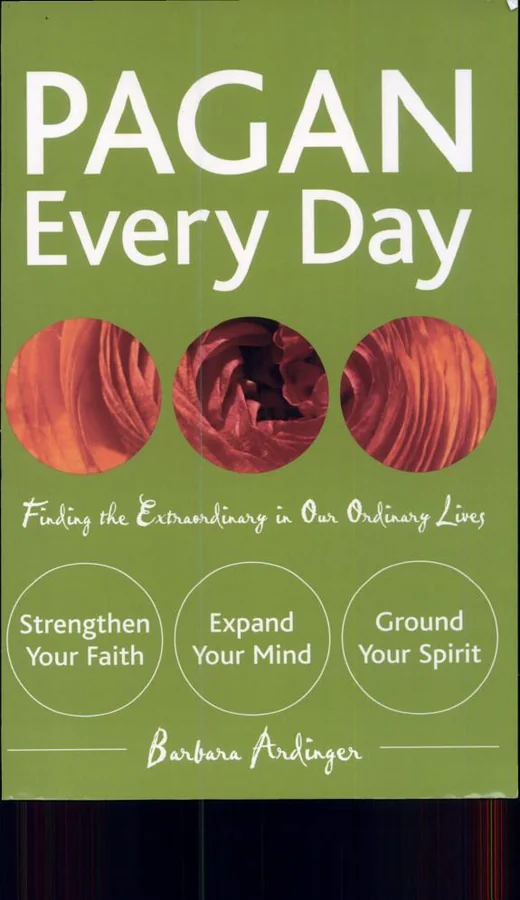
Pagan Every Day
 83
83

Pagan Every Day
Barbara Ardinger’s "Pagan Every Day" sidesteps the usual solemnity often associated with spiritual texts, opting instead for a delightfully irreverent yet deeply observant tone. The strength of this collection lies in its sheer accessibility; by offering a distinct entry for every day of the year, it makes consistent engagement with pagan concepts feel manageable and even enjoyable. Ardinger possesses a keen eye for the spiritual undertones of the quotidian, presenting observations that are both charmingly specific and universally relatable. For instance, her musings on the "sacred mundane"—finding divinity in a wilting houseplant or a particularly persistent bit of laundry—are precisely the kind of grounding insights many practitioners seek. The limitation, however, is that the brevity of daily entries sometimes means concepts are introduced rather than fully explored, leaving the reader to ponder the deeper implications independently. Despite this, the book serves as an excellent primer and a constant companion for those wishing to weave paganism into the fabric of their lives. It is a witty and wise guide for finding the extraordinary in the ordinary.
📝 Description
83
Barbara Ardinger published 'Pagan Every Day' in 2006, offering daily spiritual prompts.
This book collects a year's worth of daily reflections for contemporary pagans. Ardinger aims to help readers find the sacred in everyday life, showing how spiritual experiences can appear in common aspects of modern living. The entries encourage pagans to view their path not as a strict set of rules, but as a personal and adaptable way of engaging with the world, often with a touch of humor.
'Pagan Every Day' suits both experienced pagans seeking new perspectives and those new to paganism who want an approachable introduction. It will appeal to readers interested in contemporary spirituality, ecofeminism, and those who enjoy reflective writing. The book provides prompts for contemplation throughout the year, making it useful for personal spiritual practice.
Published in 2006, 'Pagan Every Day' arrived during a time of significant growth and diversification in modern Paganism. Following earlier Wiccan foundations, the late 20th and early 21st centuries saw a broader range of pagan expressions. Ardinger's work reflects this shift toward more personalized and eclectic approaches, moving beyond established neopagan structures. The book appeared as feminist spirituality and earth-centered practices gained wider recognition, influenced by ideas emphasizing immanence and individual spiritual discovery.
💡 Why Read This Book?
• You will learn to identify spiritual significance in commonplace events, inspired by Ardinger's concept of the "sacred mundane," a practice that transforms daily routines into opportunities for connection. • You will gain a fresh perspective on paganism as a flexible, personal path, moving beyond rigid doctrines, as exemplified by the book’s 2006 publication during the diverse growth of modern paganism. • You will feel empowered to practice daily pagan reflection, using the book's structure as a gentle guide to observe and appreciate the immanence of the divine in nature and personal experience.
⭐ Reader Reviews
Honest opinions from readers who have explored this book.
❓ Frequently Asked Questions
What is the primary focus of "Pagan Every Day" by Barbara Ardinger?
The book provides a daily entry for every day of the year, offering humorous and insightful reflections on paganism as a spiritual practice, encouraging readers to find the sacred in everyday experiences.
When was "Pagan Every Day" first published?
The original publication date for "Pagan Every Day" was August 1, 2006.
Is this book suitable for beginners in paganism?
Yes, its accessible, humorous, and daily format makes it an excellent introduction for newcomers interested in exploring pagan spirituality in a practical way.
What kind of paganism does Barbara Ardinger discuss?
Ardinger explores contemporary paganism, focusing on personal experience, nature-based spirituality, and finding the divine in the mundane, reflecting the diverse landscape of modern pagan practices.
Does the book offer practical exercises?
While not a book of formal exercises, each daily entry serves as a prompt for reflection and observation, encouraging readers to integrate pagan perspectives into their daily lives.
What is the overall tone of "Pagan Every Day"?
The tone is consistently humorous, witty, and contemplative, making the exploration of spiritual themes engaging and lighthearted rather than overly serious.
🔮 Key Themes & Symbolism
The Sacred Mundane
This theme emphasizes the core idea that spirituality is not confined to temples or specific rituals but is woven into the fabric of everyday life. Ardinger encourages readers to recognize the divine presence in ordinary activities, objects, and occurrences—from doing laundry to observing the weather. The book's daily format inherently supports this by prompting readers to find sacredness in the specific moments of each day, fostering a continuous, immanent connection to the world around them and within them.
Contemporary Paganism
Ardinger's work reflects the diverse and evolving nature of modern paganism, which emerged significantly in the mid-20th century and continued to diversify. The book moves beyond earlier, more structured forms of neopaganism to embrace an eclectic and personal approach. It highlights how individuals can craft their own spiritual paths informed by nature, personal experience, and a belief in immanence, rather than adhering strictly to established traditions or deities.
Immanence and Animism
A central tenet explored is immanence—the belief that the divine is present within the world, rather than separate from it. This is closely linked to animism, the concept that spirits or life forces inhabit natural objects and phenomena. Ardinger's reflections often invite readers to perceive the inherent sacredness and vitality in the natural world, encouraging a worldview where trees, stones, and even a cup of tea can be seen as imbued with spiritual significance.
Humor as Spiritual Practice
Unlike many spiritual guides, "Pagan Every Day" consistently employs humor and wit. This approach is not merely for entertainment; it serves as a vital tool for making spirituality accessible and relatable. By laughing at the absurdities of life and finding amusement in spiritual exploration, Ardinger suggests that joy and lightheartedness are integral components of a healthy spiritual practice, explaining spiritual concepts and encouraging genuine engagement.
💬 Memorable Quotes
Direct passages from the work, attributed to the author.
“Paganism is a way of living, not just a belief system.”
— This interpretation highlights the book's emphasis on practice and integration. It suggests that being pagan involves embodying certain values and perspectives in one's actions and interactions throughout the day, rather than simply holding a set of doctrines.
“The sacred is often found in the unexpected.”
— This reflects the book's encouragement to look beyond conventional spiritual settings and find moments of divine connection in unusual places or during routine activities, fostering a sense of wonder.
“Spirituality can be joyful and accessible.”
— This captures the lighthearted and approachable tone of Ardinger's writing, suggesting that spiritual exploration does not need to be arduous or intimidating but can be a source of pleasure and ease.
💡 Key Ideas
Editorial paraphrase of the work's core concepts — not direct quotes.
Finding the divine in the everyday.
This paraphrased concept captures Ardinger's central thesis: that spiritual experiences and sacredness are not limited to extraordinary moments but are present in the mundane aspects of daily life, waiting to be recognized.
A year of witty observations on finding the divine in the mundane.
This interpretation summarizes the book's combination of humor and spiritual insight, emphasizing its daily structure and its focus on integrating pagan perspectives into everyday life.
🌙 Esoteric Significance
Tradition
While not strictly adhering to a single lineage, "Pagan Every Day" draws heavily from contemporary Pagan and Neopagan traditions, particularly those emphasizing nature spirituality, immanence, and animism. It reflects the broader shift within esoteric circles towards personal revelation and eclectic practice, moving away from the more codified systems of earlier Hermetic or Theosophical movements. Ardinger's work fits within a modern esoteric sensibility that prioritizes lived experience and individual connection to the divine over dogma.
Symbolism
The book implicitly uses the symbolism of the cycle of the year, with each day representing a moment within the larger cosmic dance. Natural elements—plants, weather, animals—function as symbols of immanent divine energy. The act of daily reflection itself symbolizes commitment and the ongoing process of spiritual growth, where ordinary objects and events become imbued with sacred meaning, akin to how symbols are used in ritual to evoke deeper understanding.
Modern Relevance
Ardinger's approach appeals to contemporary practitioners of nature-based spirituality, ecofeminism, and mindfulness. Thinkers and communities focused on integrating spiritual practice into daily life, finding connection in a secularizing world, and fostering an animistic worldview find her perspective valuable. Her work influences modern online Pagan communities and blogs that emphasize accessible, personal spirituality and the celebration of the earth's cycles.
👥 Who Should Read This Book
• Individuals new to Paganism seeking an approachable and engaging introduction to its core concepts and daily practices. • Experienced Pagans looking for fresh perspectives and prompts to deepen their connection to their path through everyday observation. • Readers interested in contemporary spirituality and mindfulness who appreciate a witty, literary style that finds the sacred in the mundane.
📜 Historical Context
"Pagan Every Day" was published in 2006, a period marked by the continued expansion and diversification of the modern Pagan movement. Following the groundwork laid by figures like Gerald Gardner and the rise of Wicca in the mid-20th century, the late 20th and early 21st centuries saw a burgeoning of eclectic traditions, earth-centered spirituality, and feminist theology within Paganism. Ardinger's work aligns with this trend, reflecting a move towards more personalized, immanent, and accessible spiritual practices. It emerged in a landscape influenced by writers like Starhawk and Margot Adler, who were exploring the intersection of spirituality, activism, and contemporary life. While not facing direct censorship, the broader Pagan movement of the time was still navigating mainstream perception, with some societal skepticism towards alternative religious paths. Ardinger's humorous and down-to-earth approach helped explain Paganism for a wider audience.
📔 Journal Prompts
The concept of the 'sacred mundane' and its presence in your morning routine.
Reflecting on the 'immanence' of the divine in a natural element you encountered today.
Identifying moments where humor served as a spiritual anchor during your week.
Exploring the animistic perspective on a common household object.
Considering how the cycle of the year is reflected in your current personal experiences.
🗂️ Glossary
Paganism
A broad term encompassing various modern nature-based and polytheistic spiritual paths that often emphasize reverence for the Earth, cycles of nature, and diverse deities or divine forces.
Immanence
The belief that the divine or sacred is present within the material world and all of creation, rather than being transcendent or existing separately from it.
Sacred Mundane
The idea that ordinary, everyday activities, objects, and experiences hold spiritual significance and can be recognized as sacred moments.
Animism
The belief that spirits inhabit natural objects, phenomena, and the universe itself, viewing the world as alive and imbued with consciousness.
Neopaganism
Modern Pagan religions that emerged primarily in the 20th century, often drawing inspiration from ancient polytheistic traditions and focusing on nature worship.
Eclectic Practice
A spiritual approach that draws from multiple traditions, beliefs, and practices, synthesizing them into a personal, unique path.
Daily Reflection
The practice of taking time each day to contemplate one's experiences, thoughts, and spiritual path, often using prompts or specific themes.
This book appears in 1 collection
🔮 Readers Also Liked
Browse all →![Histoire de M. Oufle, par abbé Bordelon Cretouchée et réduite par M. G.] et la Description du sabbat. ... 1793: Iss 140](/img/thumb/histoire-de-m-oufle-par-abb-bordelon-cretouch-e-et-r-duite-par-m-g-et-la-description-du-sabbat-1793-iss-140-bordelon-laurent-1653-1730.webp)









From the “Neopaganism” Collection
View all →







More Free Witchcraft & Paganism Books
View all →