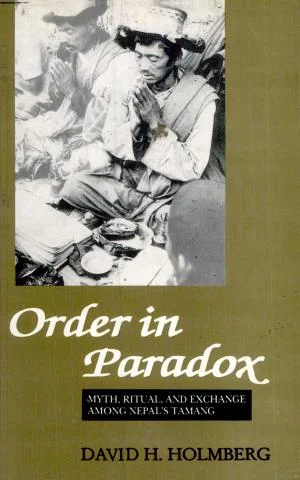
Order In Paradox Myth, Ritual And Exchange Among Nepal`S Tamang
 73
73

Order In Paradox Myth, Ritual And Exchange Among Nepal`S Tamang
David H. Holmberg's "Order in Paradox" is a rigorous and often intricate exploration of Tamang society in Nepal, eschewing broad generalizations for granular analysis. The book's strength lies in its detailed ethnography, particularly its illumination of the paradoxical nature of exchange, which simultaneously binds and stratifies the Tamang. Holmberg's dissection of sacrificial practices, from the mundane to the symbolic, reveals a sophisticated understanding of ritual's role in maintaining social cohesion. However, the dense prose and academic focus, while commendable for scholarly rigor, can make certain sections challenging for the less initiated reader. The specific analysis of the interplay between spoken and written ritual languages, while fascinating, could have benefited from more direct comparative examples to fully underscore its significance. Ultimately, "Order in Paradox" offers a valuable, if demanding, window into a complex cultural system.
📝 Description
73
David H. Holmberg's 1996 study examines the Tamang people of Nepal through their rituals, religion, and exchanges.
Published in 1996, David H. Holmberg's "Order in Paradox" offers a detailed ethnographic look at the Tamang people of Nepal. The book goes beyond simple description to analyze the structures that shape Tamang life. Holmberg scrutinizes how spoken and written ritual languages interact, the different kinds of sacrifice practiced, and the paradoxical nature of exchange within their society. This is a scholarly investigation into the logic and cosmology of this cultural group, not a brief overview.
The work is intended for anthropologists, ethnographers, and scholars of religion and comparative mythology. It will interest those focused on Himalayan cultures, particularly Nepal, and Buddhist societies outside of established monastic structures. Readers looking for a rigorous, evidence-based analysis of ritual systems, kinship, and economic exchange in non-Western settings will find "Order in Paradox" valuable. It is well-suited for academic study and advanced research.
This work engages with the study of Himalayan Buddhism, specifically how Indic traditions adapted in the mountainous regions of Nepal. It looks at local cosmologies and the performative aspects of ritual, challenging earlier, more general theories of religion and social structure. The book provides detailed ethnography relevant to comparative studies of ritual economy and symbolic systems in South Asia.
💡 Why Read This Book?
• Gain insight into the intricate 'paradox of exchange' as analyzed in Tamang society, understanding how reciprocal actions can simultaneously create social bonds and reinforce hierarchies, a concept detailed in Holmberg's fieldwork. • Explore the diverse forms of sacrifice within Tamang Buddhism, moving beyond simplistic notions of ritual to appreciate its multifaceted role in mediating social and cosmic order, as presented in the book's analytical chapters. • Understand the complex relationship between spoken and written ritual languages in shaping religious understanding, a dynamic explored through specific ethnographic examples from Nepal's Tamang communities.
⭐ Reader Reviews
Honest opinions from readers who have explored this book.
❓ Frequently Asked Questions
What year was David H. Holmberg's "Order in Paradox" first published?
David H. Holmberg's "Order in Paradox: Myth, Ritual and Exchange Among Nepal's Tamang" was first published in 1996, offering a comprehensive ethnographic study.
What specific ethnic group does "Order in Paradox" focus on?
The book focuses on the Tamang people of Nepal, providing an in-depth examination of their unique social structures, religious practices, and ritualistic exchanges.
What are the main themes explored in "Order in Paradox"?
The main themes include myth, ritual, social exchange, Tamang Buddhism, sacrifice, and the interplay of spoken and written ritual languages within Tamang society.
What is the 'paradox of exchange' as discussed in the book?
The 'paradox of exchange' refers to how reciprocal transactions, while essential for social bonding, also serve to establish and perpetuate social stratification and hierarchy among the Tamang.
What kind of academic discipline does "Order in Paradox" belong to?
The book is primarily an anthropological and ethnographic study, with significant contributions to the sociology of religion and comparative mythology.
Does the book discuss Tamang Buddhism specifically?
Yes, the book draws on informative descriptions of Tamang Buddhism to offer comparative insights into their social and religious practices, including marriage exchange and sacrifice.
🔮 Key Themes & Symbolism
The Paradox of Exchange
Holmberg meticulously details how exchange, a fundamental social mechanism, operates with inherent contradictions among the Tamang. While gifts and reciprocal transactions are meant to foster community and alliance, they simultaneously create and reinforce status differences. This dynamic is not seen as a flaw but as a core organizing principle, shaping social relations and economic interactions. The work analyzes how this paradox manifests in marriage exchanges, alliances, and broader community obligations, revealing a sophisticated understanding of how social order is constructed and maintained through seemingly contradictory processes.
Diversity of Sacrifice
The book offers a nuanced exploration of sacrifice within Tamang ritual life, moving beyond simplistic interpretations. Holmberg differentiates between various forms of sacrifice, including animal offerings, symbolic acts, and prestations, examining their specific roles in mediating relationships between humans, deities, and the cosmos. He illustrates how these diverse sacrificial practices contribute to maintaining balance, appeasing spiritual forces, and reinforcing social structures. This analysis highlights sacrifice not just as appeasement but as a complex communicative act central to Tamang cosmology and social reproduction.
Spoken vs. Written Ritual
A significant aspect of "Order in Paradox" is its investigation into the interplay between oral traditions and written texts in Tamang ritual performance. Holmberg demonstrates how different modes of communication carry distinct social and religious implications. Oral recitations often embody living traditions and community memory, while written scriptures may represent a more codified or authoritative religious knowledge. The book examines how these two forms interact, sometimes in tension, sometimes in complementarity, to shape the performance and understanding of ritual, offering insights into the evolution and practice of Tamang religion.
Coherence of Religious Fields
Despite the apparent paradoxes and diversity within Tamang practices, Holmberg argues for the underlying coherence of their religious field. He shows how disparate elements—mythology, ritual, exchange systems, and social organization—are interconnected and mutually reinforcing. This coherence is achieved through shared cosmological understandings and the systemic logic of their ritual and exchange practices. The study illuminates how Tamang society maintains a unified worldview and social order, even in the face of complexity and apparent contradiction, providing a model for understanding the integration of religious and social life.
💬 Memorable Quotes
Direct passages from the work, attributed to the author.
“The study illuminates the diversity of types of sacrifice.”
— This statement highlights a core analytical contribution of Holmberg's work: moving beyond a monolithic view of sacrifice to detail its varied forms and functions within Tamang society, revealing its complexity as a ritual and social tool.
“The paradox of exchange that d...”
— This fragmented phrase points to a central theoretical concept: the inherent contradiction within Tamang exchange systems, where acts of giving and receiving simultaneously create social bonds and establish hierarchies, a key focus of the book's analysis.
“Holmberg draws on his informative descriptions of Tamang Buddhism for comparativist insights into marriage exchange caste, sacrifice, and the coherence of religious fields.”
— This indicates the book's methodological approach, using detailed ethnographic data on Tamang Buddhism to inform broader anthropological debates on kinship, social stratification, religious systems, and their interconnectedness.
“This lively account of ritual, religion, and exchange in the Tamang society of Nepal is sophisticated and well written.”
— This blurb excerpt suggests the book balances rigorous academic analysis with engaging prose, making complex ethnographic material accessible to scholars and advanced students interested in Himalayan cultures.
“The interplay of spoken and written ritual languages.”
— This points to another crucial theme: how different forms of ritual communication—oral performances versus textual traditions—function and interact within Tamang religious life, shaping belief and practice.
🌙 Esoteric Significance
Tradition
While not explicitly part of a Western esoteric lineage like Hermeticism or Kabbalah, "Order in Paradox" significantly illuminates the esoteric dimensions of a non-Western religious tradition. It offers a scholarly lens through which to view the complex cosmology and ritual practices of Tamang Buddhism, which shares roots with Vajrayana Buddhism. The book's focus on myth, ritual, and the symbolic ordering of the cosmos provides material for comparative study by those interested in the universal structures of esoteric thought, regardless of cultural origin.
Symbolism
The Tamang practices described by Holmberg are rich with symbolic meaning. Sacrifice, for instance, is not merely an act of offering but a potent symbol of cosmic balance and social reciprocity. The interplay between spoken and written ritual languages can be seen as symbolizing the tension between living tradition and codified doctrine. The very concept of 'order in paradox' itself functions as a symbolic representation of how seemingly contradictory elements are harmonized within a coherent worldview, reflecting a sophisticated understanding of duality and unity.
Modern Relevance
Contemporary scholars of ritual studies, anthropology of religion, and comparative mythology draw on Holmberg's work to understand the enduring complexities of ritual and social exchange. Thinkers interested in post-structuralist approaches to cosmology and the performativity of religion find the book's analysis of paradox and symbolic action highly relevant. Furthermore, those studying the adaptation and evolution of Buddhist traditions in diverse cultural contexts continue to cite "Order in Paradox" as a foundational ethnographic account for understanding local religious fields.
👥 Who Should Read This Book
• Anthropologists and ethnographers specializing in Himalayan cultures, who will find a detailed case study of Tamang social structures, religious beliefs, and exchange systems. • Scholars of comparative religion and mythology, seeking to understand the intricate workings of Buddhist ritual, sacrifice, and cosmology outside of mainstream monastic traditions. • Students of social theory and ritual studies, interested in the analytical framework for understanding paradox, exchange, and the coherence of religious fields in non-Western societies.
📜 Historical Context
Published in 1996, "Order in Paradox" emerged during a vibrant period in anthropological studies of South Asia, characterized by increasing engagement with local cosmologies and the complexities of religious practice. Holmberg's work contributed to a growing body of literature on Himalayan societies, particularly the diverse Tibeto-Burman speaking groups of Nepal, challenging earlier, more generalized theories of religion and social structure. It paralleled and engaged with scholarship by figures like Stanley Tambiah and Arjun Appadurai, who were also exploring the relationship between ritual, economy, and social power in Buddhist and Indic contexts. While not facing direct censorship, the book's detailed ethnography of Tamang practices offered a significant counterpoint to more idealized portrayals of Buddhist societies, providing critical data for comparative analyses and influencing subsequent research on ritual economy and symbolic systems in the region.
📔 Journal Prompts
The Tamang paradox of exchange: how does reciprocity create hierarchy?
Reflect on the significance of diverse sacrificial practices in maintaining social order.
Consider the relationship between spoken myths and written texts in shaping religious understanding.
Analyze the concept of 'religious fields' in relation to Tamang cosmology.
How do myth and ritual interrelate in the Tamang tradition?
🗂️ Glossary
Tamang
An ethnic group indigenous to Nepal, primarily inhabiting the hilly regions. They have a distinct Tibeto-Burman language and a syncretic form of Buddhism often blended with indigenous beliefs.
Ritual
A sequence of activities involving gestures, words, actions, or objects, performed according to a set sequence, often for religious or ceremonial purposes. In "Order in Paradox," it refers to the structured practices of the Tamang.
Exchange
The act of giving one thing and receiving another in return. In the context of the book, it refers to social, economic, and ritual transactions that create and maintain relationships within Tamang society.
Sacrifice
An offering, typically of an animal or human, made to a deity or supernatural power. Holmberg details the various forms and purposes of sacrifice within Tamang religious practice.
Myth
A traditional story, especially one concerning the early history of a people or explaining some natural or social phenomenon, and typically involving supernatural beings or events. The book examines Tamang myths.
Caste
A system of social stratification, often hereditary, characterized by endogamy, occupational restrictions, and social hierarchy. The book explores caste dynamics within Tamang society and its relation to exchange.
Religious Field
A concept referring to the interconnected system of beliefs, practices, symbols, and institutions that constitute a particular religion or spiritual tradition within a society.
This book appears in 1 collection
🔮 Readers Also Liked
Browse all →









From the “Shamanism” Collection
View all →








More Free Occult Philosophy Books
View all →